
Updated Situation Report as of August 10, 2026
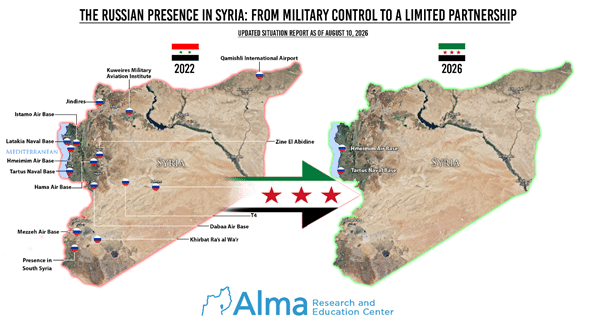
Following the fall of the Assad regime, Russia lost its hegemonic position in Syria, but it is not abandoning the country. Recent developments point to a change in the model of the Russian presence: from independently controlled bases and a broad military deployment to a more limited presence, subject to Syrian sovereignty and based on training, cooperation, and economic and technical dependence.
Background: The Russian Presence During the Assad Era
According to a May 2022 report by the Alma Center, on the eve of the war in Ukraine, the Russian force in Syria numbered approximately 10,000 troops. They were deployed at two main bases, the Hmeimim Air Base and the naval base in Tartus, as well as at smaller bases and field outposts across the country.
The force included air, naval, air defense, intelligence, armor, infantry, engineering, special forces, and military police components. Hmeimim served as the hub for Russian air operations and housed the coordination headquarters with Israel, while Tartus provided Russia with a strategic naval foothold in the eastern Mediterranean and a logistics and intelligence center.
The presence was based on long-term lease agreements that granted Moscow extensive control over the facilities. It enabled Russia to protect the Assad regime, influence the development of the Syrian armed forces, and compete with Iran over centers of power in the country. At the same time, the deployment of Russian forces near Iranian targets constrained Israel’s freedom of action and required a deconfliction mechanism.
Following Russia’s invasion of Ukraine in 2022, signs had already emerged of a certain reduction in the force and the diversion of troops and attention to the Ukrainian theater. However, the Alma Center assessed that Russia would continue to regard Syria as a strategic asset and would not relinquish it.
The Situation Following the Fall of the Regime
A Washington Institute analysis published on July 27 concluded that Russia had lost its hegemonic position in Syria, but adapted quickly to the new reality. Russia seeks to remain one of several actors competing for influence in Syria, but it is no longer the government’s dominant military and political patron.
The new Syrian leadership is drawing closer to the United States and the West, but is not interested in completely severing ties with Russia. Russia still retains significant assets: veto power in the UN Security Council, supplies of wheat and energy, the ability to maintain Russian and Soviet military equipment, and ties in the currency-printing and phosphate sectors. In addition, the new Syrian government inherited a debt of approximately $1.2 billion to Russia.
Nevertheless, Syria is working to reduce its dependence. It is considering alternatives for printing currency in the United Arab Emirates and Germany, and, according to another report, has agreed to drastically reduce its imports of Russian crude oil as part of its talks with the United States on lifting the remaining sanctions against it. This move could weaken a key source of Russian leverage, but it could also create an energy shortage in Syria if no alternative source is found.
The New Arrangement at Hmeimim and Tartus
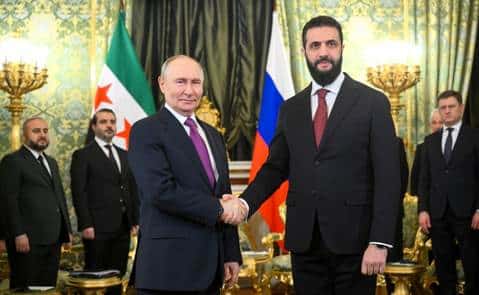
The most significant development was reported on August 9: according to a statement by the Syrian Ministry of Foreign Affairs, Damascus and Moscow reached an agreement on the future of the Russian military facilities at Hmeimim and Tartus.
According to the statement:
- The civilian infrastructure, including the airport at Hmeimim and the commercial maritime terminal at Tartus, will gradually be transferred to the administration of the Syrian government.
- The military facilities will be converted into joint training centers.
- The process is expected to be completed within three months.
- The Syrian Civil Aviation Authority has already taken over Latakia International Airport located within the Hmeimim complex from Russia and has begun work to prepare it for civilian flights.
If the agreement is fully implemented, it will represent a substantial change from the Assad era: Russia will lose its exclusive control over strategic infrastructure while retaining a certain military and professional foothold through joint training mechanisms.
Situation Assessment
- This is not a full Russian withdrawal, but rather a change in its mode of operation. Russia is shifting from an independent military presence based on facilities under its control to a model resembling a security partnership with the host country. This model is less costly, less exposed to political pressure, and allows Russia to maintain physical access in Syria.
- The balance of power has shifted in Syria’s favor. During the Assad era, the lease agreements granted Russia long-term control over the facilities without significant compensation. The new arrangement, by contrast, restores Syrian government control over civilian infrastructure and reduces Russian autonomy. Damascus is not severing ties, but is using its rapprochement with the West to improve its terms with Moscow.
- The focus of Russian influence is shifting from the direct use of force to institutional dependence in force development. Weapons maintenance, military training, the supply of spare parts, and ties with the Syrian officer corps may become more important tools than the number of troops or aircraft on the ground.
- The reduction in Russian oil imports is a key test. If Syria succeeds in finding alternative suppliers and sources of financing, an important source of Russian leverage will be weakened. If the alternatives prove insufficient, energy dependence may persist alongside Syria’s rapprochement with the West.
- From Israel’s perspective, there appears to be a potential reduction in the risk of direct friction with Russian forces. The transition from operational facilities under Russian control to joint training centers may ease the coordination constraints that previously affected Israeli activity in Syria. However, the presence of instructors, Russian systems, and intelligence ties requires a reassessment of the deconfliction mechanisms, rather than assuming that they are no longer necessary.
Conclusion
During the Assad era, Russia was a dominant military power with autonomous bases and the ability to exert direct influence over the Syrian arena. Following the fall of the Assad regime, Russia appears to be a more limited actor: it is losing control over Syrian infrastructure and policy, while retaining influence through military training, weapons maintenance, economic ties, and its international standing.
The new arrangement does not mark the end of the Russian presence in Syria, but rather its transformation from the presence of a great power protecting a regime into a conditional, shared, and negotiated presence.
The key test over the next three months will be the gap between the declarations and their actual implementation: the size of the Russian force that remains, the status of the military facilities, Russia’s freedom of access to the port and airport, and Damascus’s ability to replace its economic and energy dependence on Moscow.




One Response
Dear Dr Zoe,
Putins Russian terror empire is collapsing, along with the ayatollah/IRGC terror empire. China and North Korea are close to the same fate. All linked themselves into a death spiral CRINK Axis of Evil: spinning on the black hole axis of lies and rebellion falsely labeled as resistance. The Light of Liberty will awaken the poor masses to destroy their oppressors.