Hezbollah’s decision to join the war and open fire toward Israel (March 2) sparked a broad wave of political and public criticism within the camp opposing Hezbollah in Lebanon. The expected Israeli response on Lebanese territory sharpened, among political and public actors, the fundamental question regarding Hezbollah’s status within the state and who is authorized to decide on going to war in Lebanon’s name. Thus, the basic issue of the sovereignty of the Lebanese state and its ability to control security decisions carrying broad national implications returned to the center of the discourse.
Lebanon’s Prime Minister, Nawaf Salam, quickly convened urgent discussions and defined the rocket fire from southern Lebanon by Hezbollah as an “irresponsible act” that endangers Lebanon and provides Israel with a pretext to expand its attacks. He later even declared a ban on Hezbollah’s military activity and the restriction of its activity to the political sphere, a statement of principled significance, even if its practical implementation is doubtful, if at all.
Lebanon’s President, Joseph Aoun, warned against turning Lebanon into an arena for “support wars” that do not serve the national interest. Additional figures in the political system—including Michel Suleiman, former President of Lebanon, and Samir Geagea, leader of the Lebanese Forces—called for limiting the organization’s military activity and even for outlawing it.
Lebanon’s Minister of Information, Charles Al-Hajj, delivered an unequivocal message: “We cannot have half a state,” and “a group cannot make decisions in place of the state.” At the same time, it was reported that ministers from the Amal movement did not place a significant obstacle before the government’s decisions, conduct that commentators interpreted as a certain “crack” within the Shiite camp, or at least as a signal that even among Hezbollah’s close allies there is an interest in preventing a security deterioration that would severely harm their support base as well.
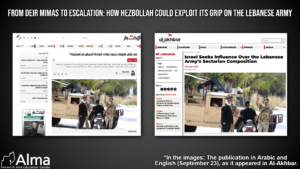
Lebanon’s president urged the army to implement the government’s decisions without fear of “excessive coordination” with other actors, emphasizing that the state is the one that makes the decisions and bears responsibility for them. In contrast, the army commander, Rodolphe Haykal, expressed reservations regarding the army’s ability to implement the decisions immediately and fully, and stressed the need for “coordination and understanding” among all actors, another expression of the structural limitations of the Lebanese state in the face of Hezbollah’s military and political power.
For its part, Hezbollah presents the decision to join the war as a direct response to the killing of Iran’s Supreme Leader, Ali Khamenei, as part of the American–Israeli strikes. The attack against Iran is defined as “American–Israeli aggression,” and the organization presents its involvement as an obligation within the framework of the “Axis of Resistance.” It is also claimed that Israel continued its attacks in Lebanon even after the 2024 ceasefire, and therefore the action is presented as the defense of Lebanon.
Hezbollah’s media channels also respond to the political criticism in Lebanon. The central message being disseminated is that the Lebanese government is incapable of defending the country and that attempts to limit the organization’s activity only “serve Israel.” In this way, the organization seeks to preserve its legitimacy through the familiar narrative of presenting itself as a security alternative to the weak state and as the “defender of Lebanon.”
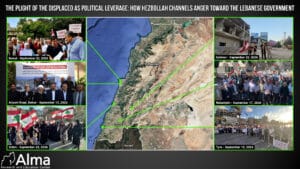
At the same time, the public arena has also seen an escalation in critical discourse. On social media, a wave of sharp criticism appeared against Hezbollah, claiming that it is dragging Lebanon into a war that is not its own. Citizens emphasized that the state is not a direct party to the confrontation, yet the public is paying the price in the form of civilian evacuations, damage to infrastructure, and ongoing instability. Documentation of angry and distressed citizens after receiving Israeli evacuation notices illustrates the emotional depth of the criticism and the sense of helplessness regarding decisions made outside the framework of the state.
At the same time, there is a growing undermining of the “victory” narrative promoted by Hezbollah. The claim that the organization is “very far from victory,” and that the official declarations do not correspond with the operational reality, in which there are casualties, wounded, and ongoing destruction, undermines the credibility of the deterrence discourse on which the organization has relied for years.
As the gap between the official narrative and the daily lived experience of citizens widens, the power of the narrative also erodes, thereby weakening one of the central sources of legitimacy on which the organization has relied over the years.
Another significant element is the rise in open hostility toward Iran. Parts of the public expressed public joy over Khamenei’s death, and satirical content targeting Iranian media circulated. This represents a crossing of a perceptual threshold: a transition from implicit criticism of Iranian influence in Lebanon to open hostility toward it – a phenomenon illustrating the growing identification between Hezbollah and the ideological loyalty and regional interests of Tehran, and the reputational price the organization is paying in the domestic arena.
An increase in criticism of Hezbollah has been recorded not only among parts of Lebanese society that are in any case identified as opposition to Hezbollah. Even within the Shiite environment itself—the organization’s traditional support base—certain (albeit limited) indications of criticism and anger are identifiable regarding the organization’s entry into the fighting and the severe consequences for the state and the population.
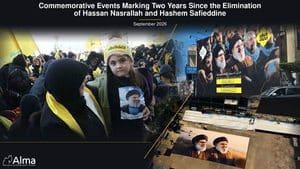
Against the backdrop of the escalation and the growing criticism of Hezbollah, sectarian tensions have also been recorded in several areas of Beirut. According to various reports, groups of Hezbollah supporters entered neighborhoods with a Sunni majority in the city while waving Hezbollah flags and pictures of Nasrallah. The move provoked sharp reactions from local residents, and in several locations verbal and physical confrontations developed. Local security forces were required to intervene to prevent a broader deterioration of the situation. These incidents reflect the growing sectarian tension in Lebanon amid the war and the public criticism of Hezbollah’s decision to enter the confrontation.
Does the very emergence of critical voices within Hezbollah’s support community, even if still limited, indicate the first cracks in the organization’s monopoly over political legitimacy within Shiite society? At this stage, we assess that it does not. Ultimately, the Shiite population is fully dependent on Hezbollah (for ideological reasons, social dependence, and fear).
In response, Hezbollah is restricting media activity in areas under its control, particularly in the Dahiya district of Beirut, where journalists have been barred from entering the area and documenting the destruction following the strikes.
These developments may indicate an erosion of Hezbollah’s political legitimacy within the Lebanese arena, especially as its military actions are perceived as serving the regional interests and ideology of the Islamic Republic of Iran more than a Lebanese national interest. Hezbollah indeed operates as a legitimate political party within state institutions, but at the same time maintains independent military autonomy, a structural tension that continues to lie at the heart of Lebanon’s political and security crisis.
Opposite the supporters of the “Resistance camp,” a civic discourse is taking shape that calls for placing the Lebanese national interest above any regional axis. The confrontation is no longer only military; it is also one of internal politics and public perceptions. The question of the legitimacy of making decisions about war outside the framework of the state is becoming a central point of contention in public and political discourse.
From a broader perspective, the recent developments may deepen the tension between Hezbollah’s functioning as an institutional political actor and its continued existence, as an independent military force. As the civilian cost rises and public criticism expands—particularly if it continues to penetrate even into the Shiite support base, the demand to return the monopoly over decisions of war to the Lebanese state may intensify.
This demand is not only a security issue, but also a fundamental question about the sovereignty of the Lebanese state and the limits of Hezbollah’s political power within it.