
Dr. Zoe Levornik and Tal Beeri
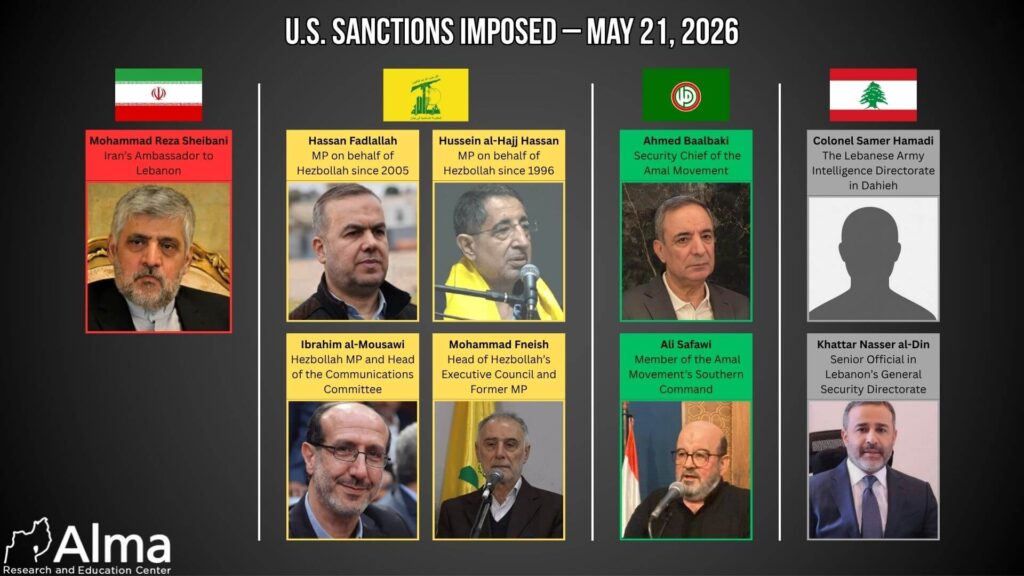
On May 21, the U.S. Department of the Treasury imposed sanctions on nine individuals from Hezbollah and the Amal Movement, a senior officer in the Lebanese Army, a senior official in the General Directorate of General Security (GSGD), and an Iranian diplomat (see details below).
According to the U.S. Treasury statement, these individuals operate from within state institutions — including parliament, the army, and the security apparatuses — and assist Hezbollah in maintaining its status as an independent military and political force backed by Iran. In doing so, they undermine Lebanese sovereignty and the state’s ability to exercise full control over its institutions.
These sanctions mark an expansion of the direct campaign against the political, security, and economic network of influence that Hezbollah has built for itself in Lebanon over the years.
Below are details regarding the individuals sanctioned:
Mohammad Fneish – head of Hezbollah’s Executive Council, which is responsible for operating all of Hezbollah’s civilian institutions across all areas of life. These institutions effectively constitute Hezbollah’s civilian “state,” enabling its military activity and sustaining its Shiite support base.
Members of Parliament Hassan Fadlallah, Ibrahim al-Moussawi, and Hussein al-Hajj Hassan are among the most prominent figures in Hezbollah’s propaganda, media, and political apparatus.
Alongside Hezbollah members, sanctions were also imposed on senior figures in the Shiite Amal Movement, Hezbollah’s main ally. Ahmad Baalbaki, the Amal Movement’s security chief, and Ali Safawi, commander of Amal forces in southern Lebanon, are responsible, among other things, for military coordination with Hezbollah and for assisting terrorist activity against Israel.
It should be recalled that Amal military operatives have carried out, and continue to carry out, terrorist activity alongside Hezbollah against Israel from southern Lebanon, and that dozens of them have been killed to date. In addition, Amal’s military infrastructure spread throughout southern Lebanon is also used by Hezbollah from time to time.
The inclusion of senior Amal operatives in the sanctions list reflects an important and clear American message according to which Washington views the “Shiite duo”, Hezbollah and Amal, as a single political and security framework, rather than maintaining the artificial distinction between the “resistance” and the Amal Movement. Nabih Berri, leader of the Amal Movement, has long exploited and continues to exploit this distinction to his advantage.
The most dramatic step internally within Lebanon was the inclusion of two senior security officials: Khattar Nasser al-Din from the General Directorate of General Security and Brigadier General Samer Hamadi, head of the military intelligence office in the Dahieh area. Both shared intelligence information with Hezbollah.
In our assessment, the General Directorate of General Security maintains close cooperation with Hezbollah’s security apparatuses, particularly in counterintelligence activity. In addition, we assess that there is close cooperation with Hezbollah regarding smuggling operations through Lebanon’s border crossings, for which the Directorate is responsible for (see our April 2026 article on Hezbollah smuggling through the al-Masnaa crossing).
Lebanese Army Intelligence has been infiltrated by Hezbollah (see our August 2025 article on Hezbollah’s infiltration of Lebanese intelligence). Over the years, Hezbollah has operated a considerable number of Shiite officers within the institution for its own benefit and has invested significant effort in consolidating its influence there due to the institution’s central role within the Lebanese Army and its substantial impact on the army’s operational activity.
Hamadi’s predecessor in the position, Brigadier General Maher Raad, also maintained cooperation, in the context of smuggling operations, with senior Hezbollah figures, foremost among them Wafiq Safa. Like Hamadi, Raad was neither dismissed nor removed from the army; he was merely reassigned to another intelligence position.
From the American perspective, this constitutes proof that Hezbollah has succeeded in infiltrating the state’s official security institutions as well. Within Lebanon itself, however, the move has been perceived as a particularly sensitive escalation that could further undermine the standing of the army, one of the few institutions in the country that still enjoys a relative degree of public trust and consensus.
In addition, Mohammad Reza Sheibani, the Iranian ambassador-designate to Lebanon, was also included in the sanctions. Lebanon declared him “persona non grata,” yet he refused to leave the country and is currently physically present at the Iranian embassy in Beirut. The Iranian ambassador in Lebanon serves as a representative of the Islamic Revolutionary Guard Corps and acts as a liaison to Hezbollah.
Reactions in Lebanon
While the Lebanese government chose not to officially comment on the sanctions, the responses from Hezbollah, Amal, and Lebanon’s security establishment reflected an attempt to present a unified front against American pressure. Hezbollah described the sanctions as “an American intimidation attempt” and part of what it called the “Zionist aggression” against Lebanon. The organization claimed that the real reason behind the move was opposition to the disarmament of the “resistance,” and argued that the sanctions constituted a “badge of honor” for those included on the list.
In his May 24 speech marking “Resistance and Liberation Day” (the withdrawal of IDF forces from Lebanon in May 2000), Hezbollah leader Naim Qassem called on the Shiite base to take to the streets, bring down the government, and resist “with full force” what he described as the “Israeli-American project” against Lebanon. His remarks came against the backdrop of growing domestic and international pressure on Hezbollah’s economic and financial institutions, foremost among them the Al-Qard Al-Hassan bank, as well as on the broader political-economic network the organization has built over the years — an area Hezbollah considers a strategic red line.
In our view, Hezbollah has an interest in dragging Lebanon into a civil war, since it would emerge from such a war even stronger, thereby advancing the organization toward its primary objective: taking control of Lebanon.
Qassem’s statements reflect the depth of the organization’s concern over the emerging shift in the American and international approach toward Hezbollah. Whereas in the past the pressure focused mainly on Hezbollah’s military and security apparatus, a broader approach is now taking shape that seeks to target the economic, political, and social sources of power that enable the organization to maintain its status as a “state within a state” in Lebanon.
The pressure being applied to Hezbollah’s financial system, alongside sanctions against political and security figures associated with the organization, threatens Hezbollah’s very ability to continue sustaining its Shiite support base. In response, Hezbollah is attempting to establish an internal deterrence equation whereby any harm to its civilian-economic infrastructure could lead to internal escalation and even push Lebanon toward a broad civil conflict.
The Amal Movement also viewed the sanctions as an attempt to exert political pressure on Parliament Speaker Nabih Berri, particularly in light of his opposition to direct negotiations with Israel.
The most unusual reaction came from the Lebanese Army, which chose not to distance itself from the officers included in the sanctions list. In its statement, the army emphasized that all officers and soldiers act “with professionalism, responsibility, and discipline, in accordance with the directives of the command,” and that their loyalty is solely to the homeland. Reports in Lebanon also indicated a perception within the military establishment that the sanctions were intended to pressure the army after it rejected American proposals to establish a dedicated mechanism to combat Hezbollah, and that they were also aimed at weakening the army’s resolve regarding demands for an Israeli withdrawal from southern Lebanon and an end to the strikes.
The Lebanese State Prefers Others to Do the Work for It
Despite repeated statements by the Lebanese leadership regarding the need to restore state sovereignty, disarm Hezbollah, and even advance political and security understandings with Israel, in practice the government is not taking meaningful action against the “state within a state” that Hezbollah has built over the years.
Hezbollah continues to operate deep within state institutions, the political system, the security apparatuses, and even within the Lebanese Army itself, while continuously undermining the authority of the central government. The Lebanese government’s avoidance of uprooting Hezbollah’s centers of influence from state institutions effectively enables the continued dominance of the pro-Iranian axis in Lebanon and perpetuates the state’s dependence on forces that are not fully subordinate to it.
Behind Lebanon’s paralysis also lie profound internal considerations: fear of sliding into a violent confrontation with Hezbollah, alongside the state’s economic and institutional weakness and its inability to provide basic services to the Shiite population, a vacuum that Hezbollah fills through the welfare, healthcare, and educational systems it operates through its Executive Council.
This reality creates a deadlock in which the Lebanese government ostensibly recognizes the need to reduce Hezbollah’s power, yet in practice refrains from taking measures that could ignite a broad internal confrontation and lead to further destabilization of the country.
Conclusion
The sanctions imposed by the U.S. Department of the Treasury on senior Hezbollah officials, members of the Amal Movement, officers in Lebanon’s security apparatuses, and an Iranian diplomat reflect a significant shift in Washington’s approach toward Lebanon. The United States can no longer suffice with a direct campaign against Hezbollah as a terrorist organization alone; it must also act against the broader political, security, and economic network of influence that Hezbollah has built within Lebanese state institutions.
The inclusion of senior Amal figures and officers from the army and security services signals that, from Washington’s perspective, there is no longer any meaningful distinction between Hezbollah and parts of the Lebanese establishment.
At the same time, the move exposes the weakness of the Lebanese government, which continues to avoid a direct confrontation with Hezbollah and is becoming increasingly dependent on external pressure to curb the entrenchment of the pro-Iranian axis within the country.



One Response
Dear Dr. Zoe and Tal,
Although it is a positive action for the USA to sanction these terrorist criminals, the lethargic Lebanese response is also indicative of a symbiotic diseased patient incapable of self defence. The ENTIRE hezbollah terrorist structure is EVIL. All of it MUST be removed and DESTROYED to restore health.