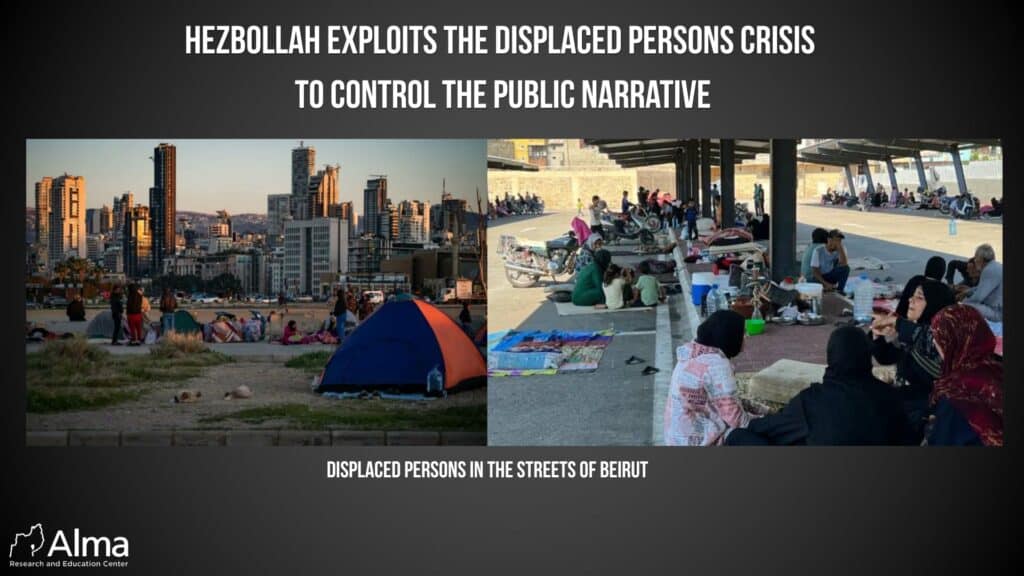
Hezbollah’s war is not conducted solely on the battlefield. Alongside the military campaign, the organization operates systematically to preserve and protect the “resistance” narrative among its Shiite base—a narrative that constitutes a cornerstone of its public legitimacy.
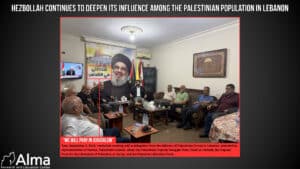
Recent evidence indicates a focused effort by Hezbollah to control public discourse among displaced populations in Lebanon. According to reports, operatives affiliated with the organization are active within reception centers and displacement camps, at times with the assistance of displaced individuals themselves who are identified with the organization. These actors receive material support—financial or logistical—and fulfill a dual role: maintaining “order” within the camps and concentrations of displaced persons, while also monitoring discourse and civilian conduct.
In the following video, a displaced person is threatened by a Hezbollah operative after expressing criticism of the organization to the media.
In practice, this activity translates into a mechanism of control over public perceptions. Hezbollah operatives act to prevent critical expressions toward the organization, limit media exposure of the displaced population’s distress, and sever the link between their situation and the outbreak of the war itself. In doing so, the organization seeks to preemptively neutralize alternative narratives that could undermine its public legitimacy.
This phenomenon is part of a broader pattern characterizing Hezbollah’s civilian activity over the years. The organization does not rely solely on military force, but also builds a parallel system of civilian services—welfare, education, and humanitarian aid—that creates deep dependency among the population. This dependency, particularly under conditions of crisis and weak state governance, becomes a central tool in shaping perceptions and ensuring loyalty.
In this context, three complementary components can be identified in Hezbollah’s strategy:
- Intimidation and control – creating an environment in which criticism is perceived as dangerous or illegitimate.
- Civilian dependency – strengthening the link between the population and the organization’s aid mechanisms in place of the state.
- Ideological narrative – promoting messages of sacrifice, honor, and struggle, framing the harsh reality as an integral part of legitimate resistance.
The combination of these three components enables Hezbollah to conduct a “battle over perceptions” alongside the military fight. In this sense, displacement camps are not merely a humanitarian space, but also a strategic arena in which the perception of reality of the next generation is shaped.
Ultimately, Hezbollah’s activity in the civilian sphere during wartime is not merely an emergency response, but a direct continuation of a long-term operational model: the integration of military power, social control, and the shaping of perceptions. This model allows the organization to maintain internal stability even under increasing pressure, while at the same time exposing the depth of dependency between the Shiite community in Lebanon and the organization, as well as the growing difficulty in separating civilian assistance from mechanisms of control.