
Executive Summary
Since the start of the current campaign against Hezbollah in March 2026, and especially since the ceasefire took effect on April 18, the small drone (quadcopter) — and particularly the FPV (First Person View) drone based on fiber-optic navigation — has become the prominent weapon used by Hezbollah against IDF forces in southern Lebanon. Over 80 explosive drones have been launched at IDF forces in recent weeks, of which about 15 hit and killed 4 soldiers and a civilian, and caused injuries to dozens of soldiers.
In September 2024, the Alma Center published a report on the FPV drone threat and the expectation of Hezbollah adopting this weapon as a primary tool on the battlefield (link to the report).
In the report, we defined the quadcopter drones as the “lone terrorist’s air force” and stated that this is a very significant emerging challenge against IDF maneuvering. The report presented, among other things, scenarios of a swarm of dozens of attacking drones controlled from a single operating station, and a scenario where the threat evolves into a situation with a central drone managing the other small drones in a “shepherd and flock” model. In the Ukraine war, we saw the use of a quadcopter drone serving as a relay station for multiple FPV drones.
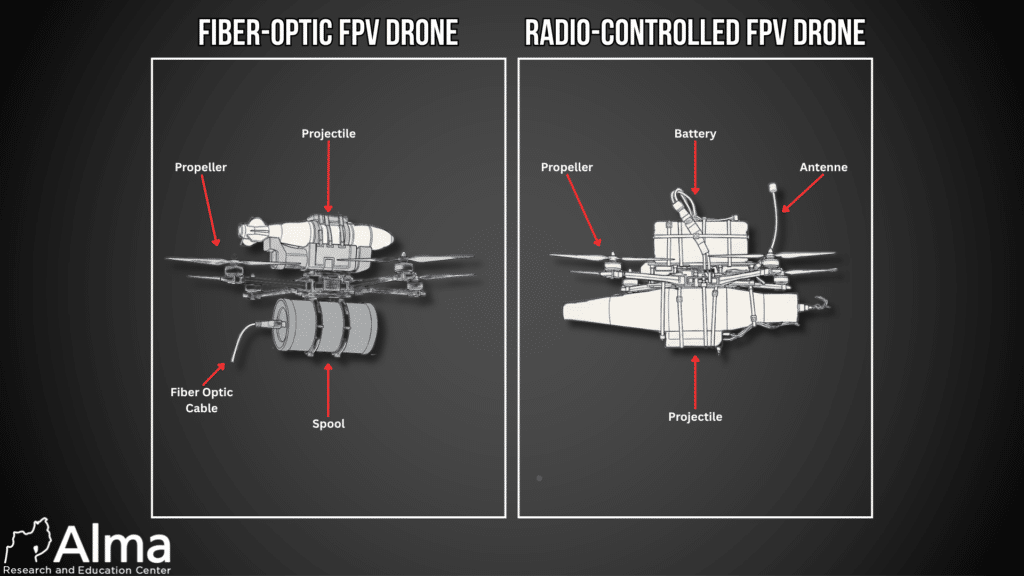
Hezbollah’s significant shift to FPV drones in general, and fiber-optic-based ones in particular, is an adoption and imitation of the use of these drones that emerged in the Russia-Ukraine war, where this tool became a major lethal factor in 2025. The optical fiber connects the operator to the drone with a physical cable the thickness of dental floss, completely nullifying the effectiveness of electronic warfare and spectral jamming upon which the defense arrays against this threat rely.
The drone does not emit an electromagnetic signal, its firing source cannot be geolocated, and being small, with 4 small electric motors, flying close to the ground — its radar and infrared signature are minimal. Detection by electro-optical or acoustic sensors seems to be the most realistic means, although this type of detection provides a shorter warning time than radar detection.
According to IDF estimates, Hezbollah has dozens of operators of this type of drone operating in southern Lebanon, Among other places, from inside civilian homes. It is possible that Hezbollah is also managing to launch the drones from within the “Yellow Line.”
Before launching the explosive drone, Hezbollah operatives sometimes launch a regular observation drone, which locates and identifies the target, followed by the explosive drone.
There are several possible solutions against this threat, ranging from nets for passive defense, defensive drones that attack the threat, computerized sights that can be installed on assault rifles, and mobile laser detection and interception systems.
The IDF aims to introduce solutions to the battlefield within a timeframe of weeks to months.
Kinetic interception becomes particularly challenging due to the difficulty in the detection stages against small, fast, and maneuvering targets.
The IDF is required to rapidly adapt equipment, distribute immediate solutions in the field (deploying nets, camouflage, dummy targets) alongside the development of the long-term response by the Air Force and defense industries.
If the gap is not bridged quickly, hundreds of dollars will defeat millions of dollars, and tactical success will translate into a strategic limitation of Israeli freedom of action.
Threat Characteristics
The small quadcopter drones used by Hezbollah are not traditional military attack UAVs, but the conversion of cheap civilian drones of a type that can be purchased on any Chinese e-commerce network — into precision weapons. The FPV drone allows the operator to see the battlefield from the drone’s own perspective, in high video quality and in real-time, and direct it at pinpoint targets with high precision. The threat range is estimated at tens of kilometers.
Hezbollah’s systematic transition to FPV is agile and is part of the learning competition and introduction of measures and countermeasures that characterizes every war.
The organization’s historical usage pattern was based on rockets, anti-tank missiles (especially Kornet), and Iranian fixed-wing long-range UAVs.
These were largely blocked by Iron Dome systems, with increasing help from laser systems deployed on the northern border, and the rest of Israel’s multi-layered air defense, which includes EW (Electronic Warfare) systems.
Hezbollah learned in Russia-Ukraine that advanced defenses can be bypassed through the mass procurement of cheap drones and the addition of small explosive charges.
The conversion to optical fiber also neutralizes the final layer of defense — electronic warfare.
The drones (manufactured as a civilian product mainly in China) are adapted by Hezbollah for attack operations in relevant workshops across Lebanon.
Hezbollah primarily adds an improvised explosive charge to the drone and sometimes also the optical fiber up to tens of kilometers long, connected directly to the operator.
These drones are a relatively very cheap means. The unit cost of such a drone is only about $300-$400 for the simple small drones and up to about $4,000 for the larger drones.
The assessment is that Hezbollah has accumulated a significant stockpile.
In June 2024, Lebanese security forces seized a shipment of 5,000 drones with a range of 50 km and a carrying capacity of 7 kg of explosives — but dozens of other shipments have reached Hezbollah.
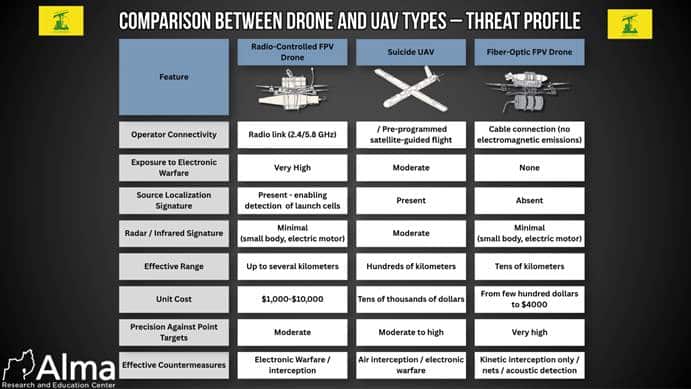
The optical fiber, tens of kilometers long in some of the cases documented in the war in Ukraine, provides high-quality video without jamming interference, and allows the operator to fly low, hide between buildings and ruins, and reach the target without the ability to be identified.
Hezbollah combines this advantage with an operational pattern that makes response difficult: the launch is carried out from a distance from areas where the IDF does not operate on the ground, underground in some cases, and from civilian auxiliary structures.
In the first stage, Hezbollah operatives acquire a target with an observation drone and gather intelligence on it.
In the second stage, they fit the attacking drone with armament suited for the target, and then launch it for the attack — which also requires high operator skill, but makes real-time jamming and interception very difficult.
Countermeasures
The IDF and the Ministry of Defense are working jointly with Israeli defense industries and various startups to expedite solutions based on interceptor defense drones. The Israeli company Spear has also developed an advanced interceptor drone for this mission called Viper.
In addition, there are several counter-drone defense systems based on a combination of laser interception and EW, and they can be adapted to use only the laser means, or connected to automatic 30mm firing systems, or defensive drones, along with their detection systems.
These examples include Rafael’s Drone Dome system, which includes an electro-optical sensor by Controp, and a Lite Beam configuration laser; Israel Aerospace Industries’ Drone Guard system, which combines electro-optical sensors, algorithms, and can be connected to the Iron Drone system (an autonomous drone that intercepts attacking drones); and Elbit’s ReDrone system, which also has electro-optical sensors and can be connected to defensive drones, or 30mm automatic cannons.
The fastest effective answer to a drone operated by optical fiber is probably via interception with lead bullets, aerial grenades, or defensive drones.
The Israeli company Smart Shooter leads the field of computerized sights that can be installed on any assault rifle.
Its SMASH 3000 system is a computer-vision-based fire control system mounted on the soldier’s personal weapon.
A camera and sensor provide a continuous image to the computer mounted on the weapon, which analyzes the threat image in real-time, locks onto a moving target, and presents the soldier with an accurate firing window — thus turning even a soldier without special training into a “first-shot sniper.”
Simultaneously, these days, the IDF’s Ground Arm is making an urgent procurement of dedicated anti-drone ammunition: fragmenting bullets and testing of dedicated anti-drone rifles as a last resort defense for forces in the field. Thousands of crates of this type of fragmenting ammunition were ordered from the US and their arrival in the arena is expected during the coming week.
The logic of the fragmenting ammunition is identical to that of “shotgun” ammunition: since the target is small, maneuvering, and three-dimensional, a “cloud” shape of bullets dramatically raises the chances of a hit compared to a single bullet.
Passive Countermeasures: Nets, Camouflage, and Dummy Targets
Alongside the development of interception means, the IDF has adopted in the field the passive solution born in Ukraine — wide deployment of nets over combat vehicles and positions. Reservists from Brigade 3, who have been dealing with the close-to-the-ground aerial threat for the past two and a half years, conducted a documented field test in which they deployed a net over a Hummer jeep, launched a drone — and the drone was caught in the net.
Since then, the technique has spread: IDF soldiers in southern Lebanon currently deploy nets on their vehicles in the areas where they operate, recognizing that against the current inability to intercept — the nets are supposed to prevent the final hit on the forces.
Looking Ahead
The operational gap between Hezbollah and the IDF in the small drone arena is the most significant gap that has opened in the current campaign — and it is not limited to technology but to doctrine, procurement, and the Israeli defense establishment’s risk perception. The timeline for fully coping with the drone threat is likely a matter of weeks-to-months, not days.
Meanwhile, the cost asymmetry remains: a $300-$400 drone kills and injures soldiers, and affects an entire operational workspace of IDF forces in southern Lebanon.
Added to this is the propaganda and psychological consciousness arena: Hezbollah compares the fiber-optic-operated FPV to the Kornet missiles of the Second Lebanon War, and describes the phenomenon as “creating a constant sense of threat, harming the soldiers’ sense of security, and eroding civilian morale.”
Conclusions
First, in the immediate term, the response must be multi-layered and simple: physical nets on vehicles, fragmenting ammunition for every combatant and outpost, the installation of computerized sights for at least several combatants in every maneuvering company, dummy targets and professional camouflage, and an intelligence effort to thwart the assembly workshops and the launch operatives and sites.
Second, in the medium term, a conceptual revolution is required — a transition from a model of “centralized air defense in electronic warfare” to a decentralized model of “kinetic personal defense with a local sensor on every company”.
The Israeli defense industry is qualified to provide this response, but at a pace that is contingent on the Ministry of Defense’s procurement ability to respond in weeks and not years.
If the IDF does not close this gap quickly, Hezbollah — following Ukraine and Russia — will dictate the new rules of the game in the ground arena in southern Lebanon: an arena where hundreds of dollars defeat millions of dollars, and tactical success translates into a strategic limitation of Israeli freedom of action.





One Response
Dear Yaakov,
It is an absolute necessity that decisive offensive measures, both overt and covert, be employed immediately to confront this threat. Each drone strike must be countered with overwhelming force. Identify drone operation locations and bomb them into oblivion. The State of Israel will not bow down under terror tunnel rat threats. The Devouring Lion will destroy its enemies. If Lebanon wants to continue as a nation it must take action now, or face extinction.