The Iranian Arena
Extensive strikes across Iran are ongoing. Over the past 24 hours, strikes were reported in Tehran, Shiraz, Kermanshah, Sirjan, Ahvaz, and the Kurdistan region. In this context, approximately 20 weapons production sites and research and development centers across Tehran were targeted, as well as Mehrabad International Airport in the western part of the city. In addition, the building of the former United States embassy in Tehran was struck, which, according to reports, had been used as a gathering site for Basij fighters.
The IDF struck a facility owned by the company “Tofigh Daru,” which served as a central supplier of fentanyls to the SPND organization, which is responsible for the development of chemical weapons for the Iranian regime. Additionally, the steel plant in Isfahan was struck for the second time this week, as well as the “Al-Ahwaz” steel plant in the Ahvaz region. Iranian opposition sources also reported a nighttime strike on the Sepid-Dasht steel plant in Borujen, located in Chaharmahal and Bakhtiari province, south of Tehran.
According to a report in the Wall Street Journal, the American aircraft carrier “George Bush” departed yesterday from the port of Norfolk in Virginia on its way to the Middle East.
Eliminations
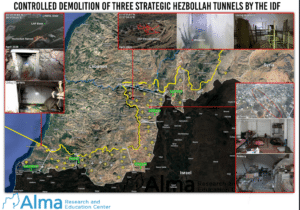
The IDF eliminated the head of the engineering branch of the Lebanon Corps of the “Quds Force,” the engineer Mehdi Vafaei, in the area of Mahallat in Iran. During his 20 years of activity as head of the engineering branch, Vafaei advanced underground projects in the territories of Lebanon and Syria. He led the establishment of underground infrastructure for Hezbollah and the Assad regime in Syria, and managed dozens of underground projects in Lebanon that were used for the storage of advanced weapons.
In addition, Iranian media reported that Qassem Karishi, deputy commander of the Basij, was eliminated in an Israeli strike approximately two weeks ago.
Iranian Activity in the Region:
Qatar – A vessel was hit by a missile north of Doha.
Bahrain – A fire broke out at a facility in the country following an Iranian attack.
The Islamic Revolutionary Guard Corps is threatening to target American companies, including Microsoft, Apple, and Boeing.
Iraq
The Iraqi Ministry of Interior confirmed that American journalist Shelly Kittleson was kidnapped in Baghdad. In addition, Iraqi authorities arrested an individual linked to the “Kata’ib Hezbollah” militia in Iraq, who is believed to be involved in her abduction.
The Israeli Arena
On March 31, three ballistic missile attacks from Iran toward Israel were identified—two toward the Tel Aviv area and one toward the Jerusalem area.
The Houthis launched a ballistic missile from Yemen toward the Negev area; the missile was intercepted and there were no casualties.
At least one of the attacks toward the Tel Aviv area involved a cluster munition missile. Impacts were identified in Petah Tikva and Bnei Brak, where seven people were injured, including children. In total, since the beginning of the campaign, 416 waves of attacks from Iran toward Israel have been identified.
As of Wednesday, April 1, 2026, at 07:00 a.m., 6,286 casualties had been evacuated to hospitals, of whom 100 are currently hospitalized.
At the same time, Hezbollah’s activity against Israel continues. On March 31, 46 waves of attacks toward Israeli territory were identified, an increase of more than double compared to the previous day.
Munitions: 29 attacks involved high-trajectory fire (rockets and missiles), and 17 attacks involved the use of UAVs.
Geographical distribution:
- 31 waves of attacks targeted border communities (0–5 km)
- 14 attacks targeted cities and communities up to the Haifa line (5–40 km)
- One wave of attack targeted an area south of Haifa—approximately 50 km—toward the Jezreel Valley and the Carmel Coast.
Lebanon and Hezbollah
The European Union and a group of European foreign ministers issued an unusual statement in which they placed responsibility for the current situation on Hezbollah, condemned its attacks on Israel with Iranian support, and called for their immediate cessation. They also called for support for the Lebanese government, strengthening of state institutions, restoration of Lebanese sovereignty over the entire territory of the state, and ensuring the exclusive possession of weapons by the state.
Lebanon’s ambassador to the United Nations stated in a Security Council discussion that Hezbollah had dragged Lebanon into war, despite the government being open to dialogue with it.
In a joint statement, several European countries and the European Union called on Lebanon to begin direct political negotiations with Israel, with the aim of achieving a permanent end to the conflict and creating conditions for regional coexistence. The statement also included full support for the Lebanese government, a call to restore full state sovereignty, and to concentrate weapons solely in the hands of the state.
The Kataeb Party (Christian) reiterated its demand to reduce Hezbollah’s military and security power and to implement government decisions on the matter.
Lebanese Defense Minister Michel Mansa condemned Israeli threats and argued that any attempt to impose a reality similar to that of Gaza in southern Lebanon, or to create a security zone within Lebanese territory, constitutes a severe violation of the state’s sovereignty.
Hezbollah’s Al-Manar channel reported that Iran’s Supreme Leader, Mojtaba Khamenei, sent a letter to Hezbollah leader Naim Qassem, thanking him and the organization’s members for their condolences following the killing of his father. The letter stated that Qassem is leading Hezbollah at a significant moment in the history of the resistance, and expressed confidence in his wisdom and ability to thwart the schemes of the “Zionist enemy,” defeat it, and restore pride to the Lebanese people. He also emphasized Iran’s firm commitment to continue supporting the resistance against the “Zionist and American enemy,” in his words.
The Lebanese Army announced that, in light of the escalation in fighting, particularly in areas where Israeli incursions into southern border villages were reported, it carried out a reorganization and redeployment of several units. According to the statement, the aim is to prevent a situation in which units would be encircled, isolated, or cut off from their supply lines.
The Lebanese Army evacuated positions in Christian border villages, including Rmeish, Ain Ebel, Braachit, Tayri, and Beit Yahoun. This move raised concern and strong reactions among residents and local leadership, who made clear their intention to remain in their communities despite the risks. Local authorities expressed understanding of the army’s reasoning but noted they would have preferred it to remain.
European countries announced their readiness to support the Lebanese Army and security forces through an international aid conference, once conditions on the ground allow it. As part of this, the Lebanese Army received 39 VAB armored personnel carriers as a donation from France, in a ceremony held at the Port of Beirut. French and Lebanese officials emphasized France’s support for the Lebanese Army and its role in maintaining internal stability.
Lebanese President Joseph Aoun met with the Qatari ambassador to Lebanon. The meeting addressed internal and regional developments, as well as relations between the countries. During the meeting, Aoun condemned the attacks against Qatar, expressed solidarity with it, and expressed hope that Qatar and the Gulf states would restore their security and stability.
Indonesia called on the United Nations to open an investigation following the deaths of three Indonesian peacekeeping soldiers in UNIFIL in southern Lebanon.
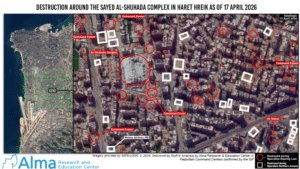
During the night and morning, strikes continued in various areas across Lebanon, including the Al-Jnah area in Beirut, the southern Dahieh, the western Bekaa, and additional southern areas.
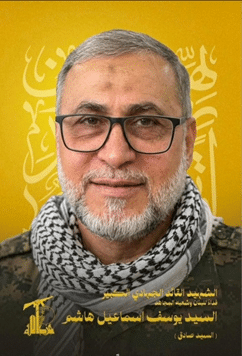
The IDF reported that during the night it eliminated from the sea the commander of Hezbollah’s Southern Front, Hajj Youssef Ismail Hashem, in a strike south of Beirut. Hashem had replaced the veteran Southern Front commander Ali Karaki, who was eliminated together with Hassan Nasrallah in September 2024.
Syria
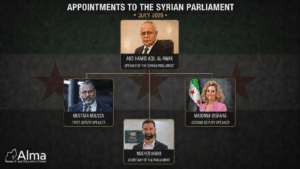
During his visit to the United Kingdom, Syrian President Ahmad al-Sharaa addressed Israel’s conduct toward Syria in a speech at Chatham House, stating that since the current leadership came to Damascus, Israel has acted negatively toward the country. According to him, Israel has attacked numerous Syrian sites, advanced toward certain positions, and violated the boundaries of the 1974 agreement, which had held for more than 50 years. He further noted that Syria had attempted to act through dialogue, initially via indirect negotiations and later through direct contacts, and that certain progress had been achieved, but claimed that at critical moments there was a shift in the Israeli position.
Regarding Iran, al-Sharaa said that Syria has exercised caution in opening relations with it so far. According to him, the current fighting is negatively affecting the region, including through disruptions to energy and fuel supplies, which in turn impact the global economy. He noted that Iran faces issues related to the development of nuclear weapons and ballistic missiles, as well as interference in the affairs of other countries. According to him, Syria recommends pursuing a negotiated solution rather than the use of military force, due to the risks involved.
The Syrian president emphasized that as long as Syria is not directly attacked by any party, it will remain outside the conflict.
The International Arena
According to a report in the Wall Street Journal, the United Arab Emirates is working to promote the reopening of the Strait of Hormuz and has even expressed willingness to join the fighting. According to the report, the UAE is pressuring the United States and Western countries to establish a military coalition to break the blockade of the strait, including taking control of strategic islands held by Iran.
At the same time, the United Arab Emirates has decided to prevent entry of Iranian passport holders into its territory.
Meanwhile, Pakistan and China have published a diplomatic initiative that includes a five-point plan to restore peace and stability in the Gulf region and the Middle East. The plan calls for an immediate ceasefire, the prompt opening of peace talks, a halt to attacks on non-military targets, securing trade routes and reopening the Strait of Hormuz, and the formulation of a peace agreement based on the principles of the UN Charter.
Turkish President Erdoğan claimed that the Israeli government is the main party responsible for the unlawful war. He further stated that, in his view, the war has not only brought destruction to the region but has also imposed a heavy economic burden on the entire world, adding that it is a government driven by conflict, chaos, and crises.
The leader of Turkey’s nationalist party, Devlet Bahçeli, stated that Turkey stands alongside Iran, adding that if a regime change were to occur, it should first take place in Israel.
The Prime Minister of Canada condemned the Israeli action, the Israeli occupation in southern Lebanon.
Note: The next report will be published on Friday, April 3.