
Two floating bridges constructed in recent months by Turkish military engineering units over the Euphrates River are presented by Ankara and Damascus as humanitarian projects intended to ease the daily lives and movement of residents of Deir ez-Zor Governorate. Indeed, the bridges provide a vital connection between the two banks of the river and facilitate the movement of residents, goods, and vehicles. However, the identity of the implementing party, the location of the projects, and the manner in which they are operated also carry broader security implications.
The bridges demonstrate that Syrian–Turkish military cooperation is no longer limited to agreements, military training, the supply of weapons, or force-building advice. Units from both militaries are now working together to establish dual-use infrastructure deep inside eastern Syria, far from Turkey’s traditional areas of influence in the north of the country. The projects thus form part of a broader process through which Ankara is involved in rebuilding the new Syrian military and expanding the Damascus government’s ability to reestablish control over the country’s territory.
The Bridge in Deir ez-Zor
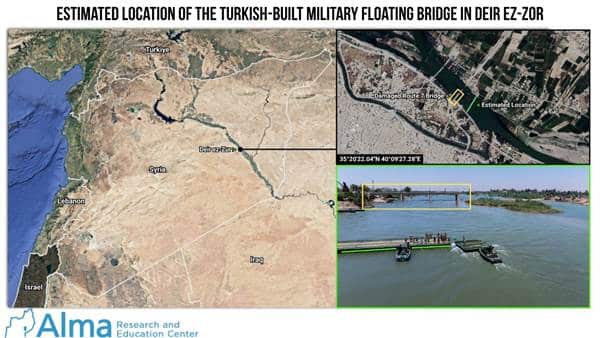
The first project is a floating bridge that was constructed in the city of Deir ez-Zor, near the al-Siyasiyah Bridge, one of the main routes connecting the city center with the eastern bank of the Euphrates and the al-Jazira region.
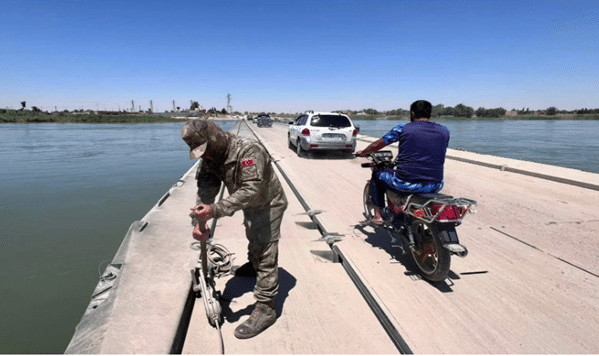
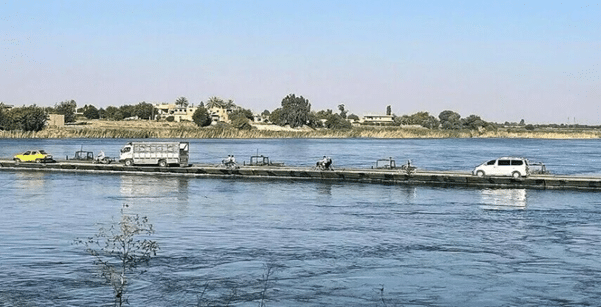
Construction of the bridge began on July 8, 2026, under the command of the Turkish Second Army’s Engineering Brigade, and it opened to traffic on July 12. According to a statement by the Turkish Land Forces, the bridge is operated around the clock jointly by the Turkish “Deir ez-Zor Task Force” and Syrian forces. The very use of the term “task force” may indicate that this is not merely a transfer of engineering equipment to the Syrians, but rather a dedicated Turkish military framework involved in the construction and operation of the infrastructure.
The Turkish Ministry of National Defense reported that 237,654 vehicles and 7,875 pedestrians crossed the bridge during its first month of operation. This is an official Turkish figure that has not been independently verified, but it indicates the importance of the crossing and the high demand for a connection between the two banks. According to the Turkish source, the bridge is 240 meters long. Earlier Syrian reports referred to a length of 280–300 meters and an engineering load-bearing capacity of up to 70 tons. However, when it opened, the Deir ez-Zor Governorate imposed a traffic limit of 25 tons. A distinction should therefore be made between the maximum load-bearing capacity attributed to the bridge during its construction and the operational limit imposed on regular traffic.
Traffic in the area was divided between two one-way crossings: the nearby earthen causeway serves vehicles entering the city, while the floating bridge carries traffic leaving Deir ez-Zor toward al-Jazira. This arrangement helps reduce congestion and maintain the continuous flow of traffic while the permanent al-Siyasiyah Bridge undergoes reconstruction. The permanent bridge, which is approximately 400 meters long and has six of its 11 spans completely collapsed, is expected to return to service in March 2027 under the current timetable.
The temporary bridge is significant beyond its local function. The al-Siyasiyah Bridge area is one of the northern gateways to Deir ez-Zor, connecting the city with the northern part of the governorate and the area leading toward Hasakah. Restoring the connection supports trade, population movement, and the provision of services; at the same time, it also improves the ability to transfer forces, equipment, and supplies between the two banks of the Euphrates.
The Bridge in al-Mayadin
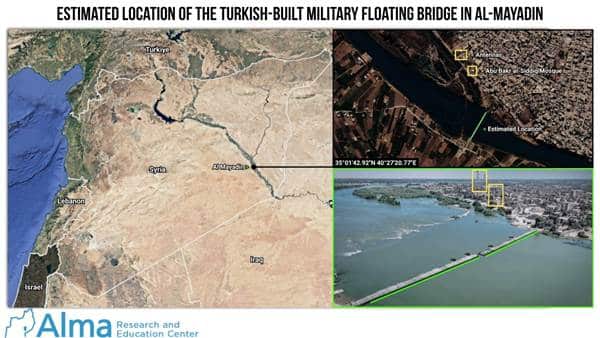
The second project was completed on August 30, 2026, in the al-Mayadin area, approximately 45 kilometers southeast of Deir ez-Zor. The bridge connects the city of al-Mayadin, located on the western bank of the Euphrates, with the al-Hawayij area and the subdistrict of Dhiban on the eastern bank.
The Syrian Ministry of Defense transported the bridge components to the area on August 26, and its assembly was completed within four days through cooperation between Syrian engineering units and the Turkish military. The Turkish Ministry of National Defense described it as a “foldable floating bridge” constructed by the Turkish Second Army’s Engineering Brigade. At this stage, no reliable official figures have been published regarding its length, load-bearing capacity, or the weight limit established for its operation.
The bridge was constructed after an earthen causeway connecting the two banks collapsed following a rise in the Euphrates’ water level in late May 2026. Following the collapse, residents were forced to use ferries and later to travel as far as al-Ashara, approximately 25 kilometers from al-Mayadin, to cross the river. The new bridge restores the direct connection between al-Mayadin and the villages east of the Euphrates, enabling the resumption of the movement of residents and goods. The Syrian authorities describe it as a temporary solution until a more permanent and secure crossing is constructed.
The location of this bridge also has strategic significance. Al-Mayadin lies along the Euphrates corridor, which continues southward toward al-Bukamal and the Iraqi border. The bridge does not in itself create a continuous corridor to the Iraqi border, but it improves connectivity between the western bank of the Euphrates and the rural area east of the river, while adding an accessible crossing point along an important regional route.
Both projects form part of a broader effort by Damascus to restore crossings in the governorate. In February 2026, the Syrian military constructed a temporary metal bridge between al-Mariyah and Marat, east of Deir ez-Zor, while work is also underway to rehabilitate permanent bridges destroyed during the war. The purpose of this effort is to transform the Euphrates once again from an obstacle separating different parts of the governorate into a route that connects them.
Civilian Infrastructure with Security Applications
At the official level, Ankara and Damascus present the bridges as assistance to the local population and as part of infrastructure reconstruction efforts. Following the completion of the bridge in al-Mayadin, Turkey’s ambassador to Damascus, Nuh Yılmaz, wrote that the armed forces of the two countries were “building the future together, even in peacetime.” Syrian Defense Minister Murhaf Abu Qasra thanked his Turkish counterpart, Yaşar Güler, for his efforts to strengthen trust and cooperation between the two countries.
However, the projects also have clear military characteristics. These are modular military bridges constructed by an engineering brigade of the Turkish Second Army, rather than civilian projects carried out by an infrastructure company. At the Deir ez-Zor bridge, joint operations by a Turkish force and Syrian forces are also continuing. This provides practical experience in planning, constructing, securing, and operating joint logistical infrastructure under field conditions.
Floating bridges are inherently dual-use infrastructure. Their current function is civilian and justified as a response to the needs of the population, and there is no evidence that they were constructed in preparation for any specific military operation. Nevertheless, they can also facilitate the more rapid movement of forces and supplies and provide logistical redundancy if permanent crossings are damaged or unavailable. The presence of several crossing points along the Euphrates reduces dependence on a single bridge and expands the Syrian government’s ability to move between different parts of the governorate.
From the Turkish North into the Depths of Eastern Syria
The central significance of the projects lies not only in the type of infrastructure involved, but also in their location. For years, the Turkish presence was concentrated in northern and northwestern Syria, near the Turkish border and in areas where factions backed by Ankara operated. The construction of infrastructure by the Turkish military in Deir ez-Zor and al-Mayadin points to an expansion of its activities deeper into eastern Syria.
The projects do not prove that Turkey is establishing a permanent military presence in the governorate. However, they demonstrate operational access, the ability to operate on the ground, and direct cooperation with the Syrian military. They also position Ankara in an area that is important for controlling northeastern Syria, connecting population centers on both sides of the Euphrates, and gaining access to the areas of Hasakah, al-Bukamal, and the Iraqi border.
In this sense, the bridges assist Damascus not only in restoring services, but also in reestablishing effective control over areas that had for years been divided among different forces and governing frameworks. From Turkey’s perspective, strengthening the Syrian state’s ability to operate east of the Euphrates is consistent with its interest in preventing the reemergence of an armed and autonomous Kurdish entity along its southern border.
Another Component in Building the New Syrian Military
As documented in previous articles by the Alma Research and Education Center, military cooperation between Ankara and Damascus evolved during 2025–2026 from declarations and general understandings into actual force building. The memorandum of understanding signed by the defense ministers in August 2025 established a framework for training Syrian soldiers and officers, providing advisory support, exchanging experts, and delivering technical and logistical assistance. Syrian soldiers subsequently participated in the EFES-2026 exercise in Turkey, a Syrian delegation visited the Turkish National Defence University, and contacts expanded into the air and naval domains as well (Alma Center, October 2025, Alma Center, June 2026).
The two bridges add a new dimension to this process: the joint deployment of military engineering and logistical capabilities on Syrian territory. These are basic but essential capabilities for any military seeking to control territory, move forces, and ensure operational continuity. The joint work enables Turkey to influence not only the Syrian military’s equipment, but also its working methods, planning, and operational doctrine.
For Damascus, Turkish assistance makes it possible to rapidly complete projects that it cannot carry out independently, strengthens the state’s presence in the east, and improves services for residents. On the other hand, the more Syria’s security and infrastructure reconstruction relies on Turkish equipment, experts, and units, the greater its dependence on Ankara becomes. The question is whether this represents a temporary stage in building an independent Syrian capability or a mechanism that will ensure Turkey’s long-term influence over the military and strategic infrastructure.
Regional Significance and Implications for Israel
Restoring infrastructure can improve the Syrian state’s ability to exercise control, contribute to stability, and reduce the areas exploited by ISIS, criminal organizations, and smuggling networks.
However, the cumulative significance of these projects is broader. Turkey is establishing itself as a key partner in building Syria’s security institutions, rehabilitating their infrastructure, and shaping their operational capabilities. Its activities are no longer confined to the north near its border but are also evident in eastern Syria and near routes leading toward the Iraqi border.
For Israel, the main challenge lies in the possibility that this process could evolve from engineering assistance, training, and advisory support into a prolonged Turkish military presence, access to bases, or the deployment of radar, air defense, and UAV systems. In previous articles, the Alma Research and Education Center noted that such capabilities could restrict Israel’s freedom of action in the air and increase the risk of direct friction with Turkey. The rehabilitation of the Abu al-Duhur military airbase with Turkish assistance and the Israeli strike there in August 2026 demonstrated that this issue is already creating tangible tensions between the two sides (Alma Center, August 2026).
The bridges in Deir ez-Zor and al-Mayadin do not, by themselves, alter the balance of power in Syria. Their importance lies in providing further evidence of the deepening relationship between the two militaries and the geographical expansion and growing influence of Turkish activity in Syria. They illustrate how assistance for civilian reconstruction also serves to build a military partnership, gain access on the ground, and embed influence within state institutions.
From Israel’s perspective, the projects should therefore be assessed as part of a broader trend rather than as isolated events. The weakening of the Iranian presence in Syria is a positive development, but the space it has vacated is gradually being filled by another regional power, one with an advanced military, an independent defense industry, and hostile relations with Israel. At this stage, Turkey is not building a military apparatus in Syria comparable to the one established by Iran, and the two should not be automatically equated. However, its entrenchment within the Syrian military and strategic infrastructure may, over time, create a new kind of state-level, technological, and political challenge.
The test will be how the process develops: whether Turkey will limit itself to temporary assistance for reconstruction and the development of Syrian capabilities, or whether the projects will serve as a foundation for a sustained presence and an expansion of military activity in central and eastern Syria and perhaps even toward southern Syria, the area most relevant to Israel.
The two bridges over the Euphrates do not yet provide an answer, but they demonstrate that Turkish involvement has already crossed another threshold, from training and advisory support to operational cooperation on the ground.



One Response
Dear Dr Zoe,
Considering the muslim brotherhood hostile rhetoric coming out of Turkey, your reporting has underlying grave concerns of clandestine jihaddist infrastructure growth in disguise. It is reminiscent of Gaza “humanitarian” infrastructure by hamas. This should be expected, since Turkey is a direct sponsor of hamas. RED FLAGS ALL AROUND THIS EVIL.