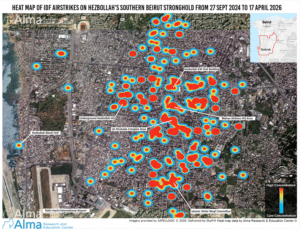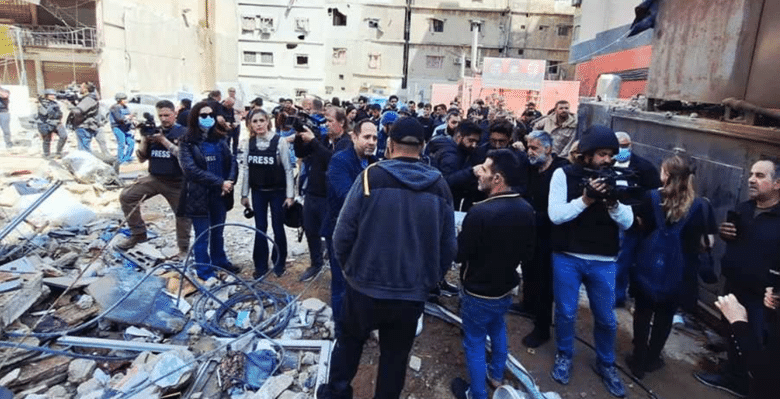
On April 10, Hezbollah organized guided tours for media outlets in areas struck by Israel in the Dahieh district of Beirut. As part of these tours, journalists were taken to sites affected by Israeli airstrikes, including the Al-Jinah complex and the Al-Salam neighborhood, where destroyed buildings and locations presented as “sites of harm to the civilian population” were documented. This move aligns with a well-established pattern of Hezbollah’s conduct in the perception domain: creating mediated, controlled, and supervised access to the field for media organizations, with the aim of shaping in advance the narrative, the framing of events, and the perspective from which they are reported. These tours are not merely a means of illustrating the scale of the damage, but primarily a tool of influence designed to steer media discourse toward a focus on civilian harm, while minimizing or obscuring the broader military context. By selectively presenting scenes of destruction and emphasizing the extent of civilian impact, Hezbollah seeks to establish a narrative of victimhood and reinforce the image that “Israeli aggression is directed against civilians.” This activity reflects Hezbollah’s concept of the “battle over consciousness,” in which the media arena is perceived as a direct continuation of the military arena. Control over imagery, narratives, and the framing of events enables the organization to maximize cognitive gains even in situations of physical damage, and to convert on-the-ground losses into political and perceptual capital. At times, this narrative does permeate international coverage, which tends to focus on the humanitarian consequences of the fighting in Lebanon, while giving limited weight to the broader context—chiefly Hezbollah’s activity as a military terrorist organization operating within and from a civilian environment through the use of human shield tactics. In this way, through control over the flow of information, management of access to the field, and direction of media coverage, Hezbollah succeeds in influencing how reality is perceived in the media sphere, including internationally, which in many cases falls short of objective reporting and overlooks the fact that Hezbollah is the party responsible for the situation in the first place. Thus, Hezbollah establishes a framing that serves its political and strategic objectives.