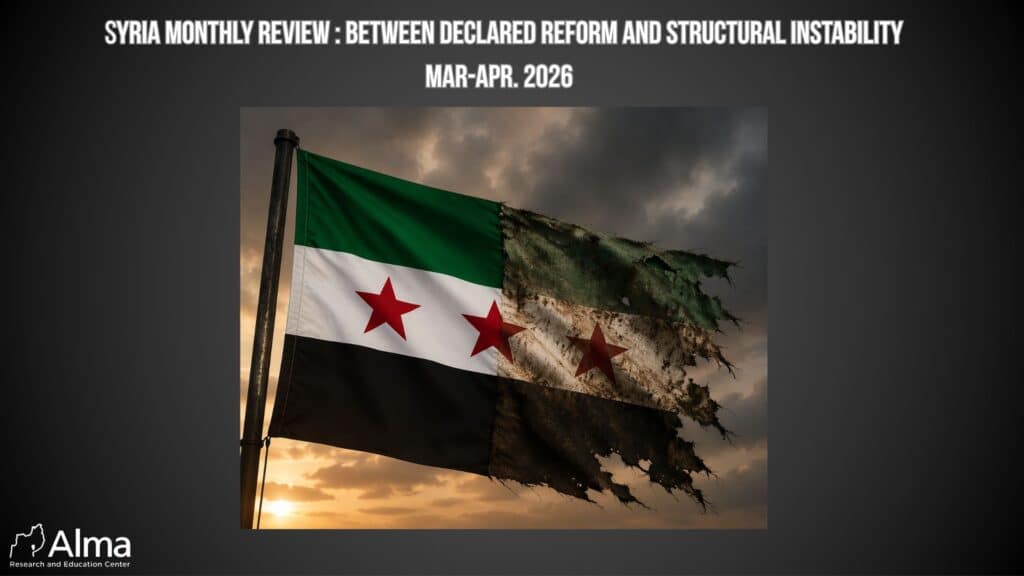
The regional campaign against Iran has shifted attention away from the Syrian arena, yet developments during March and early April 2026 demonstrate that Syria continues to serve as a central source of instability, both internally and at the regional level. Despite the absence of direct fighting on its territory, it remains a highly tense arena, in which an ongoing struggle over control, identity, and governance is taking place.
Declared Neutrality versus Geostrategic Reality
Syrian President Ahmad al-Sharaa emphasized during the war that his country is not interested in being drawn into the conflict as long as it is not directly attacked. In practice, however, Syria continues to serve as a strategic depth for the Iranian axis, a reality that limits its ability to maintain genuine neutrality.
Already at the beginning of the war (March 4), Syria began reinforcing its forces along the border with Lebanon, with the aim of increasing oversight of smuggling routes from Syria to Lebanon—particularly toward the Beqaa region. At the same time, the presence of forces was also reinforced in the south of the country, especially in the Daraa area and along the border with Israel, in an attempt to prevent Iranian influence, through actors operated by Iran, from exploiting the situation and dragging it into another confrontation. Alongside this, the Syrian regime conveyed reassuring messages to the Lebanese government, stating that the deployment of forces was not directed against Lebanon, but rather intended to strengthen control over the border and reduce smuggling.
However, it should be understood that control over the border is not merely a security issue, but also a political-strategic one. The Syrian effort to increase control over the Lebanese border reflects a broader struggle over one of the central axes of the “Axis of Resistance.” In this sense, the measures being taken do not eliminate the axis’s activity, but rather attempt to regulate and manage it—another indication of the limitations of Syrian sovereignty.
Penetration of External Actors and the Struggle for Internal Stability
On April 11, the Syrian Ministry of Interior announced that a terrorist cell planning to assassinate a religious figure (reportedly Rabbi Michael Khoury, who served as a religious leader for the local Jewish community but, according to reports, had left Damascus prior to the incident) using an explosive device had been thwarted. The five members of the cell were arrested, and according to a preliminary investigation, they had received military training outside Syria and were linked to Hezbollah, which denied any involvement.
This incident underscores that the penetration of external actors into the Syrian arena persists, and that the regime faces difficulty in fully controlling developments within its territory. At the same time, officials within the Syrian security establishment assess that Iran and Hezbollah are working to destabilize the country, including through the exploitation of the Palestinian issue. For example, in Damascus, Iran is attributed a role in instigating protests in support of Hamas and Palestinian prisoners in early April.
As we assessed in the article we published on April 5 (The“Pro-Palestinian” protests in Syria as a reflection of internal instability), Iran and Hezbollah operate in Syria through protests, incitement, and the exploitation of issues such as the Palestinian cause in order to reestablish their influence in Syria, open an additional front against Israel, and attempt to undermine the stability of the Syrian regime.
Sectarian and Political Tensions: The Druze Case
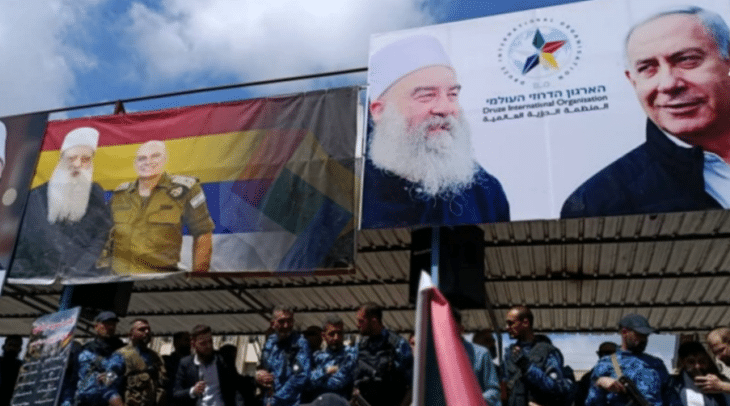
On April 11, a demonstration took place in Al-Karama Square in the city of Suwayda, including calls to support Sheikh Hikmat al-Hijri alongside demands for self-determination, the return of “occupied” villages, and clarification regarding the fate of missing persons. During the protest, flags were raised and signs were carried that included images of Israeli Prime Minister Benjamin Netanyahu alongside images of Sheikh al-Hijri—the spiritual leader of the Druze in Suwayda—and Sheikh Mowafaq Tarif, the spiritual leader of the Druze community in Israel. Also appearing in the images was Major General Ghassan Alian, who was recently appointed as the IDF’s point of contact with the Druze in Suwayda.
These protests reflect the ongoing challenge faced by the Syrian regime in enforcing central authority and unifying the various groups within the state. The demonstrations took place against a backdrop of growing internal tensions, following the dissolution of the “Judicial Committee” and the establishment of an alternative body. The Judicial Committee is a local leadership body responsible for maintaining public order, managing the province, and ensuring the functioning of essential services. It serves as an independent center of power representing the Druze community and conducts negotiations on issues of self-determination and security arrangements. Its dissolution is perceived not only as an administrative reform, but also as a manifestation of internal power struggles within the Druze leadership.
Instability in Syria does not stem solely from relations between different groups, but also from internal fragmentation within each group. Competition over leadership, resources, and influence further weakens the regime’s ability to generate stability.
“ISIS Families” and the Humanitarian Crisis in Northeastern Syria: Potential for Renewed Escalation
According to recent reports, the condition of detainees in camps of “ISIS families” in northeastern Syria—most of them women and children left without citizenship or a solution (as their countries of origin currently refuse to take them back)—constitutes a “ticking time bomb.” The dependence on humanitarian aid, which is steadily declining, alongside Kurdish warnings of radicalization and the resurgence of ISIS activity, points to a real risk of a new wave of terrorism.
In this sense, the camps are not only a humanitarian issue, but also a future security challenge, a potential “reservoir” for radicalization, stemming from the absence of a political and social horizon.
Legislation as an Indicator of Socio-Normative Change – Ban on Alcohol Sales
At the end of March, authorities in Damascus banned the sale of alcohol in most parts of the city (a reversal of a policy that for years had allowed the free sale of alcohol in Damascus without enforcement of regulation on the matter). The ban stipulates that alcohol may only be purchased in sealed bottles in a limited number of predominantly Christian neighborhoods. This step sparked debate among Syrian citizens regarding the future character of Damascus, as well as issues of rights and freedom of choice. Concerns were also raised about the economic implications of the ban, which may lead to the closure of or financial harm to many businesses.
The restriction of alcohol sales to Christian areas is perceived as problematic, as it encourages sectarian division. Critics argue that the decision ignores the social complexity of Syria. They emphasize that linking alcohol consumption to harm to public morality leads to the stigmatization of certain groups within the population. These measures also deepen sectarian rifts and may further undermine social cohesion.
The debate surrounding alcohol reflects deeper issues related to the nature of the regime, societal values, and the balance between religiosity and secularism, as it is part of a broader trend of restrictions based on concepts of “public morality.”
Over the past year, additional measures have been taken in this spirit, including recommendations for modest dress at beaches and swimming pools, bans on mixed-gender groups in restaurants in certain areas, restrictions on the employment of men in women’s clothing stores, and even a ban on public sector employees wearing makeup. While each measure on its own may appear minor, together they point to a concerning trend of increasing intervention by the authorities in private life.
Most of these decisions are made at the local level, despite statements by the central government regarding its commitment to preserving individual freedoms, once again casting doubt on the regime’s ability to enforce its governance across the entire country.
Between Reform and Continuity: Findings of the UN Report
During the month of March, the conclusions of the Independent International Commission of Inquiry of the United Nations regarding Syria were published. The report presents a complex and multi-layered picture: on the one hand, there is some degree of institutional progress following the fall of the Assad regime; on the other hand, there is a clear continuity of patterns of repression, violence, and lack of governance.
This gap between formal change and the reality in Syria lies at the heart of the country’s ongoing instability.
Institutional Progress – but Limited
The report points to several steps that can be seen as the beginning of a reform process:
- The establishment of mechanisms for transitional justice and addressing the issue of the missing people
- The issuance of arrest warrants against senior figures of the former regime
- Some easing of civil restrictions
- The initial stages of judicial reform
- The return of millions of refugees to the country
However, these are only preliminary steps and are not accompanied by a deep transformation of the power structures. In other words, institutions are being built but without the full dismantling of the foundations upon which the previous regime relied.
Ongoing Failure to Protect Civilians
Alongside this progress, the report emphasizes that the Syrian state still fails to ensure basic security for its citizens. The severe incidents of violence in 2025, particularly in coastal areas and in Suwayda, included mass killings, sectarian violence, and widespread destruction of property.
These events are not merely exceptional cases, but rather evidence that the state does not effectively control the forces operating in its name, whether official security forces or integrated militias.
The Structural Problem: A Hybrid State Without a Monopoly on Force
One of the report’s central conclusions concerns a deep structural problem: the integration of militias and armed organizations into state security institutions without an orderly process of disarmament, screening, and oversight.
This situation effectively creates a “hybrid state,” in which multiple centers of power operate simultaneously:
formal state institutions alongside militias with varying loyalties and external actors exerting influence.
The result is the absence of a monopoly on the use of force, a fundamental condition for the existence of a stable state. As long as this structure persists, the ability to achieve long-term stability remains limited.
Continuity of Repressive Patterns
Despite the political change, the report highlights the continued existence of familiar patterns from the previous regime:
- Arbitrary arrests
- Torture and abuse
- Enforced disappearances
- Deaths in detention
In other words, although the political framework has changed, the methods of operation of the security apparatus have not undergone a substantive transformation. This phenomenon reinforces the perception among the population that the change is superficial and merely cosmetic.
Land and Property Issues as a Central Source of Friction
The report emphasizes that disputes over land and property ownership have become one of the main drivers of conflict in Syria. The return of refugees, alongside widespread destruction and demographic changes, has created a reality of competing claims, revenge dynamics, and renewed displacement.
In the absence of an effective mechanism to regulate these issues, localized centers of violence are emerging, undermining stability even in areas that are not experiencing active fighting.
Social and Gender-Based Violence – A Reflection of the Depth of the Crisis
The report’s findings also point to high levels of social violence, including kidnappings and sexual violence, particularly against women from minority groups. These phenomena are not merely the result of security chaos, but reflect the deeper social dimensions of the crisis, the collapse of norms, institutions, and basic protections.
Regime Response: Declarative Acceptance, Partial Implementation
The Syrian government has accepted the report’s conclusions and presented them as a “roadmap” for reform, emphasizing its commitment to change. However, the report indicates that, so far, there remains a significant gap between declarations and actual implementation by the Syrian regime. Reforms are taking place primarily at the formal level, while existing power structures and interests continue to operate largely unchanged.
Conclusion: Political Change Without Structural Transformation
The overall picture that emerges is one of significant political change, but without a deep transformation of the mechanisms of power and control. Syria is currently caught in an ongoing tension between two opposing processes:
on the one hand, an attempt to build an institutional, lawful, and sovereign state; and on the other, the continued existence of patterns of violence, militias, and lack of control.
This tension is one of the central drivers of the country’s persistent instability. As long as the structural problems, chief among them the fragmentation of power and the absence of effective governance, remain unresolved, Syria will continue to exhibit only partial stability, with a constant potential for escalation.