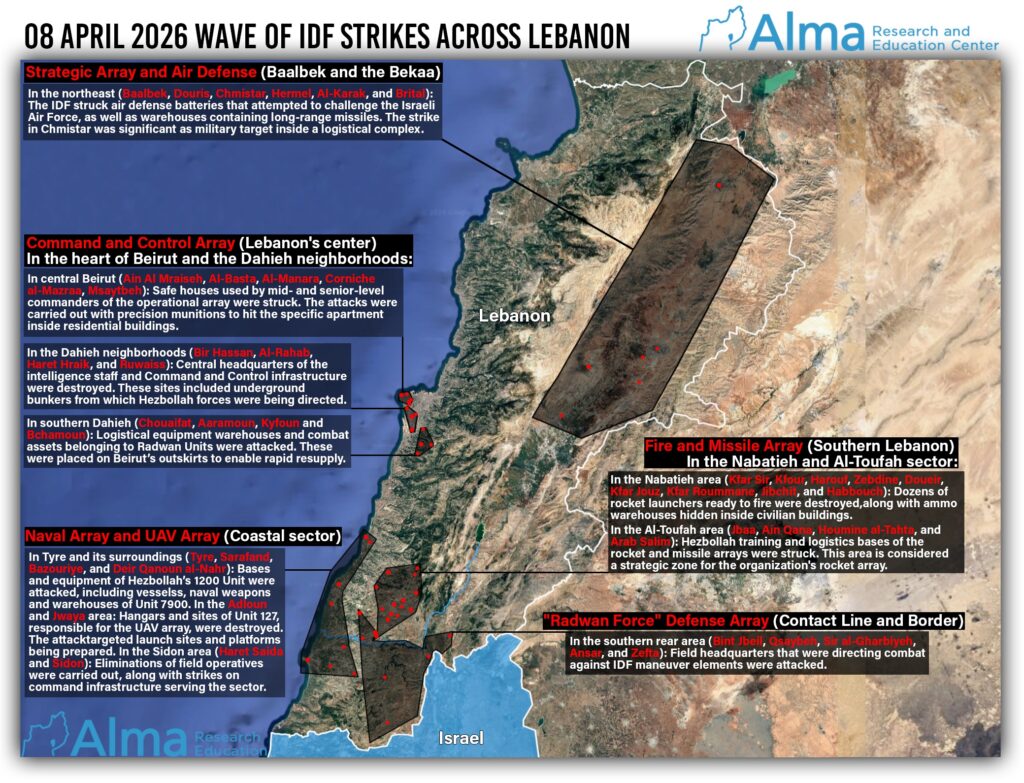
On April 8, 2026, the IDF carried out a rapid, simultaneous, and large-scale strike using precision-guided munitions against dozens of key military targets across three principal Hezbollah operating areas in Lebanon: Beirut, the Bekaa, and Southern Lebanon.
The majority of those killed were Hezbollah operatives of varying ranks and functions who were present and active at the targeted locations. As Hezbollah operates within civilian population centers and employs human shield tactics, civilians were also harmed as collateral damage, an issue that will be examined later in the analysis.
The targets that were struck (see details below) belonged to key arrays and units such as:
The command, control, and intelligence array (strikes in the Beirut area).
The rocket fire array (strikes in the Nabatieh and Iqlim Al-Toufah areas).
The naval unit – Unit 1200, the coastal missiles unit – Unit 7900, the aerial unit – Unit 127 (strikes in the coastal sector, Tyre and Sidon).
Radwan Unit arrays (strikes in Southern Lebanon and the southern Dahieh).
Strategic arrays and air defense (strikes in the Bekaa).
As of this writing, it is estimated that no fewer than approximately 250 Hezbollah operatives were killed in the strike. Among them were senior commanders responsible for force regeneration, firepower capabilities, logistics, intelligence, and defense functions, including weapons smuggling and storage, intelligence gathering and assessment, target bank development, and the buildup and operational deployment of rocket array.
Below are the details of the targets that were struck:
Command, Control, and Intelligence Array (Central Beirut and Dahieh neighbourhoods):
Central Beirut (Ain Al-Mraiseh, Al-Basta, Al-Manara, Corniche al-Mazraa, and Msaytbeh): Safe apartments and command centers used by mid- and senior-ranking commanders within the array were targeted. The strikes employed precision munitions to accurately engage specific targets operating inside residential buildings.
Dahieh neighbourhoods (Bir Hassan, Al-Rahab, Haret Hraik, and Ruwaiss): Central command centers belonging to the intelligence headquarters and command-and-control infrastructure were destroyed; these sites included underground complexes beneath civilian structures from which combat was managed.
Southern Dahieh (Chouaifat, Aaramoun, Kaifun and Bchamoun): Storage facilities containing logistical equipment and weapons were targeted, these were positioned on the outskirts of Beirut to facilitate rapid resupply to Radwan forces and territorial units operating in Southern Lebanon.
Fire and Missile Array (Southern Lebanon – Nabatieh and Iqlim al-Tuffah sector):
In the Nabatieh area (Kfar Sir, Al-Kfour, Harouf, Zebdine, Doueir, Kfar Jouz, Kfar Roummane, Jibchit, and Habbouch): Dozens of rocket launchers ready for immediate firing were destroyed, alongside ammunition depots concealed within civilian structures.
In Iqlim Al-Toufah (Jbaa, Ain Qana, Houmine al-Tahta, and Arab Salim): The IDF targeted Hezbollah training facilities and logistical hubs belonging to its rocket array. This area is regarded as strategically significant for that array.
Naval Array and UAV Array (Coastal sector – Tyre and Sidon):
In Tyre and its surroundings (Tyre, Sarafand, Bazouriye, and Deir Qanoun al-Nahr): Hezbollah’s naval unit (Unit 1200) had its bases and assets targeted, including vessels and diverse naval weapons stockpiles, along with sites belonging to Unit 7900 (coastal missile unit).
In the Adloun and Jwaya area: Hangars and facilities belonging to the aerial unit (Unit 127), which oversees the development of UAV capabilities, were destroyed. The strike focused on launch sites and equipment in preparation stages.
In the Sidon area (Haret Saida and Sidon): Targeted eliminations were conducted against field operatives, and command infrastructure used by the sector was also attacked.
Radwan Unit (Southern Lebanon):
In the southern rear area (Qsaybeh, Sir al-Gharbiyeh, Ansar, and Zefta): Field command posts overseeing combat operations against advancing IDF forces were targeted. Additionally, targets in Bint Jbeil may also have been struck.
Strategic Array and Air Defense (Bekaa):
In the depths of the country (Baalbek, Douris, Shmistar, Hermel, Al-Karak, and Brital): The IDF targeted air defense batteries that sought to contest the Air Force’s operations, along with depots storing long-range missiles. In Shmistar, the strike also impacted a major logistical complex.
Collateral Damage:
The IDF’s standard operational practice is to issue both broad and targeted warnings to the civilian population in Lebanon ahead of strikes in populated areas. In this instance, no specific advance warning was given; however, general evacuation notices for Dahieh and Southern Lebanon—disseminated at the outset of the campaign and throughout its course—remained applicable to a substantial portion of the targeted areas.
This deviation stems from the nature of the targets struck—primarily headquarters—where providing a specific prior warning could have enabled the escape of operatives and commanders, thereby directly harming the operational achievement. According to international law, the obligation to warn is not absolute and applies only when it does not frustrate the attainment of the military objective; therefore, under these circumstances, this obligation did not apply.
The assessment of the legality of the strikes in terms of collateral damage relies on three central conditions: the existence of a legitimate military target, effective warning to civilians, and adherence to the principle of proportionality—the damage caused must not exceed the damage intended to be prevented.
In this case, the targets struck—including headquarters, command infrastructure, and centers of operational activity—clearly meet the definition of a military objective.
Regarding proportionality, claims about the scope of casualties rely on the continued lack of distinction in reports by the Lebanese Ministry of Health (controlled by Hezbollah) between Hezbollah operatives and civilians. This distinction is critical for assessing collateral damage. The vast majority of those harmed in the strike (at least about two-thirds) were Hezbollah operatives. Therefore, the strike also meets this condition.
It should be noted that the target approval process in the IDF is carried out with close legal accompaniment and in accordance with international law, as an integral part of the decision-making process in planning targets for strikes in operations of this type.
Summary:
The strike was intended to damage the core operational capabilities of Hezbollah across all its main arrays. The simultaneous damage to command, fire, intelligence, special forces, and strategic infrastructures, alongside the elimination of hundreds of operatives, including commanders, reflects an attempt to undermine the organization’s competence and its ability to rehabilitate and employ force in the short and medium term.
At the same time, the operation highlights Hezbollah’s pattern of operating from within a civilian environment and the operational challenge derived from Hezbollah’s extensive use of the human shield tactic. Despite the challenge, the planning and execution of the strike meet all the criteria of the legality of collateral damage, in particular, and international law in general.