
The month of April 2026 constituted a critical stage since the outbreak of the joint American-Israeli military campaign against the Islamic Republic of Iran. After weeks of unprecedented kinetic pounding, which led to the destruction of large parts of Iranian military and economic infrastructure, as well as the elimination of the senior command echelon and the top leadership of the IRGC (for an interim report on the strategic damage assessment to Iran: https://israel-alma.org/interim-assessment-evaluating-the-strategic-damage-caused-to-iran-in-operation-roaring-lion-week-3-march-21/), the month of April was characterized as a dramatic transition period from continuous kinetic fighting to warfare characterized by economic, naval, and political attrition, and the implementation of a suffocating and comprehensive naval-economic blockade.
At the center of developments stands the temporary ceasefire that took effect on April 8, 2026 (and was subsequently renewed conditionally), through Pakistani mediation. This ceasefire temporarily halted the direct and high-intensity strikes on government centers and military and economic centers of gravity in Iran, but opened in their place an intense political and economic campaign. The United States is operating a strict demands mechanism known as “The Red Line,” which includes a demand for zero nuclear enrichment, the delivery and dismantling of enriched uranium stockpiles (440 kilograms of uranium estimated to be buried in Natanz and Isfahan), and the cessation of all interference and threats to the freedom of navigation in the Strait of Hormuz.
Conversely, Iran, which is in a deep existential crisis, is trying to leverage its residual capabilities to survive, while openly threatening a future breakout to a military nuclear capability and using a strategy of partial and selective disruption (which likely represents the maximum current capabilities of Iran) of the Persian Gulf, to try to force the West to remove sanctions.
The macroeconomic and infrastructural damage caused to Iran so far is unprecedented. Updated estimates point to direct and indirect damage in the range of hundreds of billions of dollars, constituting, according to estimates, about 40% of Iran’s pre-war GDP, in war damages.
The American naval blockade, operating alongside sporadic Iranian attempts to intimidate vessels in the Gulf, is paralyzing the economy of the Islamic Republic and causing it losses of hundreds of millions of dollars every single day.
In parallel to the physical and naval arena, a large-scale American digital economic warfare is taking place (under the name “Economic Fury”) which has led to the freezing of regime crypto assets totaling billions of dollars.
Meanwhile, Iran’s regional status appears more isolated than ever. The Gulf states were exposed to a massive volume of fire during the kinetic phase of the war, with the United Arab Emirates alone reporting over 2,819 Iranian missiles and UAVs that attempted to paralyze its economy. Because of this, the UAE, which in the past tried to hedge risks and cooperate economically at least with Iran, has begun to dismantle networks of economic activity and freeze Iranian assets. In doing so, it is closing what many described as a “back door” that was open to Iran pre-war for bypassing sanctions.
Regime Reorganization
The current campaign, which began on February 28, 2026, was characterized by a scope and intensity intended not only to roll back existential threats to Israel – chief among them the Iranian missile program – but to create a functional paralysis of the Ayatollahs’ rule and negate its power projection capability.
The opening blow created a governmental vacuum, a significant disruption in the decision-making hierarchy, and led to the flash appointment of Khamenei’s son, Mojtaba Khamenei, as the Supreme Leader by the Assembly of Experts. However, Mojtaba’s physical condition is shrouded in mystery due to reports of his injury in one of the strikes, and it is possible that the announcements issued in his name are actually controlled by the Revolutionary Guards (IRGC). Into this vacuum stepped the Speaker of the Iranian Parliament, Mohammad Bagher Ghalibaf, a former commander of the IRGC Aerospace Force, who enjoys deep connections in both the military and civilian echelons of the complex Iranian system.
Missile Array
Iran’s ballistic missile program, which for decades constituted the backbone of the regime’s security concept and primary means of deterrence toward the Gulf states, Israel, and the West, has undergone large-scale dismantling. All Iranian missile production industry sites were hit according to IDF sources, which constitutes long-term damage to the production infrastructure that took Iran decades to build, and will not be able to be rebuilt overnight.
One of the flagship sites that suffered a fatal blow is “Imam Hussein University” in Tehran – the core center of the IRGC for advanced R&D. The strike on the university led to the destruction of the wind tunnels used for testing the aerodynamic behavior of missiles, the destruction of the central engineering complex, and a chemical warfare research center that operated in the compound.
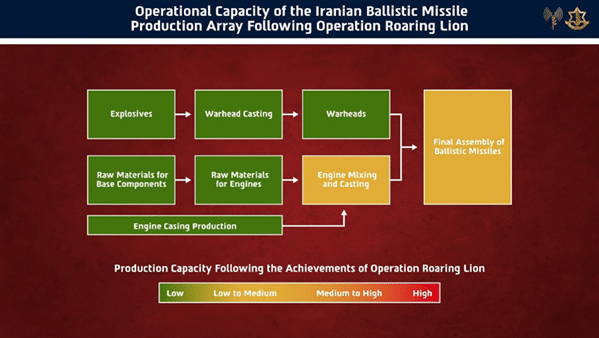
According to estimates by the IDF and the US Central Command, on the eve of the campaign in February 2026, the Iranian missile stockpile stood at about 2,500 missiles available for launch. At the end of April 2026, after joint Israeli and US forces carried out thousands of dedicated strikes against the missile program and IRGC sites responsible for the missile program, about 60% of Iran’s launcher array was destroyed.
Additionally, a number of launchers were “neutralized” temporarily, meaning they were buried under earth and rubble following bombings, but the Iranians have the ability to rehabilitate some of these underground launchers.
Estimates point to the destruction of about 190 launchers, with only about 120 operational launchers remaining in Tehran’s hands. Furthermore, over 700 ballistic missiles were destroyed in underground storage facilities prior to their launch, and about 1,500 missiles that were in production processes were completely destroyed. There is no precise public estimate of missiles remaining in the hands of the regime, but the number of launchers represents a bottleneck in firing capacity.
Diplomacy in the Shadow of the Blockade: The Islamabad Talks Channel
In an attempt to convert the coalition’s immense kinetic achievements into a diplomatic settlement ensuring the dismantling of the nuclear threat, a talks channel was opened under the naval blockade. After President Trump set a series of ultimatums to Tehran (March 21, then March 23, and finally April 7) and warned that he would act to destroy Iranian energy infrastructures and “destroy an entire civilization” if Tehran did not surrender, Pakistan mediated a temporary two-week ceasefire agreement starting April 8. The ceasefire was intended to allow the opening of the Islamabad talks on April 11-12, 2026.
The Trump administration’s demands, dubbed “The Red Line,” are clear: total dismantling of the Iranian nuclear program (“zero enrichment” and not a freeze as the old 2015 agreement demanded), delivery of all enriched uranium stockpiles in Iran’s possession into American or international hands, and the cessation of the Shiite axis’s involvement in the region.
Trump dispatched Vice President JD Vance and his advisors, Jared Kushner and Steve Witkoff, as special representatives to the talks in Pakistan against Iranian Foreign Minister Abbas Araghchi.
A fundamental and deep gap is evident in the versions published by the parties of the draft agreements under discussion. While the announcements by Iranian diplomats in English avoided mentioning the enrichment issue, the version published in Persian by Iran contained a clause speaking of “acceptance of [the right to] enrichment” by the West. This contradiction led the Trump administration to declare the Iranian announcements a “fraud” and to reject any compromise that would leave military or breakout nuclear capabilities in Tehran’s hands. Simultaneously, in an attempt to cool oil prices, the administration approved a $10 billion sanctions waiver within the framework of a temporary 30-day truce for the approval of certain energy deals, a step that drew fierce criticism from hawkish elements in Congress claiming it provides an economic “oxygen tank” to a collapsing regime.
According to a Pentagon estimate, as reported on the Axios website, the blockade so far has cost Iran $4.8 billion.
Rehabilitation Efforts
Recent intelligence from April 2026 shows that Iran is utilizing the ceasefire days to reorganize its tactical ranks. IRGC engineering units, using heavy equipment, are working vigorously in the Southern Sector of Iran to reopen entrances to tunnels and underground missile bunkers whose access shafts collapsed as a result of the bombings. These efforts are focused on creating concealed launch positions and reorganizing short-range launch capabilities toward the Gulf states. These capabilities were already activated on May 4, 2026, when Iran fired missiles and UAVs at targets in the UAE, after the US sank several Iranian boats that tried to interfere with US efforts to open a sea route for energy exports of the GCC countries.
At the same time, feverish attempts are being made to funnel electronic spare parts and engine components through remaining smuggling networks, despite the Western blockade. However, it is important to distinguish between the Iranian attempt to put neutralized launchers back into service on one hand, and to produce new missile capabilities from scratch on the other. Iran is doing the rehabilitation; it cannot do the production under current conditions.
The Energy Sector, Naval Blockade, and the Struggle over the Strait of Hormuz
Iran’s economy, which relies almost entirely on maritime trade through the Strait of Hormuz (over 90% of foreign trade and oil exports), stands before a broken trough. The US Navy imposed a blockade on Iran’s ports, with its forces preventing the entry and exit of commercial and military vessels from the Islamic Republic. This blockade, which denies Iran the ability to access open Gulf waters on a regular basis, has led to a total collapse in revenues. The Iranian economy is bleeding due to the closure, which prevents not only oil exports but also the import of essential equipment, food, and medicine to the country, creating a chain reaction of a civilian and economic crisis.
The oil export industry, which had already suffered from attacks, has frozen. Precise strikes destroyed the hubs of the petrochemical industry and neutralized 8% of the national petrochemical export capacity and about 70% of local steel production (damage of tens of billions of dollars). As a result of the inability to send tankers to international destinations (such as China), land storage facilities on Kharg Island reached full capacity.
The logistical distress forced Iran to bring back from retirement 30-year-old obsolete oil tankers (such as the tanker “NASHA”) in order to use them as floating storage facilities in Gulf waters. According to several reports, stopping the oil extraction process from Iranian oil fields may cause irreversible damage to the energy infrastructure.
In an attempt to test the blockade, the Iranian cargo ship “Touska” ignored instructions and tried to break through the US Navy’s blocking ring in the Strait of Hormuz. After six hours of ignoring warnings, American forces opened fire toward the ship’s engine room from the deck of the amphibious assault ship USS Tripoli. A force of Marines carried out a boarding and took control of the ship. This event served as a resolute illustration of the US’s willingness to enforce President Trump’s “Red Line” policy even at the cost of direct physical strikes. Simultaneously, American forces continued to confiscate ships of the Iranian “shadow fleet” that tried to smuggle oil.
Against the American blockade, Iran is employing a tactic familiar from the “Tanker War” period of the 1980s. Then, Iran operated from islands such as Farsi Island using small, fast boats and covert mining against foreign traffic. Today, the IRGC Navy (IRGCN), despite having over 100 vessels destroyed – including all Soleimani-class stealth ships and the frigate Dena – maintains a level of selective tactical disruption in the Strait of Hormuz. However, this capability is mostly limited to machine-gun fire from small boats, as cruise missile bases on the Iranian coastline were destroyed by the US, and Iran lacks the ability to build a maritime picture without aerial control over the Strait of Hormuz to hit ships, which are moving targets, from a distance.
During the April ceasefire, IRGCN boats demanded that commercial tankers provide crew lists, cargo documents, and sailing destinations as a condition for quiet passage.
The Iranian Economy, “Economic Fury,” and Intra-State Stability
The consequences of the bombings and the naval blockade on the Iranian economy are catastrophic in historical terms. According to financial experts who took part in the talks (such as sanctions expert Miad Maleki from the FDD institute in Washington), Iran lost about 40% of its GDP from before the war, with FDD estimates ranging between $50 and $300 billion, and the most reasonable estimate in their view being $144 billion in economic damage as a result of the war alone (not including the blockade damage that followed).
The loss of oil revenues (estimated at hundreds of millions of dollars per day), combined with the destruction of refineries and power sites in complexes such as Isfahan, severely damaged the financial base sustaining the Islamic Republic.
The substantial innovation in the economic campaign of April 2026 comes from the US Treasury Department and Treasury Secretary Scott Bessent, who announced the expansion of the campaign under the umbrella “Economic Fury”. The goal is to destroy Iranian “shadow banking” networks, which were used for years to bypass sanctions and to funnel salaries to the Revolutionary Guards and militias, after physical banks such as “Bank Sepah” in Tehran were destroyed by airstrikes.
The Office of Foreign Assets Control (OFAC) of the US Treasury Department operated in conjunction with cyber arms and ordered an immediate international freeze of over $4.2 billion in crypto assets (Cryptocurrency) on decentralized exchange platforms (DeFi) identified as Iranian money laundries. As part of this operation, $344 million in digital currencies held in cryptographic wallets directly owned by Iranian state entities were frozen.
The erosion of currency value has reached inconceivable dimensions. Simultaneously, demoralization and delays in salary payments to the police forces (the Basij) and the remaining security forces prevail.
The regime responds to any sign of civilian unrest by increasing repression, using the state of emergency to implement unrestrained violence against opponents and opposition activity.
Sources
- https://x.com/TheGoodISIS/status/2041955631683240355
- https://www.fdd.org/analysis/2026/04/23/total-iran-economic-damage-estimate/
- https://x.com/miadmaleki/status/2040499415744754016
- https://www.gov.il/he/pages/event-declarations190426
- https://en.wikipedia.org/wiki/List_of_attacks_during_the_2026_Iran_war
- https://en.wikipedia.org/wiki/2026_Iran_war
- https://en.wikipedia.org/wiki/2025%E2%80%932026_Iran%E2%80%93United_States_negotiations
- https://www.pbs.org/newshour/world/much-remains-unclear-after-u-s-israel-and-iran-agree-to-a-2-week-ceasefire
- https://www.aljazeera.com/news/liveblog/2026/4/17/iran-war-live-ceasefire-starts-in-lebanon-as-trump-says-tehran-deal-close
- https://www.britannica.com/question/What-is-Operation-Epic-Fury
- https://www.whitehouse.gov/releases/2026/03/peace-through-strength-president-trump-launches-operation-epic-fury-to-crush-iranian-regime-end-nuclear-threat/
- https://www.war.gov/News/Transcripts/Transcript/Article/4418959/secretary-of-war-pete-hegseth-and-chairman-of-the-joint-chiefs-of-staff-gen-dan/
- https://commonslibrary.parliament.uk/research-briefings/cbp-10637/
- https://www.strategicfront.org/forums/threads/israel-us-strike-iran-after-weeks-of-warning-explosions-heard-in-tehran.5501/page-91
- https://timesofindia.indiatimes.com/business/india-business/gold-price-prediction-today-india-where-is-gold-silver-rate-headed-on-april-22-2026-mcx-gold-futures-outlook-us-iran-war-middle-east-tensions/articleshow/130432995.cms
- https://www.axios.com/2026/05/01/us-blockade-oman-cost-iran-5-million




One Response
How did Iran,not Syria thru Hezbollah gain such control,political and Militarily get control of Lebanon. Especially right under the noses of the Israeli so close to the war in Lebanon under the Gemayel brothers . Why did Sharon and Begin recognize this and destroy Hebollah