Since the beginning of the ceasefire in northern Israel (April 17, 2026), there has been clear continuity—and even a gradual escalation—in Hezbollah’s patterns of operation. Analysis of the organization’s activity indicates the continuation of systematic offensive operations, primarily targeting IDF forces operating in southern Lebanon, alongside increased use of UAVs and drones and a steady rise in the tempo of attacks.
At the same time, a controlled level of friction is maintained vis-à-vis the Israeli home front, primarily in border-adjacent communities, enabling Hezbollah to exert sustained pressure without escalating into a large-scale conflict. This pattern indicates that Hezbollah continues to employ force in a constant and systematic manner, exploiting the operational space created by the ceasefire, while not stopping hostilities in practice.
Analysis of Hezbollah’s operational behavior does not indicate a consistent effort to establish a clear “equation of responses” vis-à-vis Israel, as observed in previous confrontations. Instead, the organization operates through a sequence of attacks that are not necessarily reactive to a specific trigger but rather constitute an independent and ongoing pattern of activity.
Focus of Attacks: IDF Forces in Southern Lebanon
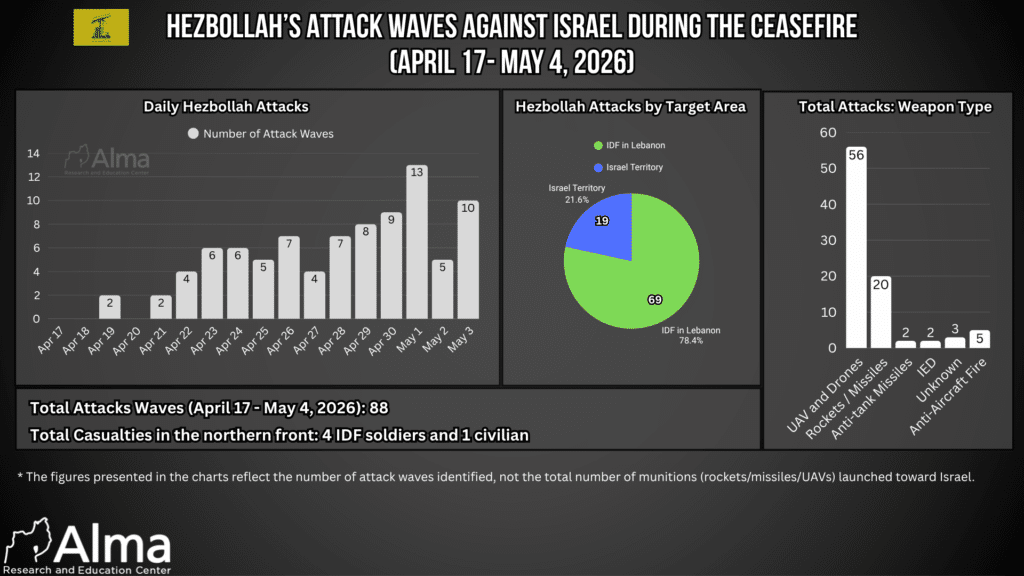
The majority of Hezbollah’s attacks are directed at IDF forces operating in southern Lebanon. In this context, a notable concentration of attacks is observed in specific areas: Ras al-Bayyda– 16 attacks, Qantara – 16 attacks. These villages are located along the frontline in southern Lebanon and constitute areas of direct friction where IDF forces operate, explaining both the high volume of activity and Hezbollah’s focused targeting in these sectors.
Means of Warfare: Dominance of UAVs and Drones
One of the most prominent characteristics of Hezbollah’s activity during the examined period is the dominance of UAVs and drones. Most attacks—both against IDF forces in southern Lebanon and those directed at Israeli territory—were carried out using these means, while the use of rockets remained secondary in scope. Specifically, of the attacks directed at Israel, 14 were conducted using UAVs and drones, while only 5 involved rocket fire.
This preference reflects Hezbollah’s operational adaptation to the current environment, leveraging the advantages of drones—high precision, difficulty of early detection, the ability to sustain low-intensity friction over time, and a significant psychological impact (particularly due to real-time documentation and dissemination of attack footage).
It should be noted that this is not a new phenomenon: Hezbollah employed explosive drones and UAVs during the previous conflict in 2024 as well; however, the current period reflects an expansion and deepening of this operational pattern.
Rising Trend in Attack Rate
A chronological analysis of attacks since the beginning of the ceasefire indicates a clear upward trend in Hezbollah’s daily operational rate. While the initial phase was characterized by relatively limited activity, the later stage shows a more consistent and elevated rate of attacks.
Attacks into Israeli Territory
During the period, 19 attacks were recorded against Israeli territory, all targeting border-adjacent communities. Of these, 14 were conducted using UAVs and drones, and 5 via rocket fire.
A notable feature is Hezbollah’s limited assumption of responsibility: only in two cases did the organization publicly claim responsibility—one targeting a military objective in the area of Kfar Giladi, and another targeting the civilian community of Shtula, for which Hezbollah explicitly declared it had struck a civilian target. This pattern reflects the use of controlled ambiguity, enabling continued offensive activity while managing exposure and escalation in the informational domain.
It should be emphasized that the data do not include several additional incidents in which UAVs were launched toward IDF forces in southern Lebanon, but triggered alerts in nearby Israeli communities due to interceptions.
Casualties
To date, 4 IDF soldiers and one civilian (an IDF employee) have been killed. Two of the fatalities were caused by explosive devices, and three resulted from explosive drone strikes.