
Recently, we have been witnessing a mindset along with statements regarding Hezbollah’s condition and status in Lebanon. We found it appropriate to address the main points, from our perspective and as of the time of the writing:
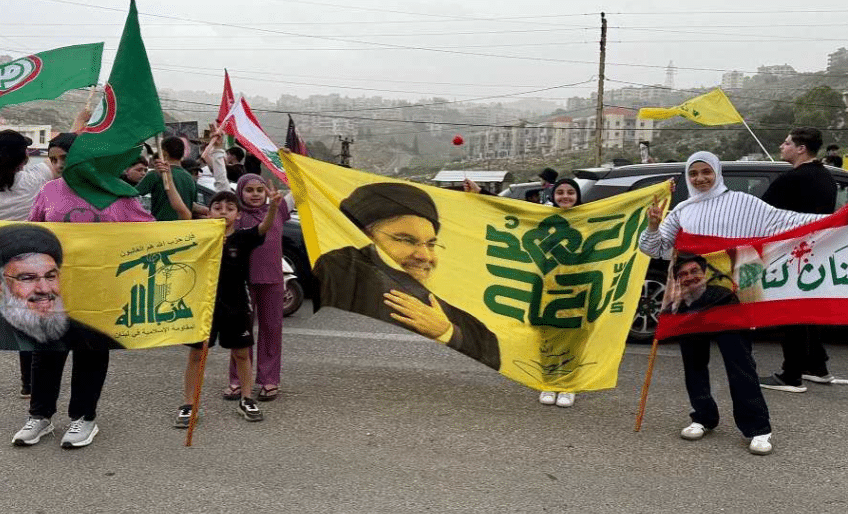
There is no process of collapse in support for Hezbollah from within its base. The claim that Hezbollah is gradually losing its Shiite base in Lebanon and is even dealing with a severe split between itself and Amal, does not reflect the reality on the ground. There is no doubt that the continuous fighting from October 2023 until today has severely harmed the Shiite public – economically, socially, and civically – but this damage, as of now, has not manifested itself into the beginning of a process of public collapse within the Shiite support base for Hezbollah as some attempt to portray.
The Shiite base is fortified in its support for the organization while becoming more radical and confrontational. If there is some degree of erosion in the organization’s standing among certain parts of the Shiite public, mainly due to the destruction, displacement, and difficult economic situation, then this is a very limited erosion (to say the least), and not a broad phenomenon of abandoning support for Hezbollah. In fact, among the organization’s core support base, the opposite trend is evident – radicalization, ideological fortification, and a confrontational outing initiated against Hezbollah’s opponents, especially vis-à-vis Christian elements in Lebanon.
It should be remembered that the Shiite base is Hezbollah’s “captive audience” due to ideology, dependency, and fear.
There is nothing new under the sun. No change in approach. The claim regarding a wave of a Shiite campaign against Hezbollah on social media is inaccurate. Most of the criticism against Hezbollah on social media comes from elements that are not part of the Shiite support base of the organization, but rather mainly from Christians, Sunnis, and long-standing well-known opponents of Hezbollah. That is: the escalation in public criticism in Lebanon against Hezbollah comes from those who have always criticized Hezbollah in the harshest manner. There is nothing new under the sun. There is no change in approach.
The large social media campaign under the slogan “No to the Destruction of Lebanon – Lebanon First” is likewise not a new development resulting from the current war. Rather, it is a relatively longstanding campaign that began as early as 2024 and has been driven primarily by Christian circles and longstanding opponents of Hezbollah, not by the organization’s Shiite support base.
Rifts within the Shiite base? Indeed, there are isolated Shiite voices criticizing the organization, but they do not represent a broad trend within the Shiite street. These are usually confrontational Shiite journalists/influencers who are well known for their opposition to Hezbollah. These cannot be considered rifts within the base.
Sometimes examples from the field are cited as evidence of a weakening in Hezbollah’s standing within its Shiite base. However, a closer examination of some of these cases suggests otherwise. For example, one widely circulated video shows an elderly Shiite man from southern Lebanon describing his dire circumstances and saying that “at my age, it is better to die than to live like this.” While he laments his personal hardship, the destruction, and the suffering around him, he neither criticizes Hezbollah nor even mentions the organization. In other words, this reflects civilian despair and exhaustion, not necessarily a political or ideological rejection of Hezbollah.
Another example is a recording by Ali Al-Zahra, a Shiite figure close to the organization and a well-known social activist. Here too, the remarks were presented and interpreted only partially.
Al-Zahra does not criticize Hezbollah in the recording; rather, he criticizes Iran for allegedly having “abandoned” Hezbollah to fight alone in southern Lebanon. In essence, his criticism centers on why the “unity of the arenas” promoted by the Axis of Resistance did not materialize in practice.
In another recording, the remarks are seemingly directed at Hezbollah and the “resistance,” although the speaker does not explicitly mention them by name. He asks: what was all of this for? For Iran? For Gaza? We lost everything, we lost our young men… However, we strongly question the authenticity of this recording Because of its audio quality.
The issue of displaced civilians is also often portrayed in a misleading way. Since the majority of residents in southern Lebanon and the Dahieh are Shiites, it naturally follows that most of those displaced by the war would also be Shiites. This fact alone does not point to opposition to Hezbollah. On the contrary, during and after the war, numerous videos and social media posts circulated featuring displaced Shiites openly expressing their willingness to sacrifice their lives for the “resistance,” endure prolonged displacement, and upon returning to southern Lebanon they hoisted Hezbollah flags on their vehicles expressing a sense of “victory.”
Is there a split within the Shiite community? The statements that presented the “Supreme Islamic Shiite Council” in Lebanon (المجلس الإسلامي الشيعي الأعلى) as a litmus test for a split within the Shiite community also present an inaccurate picture. The “Supreme Islamic Shiite Council” is the official religious-political body of the Shiite community in Lebanon. Traditionally, control over the council’s institutions is divided between the Amal Movement and Hezbollah. Therefore, at times, an impression of struggles over influence and appointments between the two sides is created. However, this is not a real “split” within the Shiite community, but rather internal power struggles over representation, influence, and centers of control within the Shiite camp itself.
In addition, attention should be paid to the fact that Nabih Berri – the most senior and stable Shiite figure in the Lebanese political system and the central liaison of the “Shiite duo” with the Lebanese government and also with the United States – continues to conduct himself with the utmost caution regarding Hezbollah. It appears that, as usual, Berri is playing both sides and de facto acting to preserve Hezbollah’s interests.
Hezbollah’s economic situation. Here there is indeed a basis for assessing that the organization has been significantly harmed. The damage to the “Qard al-Hassan” bank, the “Al-Amana” gas stations, the weakening of smuggling routes and the Captagon market following the rise of Ahmad al-Sharaa in Syria and the intensifying struggle against smuggling, alongside the difficult economic situation in Iran itself and the consequences of the war – all these indeed complicate and challenge Hezbollah regarding its economic balance. This is reflected on the ground in regard to compensation payments to evacuees, victims, families of shahids, and salaries for the organization’s operatives themselves. However, as we noted, unfortunately, Hezbollah is not losing its Shiite base…



One Response
Dear Tal,
The radical shiite jihaddists are driven by hezbollah ideology shared by the ayatollah, the IRGC and all their proxies. Death to Israel has been chanted for 47 consecutive years. The youth have been radicalized from their mother’s milk, mothers holding them up as infants to become future martyrs of death as terrorists. Hezbollah must be defunded and destroyed to bring peace.