
Sarit Zehavi and Dr. Zoe Levornik
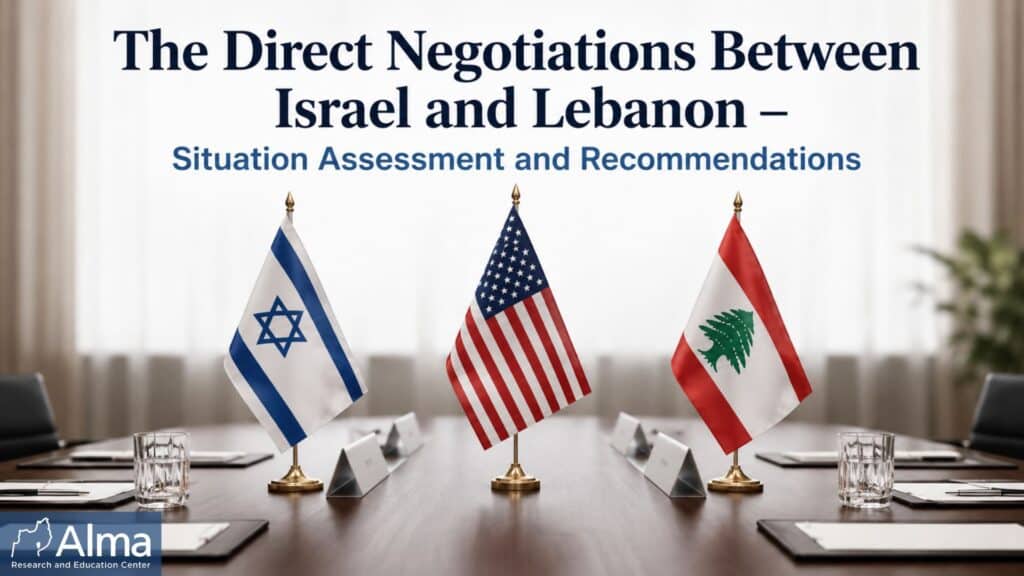
While the IDF and Hezbollah continue exchanging daily attacks, despite the ceasefire that came into effect on the night between April 17 and 18, the third round of direct talks between Israel and Lebanon, mediated by the United States, took place on May 14–15.
The U.S. State Department described the meeting as “productive talks” and announced a 45-day extension of the ceasefire agreement in order to allow progress in the negotiations. According to the established timetable, discussions on the political-diplomatic track are expected to continue in June, while the security track — the central and most sensitive component — is expected to begin on May 29.
Despite the symbolic and political significance of holding direct talks between Israel and Lebanon, the likelihood that the negotiations will produce a peace agreement that meets the security needs of both sides is extremely low. The gaps between the parties’ demands are substantial, their fundamental approaches are contradictory, and in addition, the Lebanese government faces a fundamental difficulty in actually implementing security commitments, even in cases where there is a certain degree of political willingness.
The Lebanese government and the Lebanese Armed Forces, fearing a descent into civil war, are unwilling to engage in a direct confrontation with Hezbollah. Hezbollah, for its part, refuses to disarm and to recognize a Lebanese-Israeli agreement that acknowledges the existence of the State of Israel. Israel, meanwhile, will not again allow the rebuilding of Hezbollah’s military capabilities in a way that would pose a threat to it. Under these circumstances, it is difficult to see how stability and reconstruction can be achieved on both sides of the border, or how a fundamental change can occur both in the status of Lebanese state sovereignty and in Israel-Lebanon relations.
The Demands of the Parties Involved
The official Lebanese position focuses on demanding a full Israeli withdrawal from all Lebanese territory, transferring security responsibility in the south to the Lebanese Army, preserving Lebanese sovereignty, returning displaced residents, and rebuilding the southern region. At the same time, Beirut declares its commitment to the principle of the state’s exclusive right to use force and argues that there should be no place for non-state armed groups in Lebanon.
However, there is a deep gap between these declarations and the reality on the ground. While the Lebanese government formally adopts the principle of state sovereignty, in practice it does not enforce it against Hezbollah, the country’s most powerful military, political, and social organization, which has been part of most Lebanese governments over the past twenty years. This reality has characterized the conduct of the Lebanese government ever since the first decision calling for Hezbollah’s disarmament (as well as that of the other armed militias in Lebanon) was adopted in 2004, following the assassination of Prime Minister Rafik Hariri by Hezbollah. This refers to UN Security Council Resolution 1559.
Israel, on the other hand, demands the actual and verifiable disarmament of Hezbollah as a precondition for any withdrawal from southern Lebanon or any halt to the attacks. From Israel’s perspective, any arrangement that does not fundamentally address Hezbollah’s military capabilities will at best create a temporary pause rather than a strategic change. This is because Hezbollah, as a proxy of the Islamic Republic of Iran, seeks the destruction of the State of Israel and has therefore launched wars against it three times: in 2006, 2023, and 2026. During the periods between these wars, it continued building military capabilities for invasion operations and for launching missiles and UAVs.
Hezbollah itself rejects outright the very existence of direct negotiations between Israel and Lebanon and makes clear that it will not recognize any agreement reached as part of these negotiations. In a statement on May 12, the organization’s Secretary-General, Naim Qassem, emphasized that from Hezbollah’s perspective, only indirect negotiations with Israel are possible. According to him, the very holding of direct talks constitutes a “net gain for Israel” and “free concessions” by the Lebanese state.
Qassem further clarified that the issue of Hezbollah’s weapons is not part of the negotiations with Israel but rather “an internal Lebanese matter,” which could only be discussed within a future Lebanese national security strategy, and even then while preserving the “resistance.” In addition, the organization reiterated its standing demands: an end to Israeli activity on land, in the air, and at sea; a full withdrawal from all Lebanese territory; the deployment of the Lebanese Army south of the Litani River; the release of prisoners; the return of residents; and extensive reconstruction of the combat zones.
Hezbollah argues that conducting direct negotiations with Israel represents the Lebanese government’s surrender to external pressure and to the interests of the United States and Israel, as well as a betrayal of the Lebanese people by their government.
Limitations of the American Approach
The American and broader international approach is primarily based on attempts to strengthen Lebanese state institutions through economic investments, training programs, and support for the Lebanese Army, based on the assumption that strengthening the state will, over the long term, also reduce Hezbollah’s power.
However, past experience shows that the central problem is not only the capabilities of the Lebanese Army, but mainly the lack of willingness to use force against Hezbollah. The fear of sliding into an internal confrontation and even civil war, the sectarian structure of the Lebanese Army, in which nearly half of the soldiers and officers are Shiites, many of whom have family ties to Hezbollah operatives, the direct and indirect connections between elements within the army and Hezbollah, as well as the conciliatory policy led by Army Commander Rudolph Haykal — all of these create deep structural limitations that cannot be solved simply by increasing budgets or supplying equipment.
In practice, the international community continues to view the Lebanese Army as a future alternative to Hezbollah in southern Lebanon, while under current conditions the Lebanese Army operates in coordination with, in containment of, or while turning a blind eye to the organization’s activities. In addition, it assists Hezbollah in concealing its weapons stockpiles and military activity in southern Lebanon.
The Security Reality Behind the Negotiations
Since the ceasefire was declared in April and up to the time of writing, Hezbollah has carried out 384 waves of attacks against Israel, with a focus on IDF forces operating in southern Lebanon. Israel, for its part, has conducted 534 waves of airstrikes, including one in Beirut and 15 in the Beqaa Valley.
Recommendations
Israel has a clear interest in maintaining a diplomatic channel with the Lebanese government, both for coordination purposes and in order to preserve international legitimacy for its security operations. However, a political agreement with the Lebanese government should not be viewed at this stage as a mechanism capable of producing a fundamental change in the security reality.
Even if an agreement is signed between Israel and Lebanon, the likelihood that it will lead to the effective disarmament of Hezbollah, a significant reduction in its power, or security for the residents of northern Israel is extremely low, if it exists at all. Moreover, as long as Hezbollah continues to function as a “state within a state,” both militarily and through the civilian services it provides to its support base, no fundamental change will occur in Lebanon. Any agreement with Israel will remain merely on paper.
Therefore, the IDF must be allowed operational freedom against Hezbollah in Lebanon in order to continue the policy of strategically weakening the organization. This should include consistent strikes against Hezbollah’s centers of power: its leadership, command structures, production infrastructure, smuggling routes, weapons stockpiles, force-building capabilities, and civilian infrastructure.
Every day that passes under the ceasefire in Beirut and the Beqaa Valley is another day in which Hezbollah grows stronger. Financial activity, weapons production and smuggling, and the training of operatives and commanders, alongside the renewal of operational plans against Israel, all continue uninterrupted. In practice, this prolongs the fighting in southern Lebanon and enables Hezbollah to prepare for a prolonged but limited confrontation with Israel.
In the report we published last month regarding the objectives of the negotiations, we clarified that strengthening the Lebanese Army alone does not constitute a solution. It must be accompanied by a combined effort alongside Israel’s military activity: the fall of the Islamic Republic of Iran, clear and determined action by the international community against Hezbollah’s financial operations around the world, and pressure on the Lebanese government to move from words to actions. This is also necessary in order to build relations and trust with Israel and eventually reach some form of understandings agreement that will be worth the paper it is signed on.


One Response
Dear Sarit and Dr Zoe,
To negotiate with Lebanon in its current state of occupation by the cancerous, destabilizing hezbollah is akin to negotiating with a terminal cancer patient hours from death. First we must kill and remove the cancer. Restructuring of the Lebanese government can then begin. Only then can Israel-Lebanon negotiations begin.