
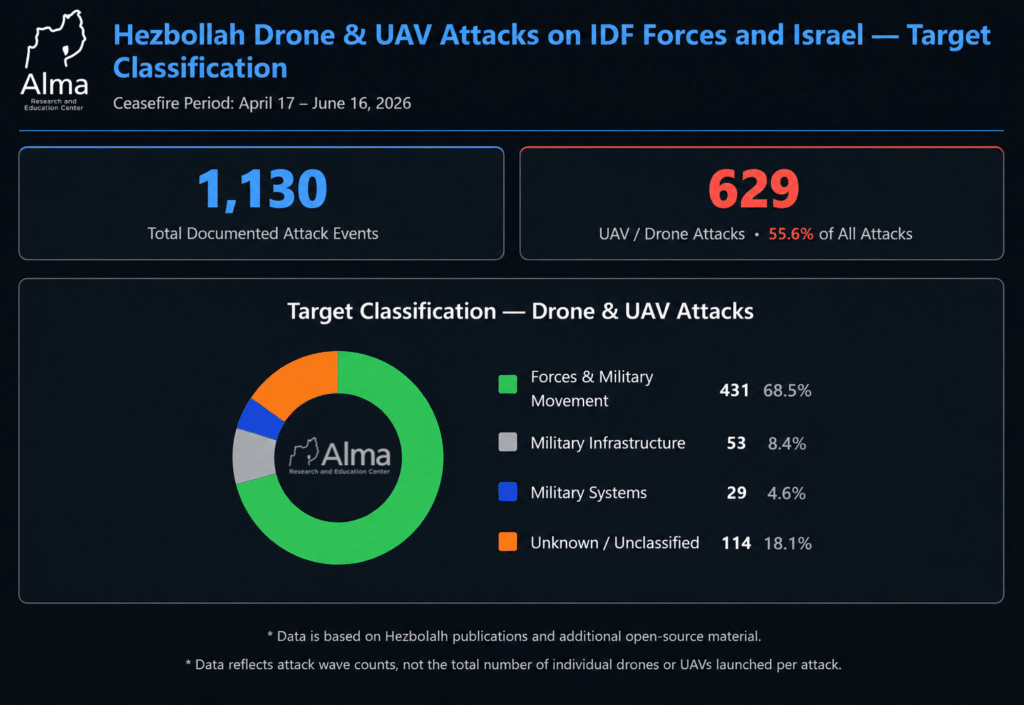
From the beginning of the ceasefire until today (April 17 – June 15, 2026), Hezbollah carried out a total of 1,130 attacks against Israel. Of these, 629 involved UAVs and drones, constituting 55.6% of all attacks.
The following is a classification of the targets attacked using UAVs and drones, based on Hezbollah publications and additional open-source material:
Military forces and movement – 68.5% (431 attacks): This category includes attacks against military forces in motion and troop concentrations, as well as various types of military vehicles, including armored vehicles (tanks, APCs, and Namer APCs), tactical and logistical vehicles such as Humvees and trucks, and engineering vehicles such as D9 bulldozers and other heavy engineering equipment.
The high rate of attacks in this category, which accounts for more than two-thirds of all UAV and drone attacks, indicates that Hezbollah concentrated its attack efforts on targeting IDF forces operating in the field, in an attempt to erode their operational freedom of action, damage weapons and mobility assets, and cause casualties among combat forces.
Military infrastructure and facilities – 8.4% (53 attacks): This category includes attacks against outposts, headquarters, military positions, bases, and other military facilities. The scope of attacks in this category indicates a secondary but consistent Hezbollah effort to damage the IDF’s fixed military infrastructure and its command-and-control centers.
Military systems – 4.6% (29 attacks): This category includes attacks against military technological systems and equipment, including cameras and observation assets, communications systems, jamming systems, Iron Dome batteries, and other technological assets. Although the number of attacks in this category is relatively low, it reflects an attempt to damage technological systems that support IDF operational activity, particularly detection, warning, and defense capabilities.
Unidentified / unclassified – 18.1% (114 attacks): Incidents in which it was not possible to determine the target of the attack due to a lack of information or insufficient details for target classification.
The fact that approximately 68.5% of attacks carried out using UAVs and drones were directed against forces, vehicles, and military movement indicates that Hezbollah’s main attack effort is focused on mobile battlefield targets rather than fixed targets.
This finding requires a deeper examination of the FPV drone threat, which is particularly suited to the real-time detection and attack of such targets. Accordingly, and based on additional open sources, FPV drones played a central role in many of Hezbollah’s attacks.
Unlike UAVs, which are usually employed against targets whose location is known in advance, FPV drones allow the operator to identify targets in real time, track their movement, and carry out a precise strike after locating them in the field. This capability makes them particularly effective against personnel, vehicles, and forces in motion.
By contrast, UAVs with a preplanned flight path are better suited to attacking fixed targets such as bases, outposts, and military infrastructure, where the target location is known in advance and can be entered before launch.
Since many attacks are based on the real-time detection and identification of forces and vehicles in the field, the central question is not only what targets are being attacked, but how they are exposed in the first place to the drone operator. Understanding these detection mechanisms is the basis for developing effective tactics to reduce exposure and lower the risk of attack (see Appendix – Exposure-Reduction Tactics).
FPV Drone Detection Mechanisms
Open-source material from the Russia–Ukraine war indicates that FPV drones rely on three main detection channels: optical/visual, thermal, and electromagnetic.
Based on open-source information, Hezbollah’s drones rely on the optical channel )daylight camera( which is based on direct real-time observation by the drone operator. Attack FPV drones may be equipped with relatively simple analogy cameras or higher-quality digital cameras.
During the current conflict with Hezbollah, assessments have emerged regarding the possible use of night-vision capabilities, partly in light of attacks conducted during hours of darkness and at least five videos of alleged nighttime strikes published by Hezbollah’s Military Media Unit. However, there is currently no formal public information that would allow this to be determined with certainty.
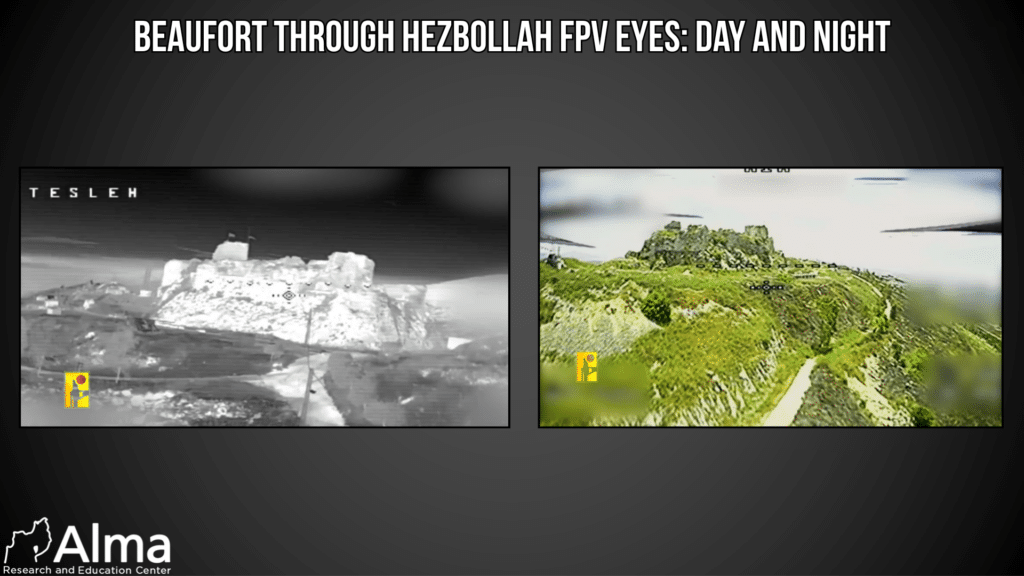
Optical detection (daylight camera): FPV drones rely mainly on daylight cameras that allow the operator to identify targets based on visual characteristics. The detection process is based on identifying movement, unusual shapes in the landscape, vehicles, people, weapons, and military equipment. In addition, objects with straight lines, symmetrical shapes, high contrast with the environment, or reflective surfaces may stand out and make target detection easier.
Thermal detection (thermal cameras – not known whether Hezbollah possesses this capability): Thermal systems identify targets through heat emissions rather than visual appearance. Therefore, even when a person, vehicle, or piece of equipment is partially concealed from sight, its heat signature may reveal its location. Heat sources such as the human body, running engines, and electronic equipment may indicate the presence of a force or activity in the field.
Electromagnetic detection (not known whether Hezbollah possesses this capability): Electromagnetic detection is based on receiving signals emitted by electronic devices and communications systems. These signals may originate from mobile phones, communications devices, navigation systems, and other electronic equipment. In cases where the capability exists to detect such signals, they may serve as an indication of the location and activity of forces in the field.
The operational implication is that protection against FPV drones is not limited to physical concealment alone. To reduce the likelihood of detection and attack, it is necessary to simultaneously reduce the visual, thermal, and electromagnetic signatures of the force operating in the field.
Appendix – Exposure-Reduction Tactics
Optical Detection
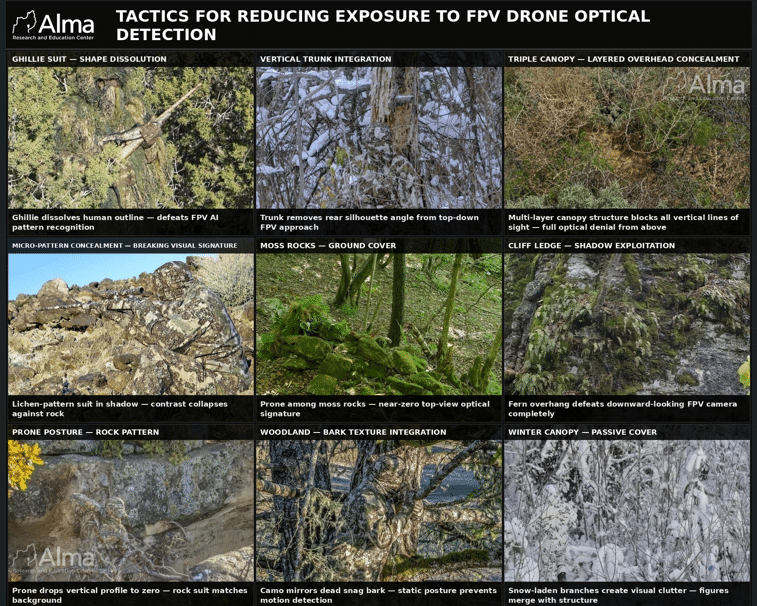
Since the optical detection channel is likely the main detection channel used by Hezbollah drone operators, particular importance should be placed on reducing the visual signature of forces in the field.
Exposure reduction:
- Use camouflage adapted to the environment: match camouflage colors and patterns to the terrain.
- Break up silhouettes and outlines: drone operators look for shapes associated with people and military equipment.
- Use shade and natural cover: shaded areas created by buildings, trees, rocks, or terrain features may make detection by daylight cameras more difficult.
- Avoid movement in open areas: movement is one of the most prominent factors for aerial detection.
- Cover reflective surfaces: glasses, screens, watches, metal parts, and other shiny surfaces may create light reflections visible from a long distance.
It is important to remember that the drone operator does not see the entire battlefield, but only what appears within the limited field of view of the drone camera. In addition, the operator does not receive sound from the surrounding environment and effectively operates based only on the image received from the camera. These limitations make well-camouflaged targets harder to identify and increase the importance of camouflage, concealment, and use of terrain.
Thermal Detection
There is currently no public information indicating that Hezbollah operates drones with thermal capabilities. However, this is a relevant capability on the modern battlefield.
Exposure reduction:
- Use natural cover and covered terrain, while staying in dug-in positions as much as possible: soil provides effective thermal insulation, and ground temperature at a depth of around one meter tends to remain stable relative to the surrounding environment. To increase effectiveness, the position should be covered with vegetation, branches, and leaves in a way that blends into the natural surroundings.
- Use natural heat barriers: thermal cameras have difficulty detecting targets hidden behind thick concrete, covered terrain features, or dense vegetation. However, concealment of the target alone is not always sufficient, since the camera may detect heat emitted through openings, ventilation shafts, or other areas through which heat escapes into the environment.
- Use dedicated means to reduce thermal signature: measures based on radiation-reflective materials, such as Mylar blankets, may reduce the thermal signature when they create a separation layer between the heat source and the environment. Their effectiveness is greater when combined with an air gap and external camouflage using branches, leaves, or camouflage netting, which reduce both the thermal signature and visual visibility.
Electromagnetic Detection
There is currently no public information indicating Hezbollah’s use of electromagnetic detection capabilities. However, this is a relevant capability on the modern battlefield.
Exposure reduction:
- Reduce the use of transmitting devices: mobile phones, smartwatches, Bluetooth earphones, radios, and other electronic equipment emit wireless signals that may expose the presence and location of the force.
- Fully power off nonessential equipment.
- Limit transmission duration: the use of communications equipment should be focused, brief, and purposeful, while reducing the exposure time created by operating transmitting devices.
- Reduce the cumulative electromagnetic signature: the greater the number of transmitting devices in an area, the greater the potential for exposure.
- Maintain operational awareness of signal exposure: similar to visual or thermal signatures, electronic signals may also indicate activity in the field. Therefore, the proper management of communications systems and electronic equipment is an integral part of reducing exposure.





2 Responses
The XM-25 ISAAS represents a weapons concept whose cancellation in 2018 was vindicated by programmatic failure rather than technological irrelevance. The battlefield of 2024–2026 has validated every aspect of the airburst grenadier concept and added a critical new mission: dismounted counter-drone engagement. The two technical modifications that transform the XM-25 from a defilade weapon into a credible anti-drone system are (1) replacement of the turns-counting programmable fuze with an RF proximity-sensing fuze (as demonstrated in the 25mm XM1228 BADGER and explicitly developed for the PGS PROX round), and (2) integration of AI-driven moving target fire control (SMASH X4 or equivalent). These are not exotic modifications — both technologies are mature, fielded at various scales, and already integrated into the XM-25’s direct successor program.
The Northrop Grumman/Colt Precision Grenadier System is the operational realization of this analysis, currently in prototype competition alongside 30mm alternatives from Barrett/MARS and FN America. The most consequential design decision separating PGS from its predecessors is the explicit C-UAS mission inclusion from the outset — ammunition, fire control, and doctrine all oriented from the start around the drone threat that killed the original XM-25’s program before the requirement even existed.
Dear Dana,
Thanks for all the technical analysis. I trust the IDF is currently stepping up the procurement and deployment of good countermeasures for all current and future threats. I believe the drones to be only a temporary threat, as current measures being employed will take them out of the threat status. God Bless the IDF!!!