
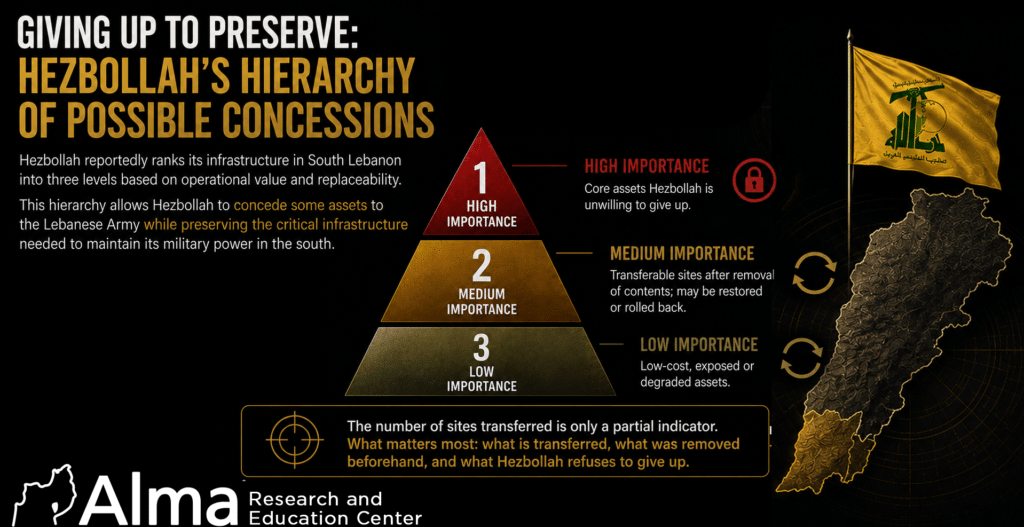
This week, it was reported in Lebanon that Hezbollah divides its infrastructure in the south of the country into three levels of importance, according to their operational value and its ability to replace them should it be forced to relinquish them.
This division may shed light on a possible course of action by Hezbollah aimed at countering the implementation of the agreement between Israel and Lebanon: creating a hierarchy of concessions that would allow it to hand over certain assets to the Lebanese Armed Forces, while at the same time preserving the infrastructure essential to its continued existence as a military force in the south.
Based on our understanding of the relationship between Hezbollah and the Lebanese Armed Forces, if such a handover takes place, it will only be possible as a result of a Hezbollah decision, and not because of an initiative or demand by the Lebanese Armed Forces.
According to the report, the lowest level consists of assets that Hezbollah is capable of relinquishing at a relatively low operational cost: small positions, limited weapons depots, observation posts, and facilities that were already exposed during the war and have lost their importance. Handing them over to the Lebanese Armed Forces may allow the organization to create a false impression of unwillingness to confront the Lebanese army (which is regarded as a consensus institution), without significantly impairing Hezbollah’s core capabilities. In all likelihood, although these assets contain only limited and basic weaponry, it will be returned to Hezbollah through a “revolving door” arrangement.
The second level includes ammunition depots, maintenance and supply facilities, staging points, launch positions, and short underground infrastructure. Hezbollah may be willing to relinquish some of these assets after removing their contents. In other words, transferring a site to the Lebanese army does not necessarily indicate that the capability it housed has been dismantled: the equipment can be relocated while preserving the option of restoring the site or establishing an alternative in the future. Alternatively, through the “revolving door” method, the site may later be “returned” to Hezbollah.
Conduct similar to that described in the two levels above was already observed in 2025, in a very limited number of documented cases in which the Lebanese Armed Forces arrived at Hezbollah sites, which were ostensibly “handed over” to them.
The highest level marks the limits of Hezbollah’s possible concessions. It includes operational centers of gravity such as command-and-control centers, strategic tunnels, depots containing high-quality weapons, and commanding sites that enable observation and the management of military activity. These are infrastructures that enable the organization to preserve command and control, survivability, high-quality weaponry, and control over the area – the skeleton upon which a military force can be rebuilt when necessary.
This hierarchy may therefore serve Hezbollah as a means of managing its assets selectively: handing over assets that have already been degraded, exposed, or are easy to replace; emptying medium-importance infrastructure of weapons and handing it over; and insisting on preserving the most essential assets. In this way, the organization could allow the Lebanese Armed Forces to expand their presence and demonstrate achievements on the ground, without necessarily relinquishing the infrastructure that would enable it to preserve and rebuild its military strength in the south.
It follows that the number of sites transferred to the Lebanese Armed Forces is only a partial measure of the implementation of the agreement. The more important questions are which infrastructures are being handed over, what was removed from them prior to the handover, and, above all, which assets Hezbollah is unwilling to relinquish. If the reported division indeed reflects the organization’s approach, it is precisely these assets that may indicate the core of the military power Hezbollah seeks to preserve in southern Lebanon.



One Response
Dear Dana,
To negotiate and reason together with pathological liars and murderers is also a form of self-delusion. Let us now rise above the insanity, defeat hezbollah to unconditional surrender, and end the conflict with Total Victory. Anything less is total misery.