
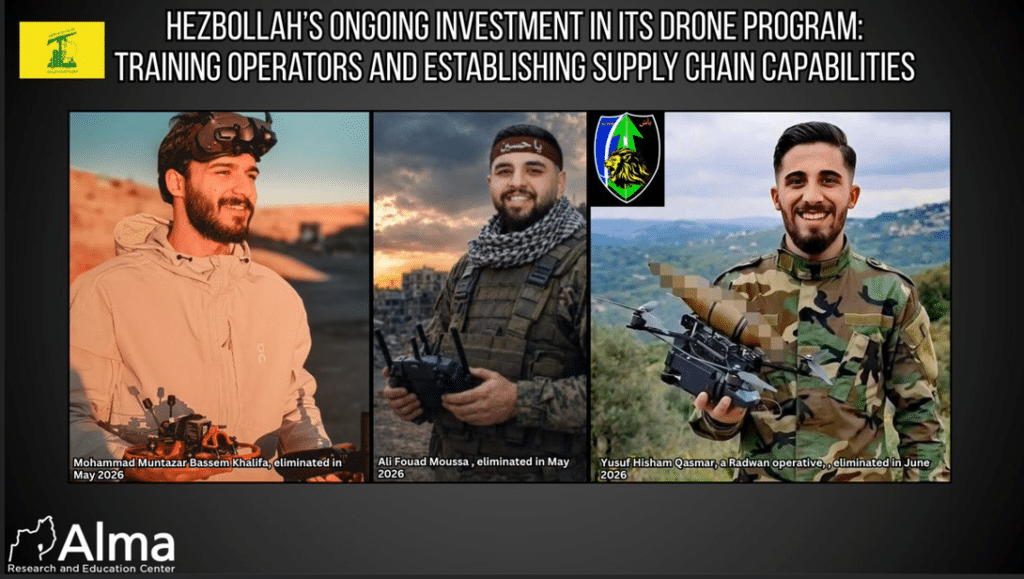
An analysis of Hezbollah’s operational patterns during the most recent campaign against Israel indicates the growing centrality of its drone force within the organization’s military activities.
Of the 1,163 attacks carried out by Hezbollah during the “ceasefire” period and until it ceased attacks against Israel (from April 17 to June 20, 2026), 637 attacks were conducted using drones and UAVs, accounting for 54.8% of all attacks. Most of these operations relied on FPV drones, which have become one of the organization’s most prominent combat tools.
The high proportion of drone and UAV attacks demonstrates that Hezbollah views these systems as a significant operational force multiplier. They provide the organization with a combination of precision, availability, lethality, and intelligence-gathering capabilities. In addition, they enable real-time documentation, which significantly contributes to Hezbollah’s information and influence campaign through the dissemination of footage from attacks.
These advantages have made the drone force one of Hezbollah’s key investment areas. As early as late 2024, the organization identified the drone force as a decisive capability in a future conflict.
In recent months, several operatives involved in drone operations for Hezbollah’s operational units have been eliminated. Hezbollah is actively working to build and maintain a dedicated drone force that will allow the organization to preserve and further develop its capabilities in this domain. Targeting these operatives is intended to undermine the expertise and manpower required to operate and sustain the drone force.
At the same time, a parallel logistical effort continues to support the development of this capability. An example can be found in a case recently uncovered in Lebanon, in which a businessman was investigated on suspicion of involvement in importing several shipments of electronic components from France allegedly intended for the production and assembly of drones for Hezbollah. According to reports, the shipments included ostensibly civilian-use items, such as motors and electronic components with a wide range of applications, which were allegedly procured and transferred through procurement networks operating in Europe and Lebanon. The case highlights the importance Hezbollah places on securing access to the components and technologies required to continue developing its drone capabilities.
The elimination of drone operators on the one hand, and the exposure of procurement and component-smuggling efforts on the other, reflect the two principal pillars upon which Hezbollah’s drone force relies: skilled personnel and a supporting logistical infrastructure. Together, these developments provide further indication that the organization continues to devote substantial resources and attention to this field.





2 Responses
Dear Dana,
Good work exposing hezbollah cancerous connections. Every connection must now be clearly verified, money traced, and operatives promptly eliminated. The appropriate commanding forces should determine if covert, overt operations or an overwhelming bombing campaign, or some combination of all three are needed for maximum immediate effect.
Since March 2026, Hezbollah’s drone campaign against Israeli forces in southern Lebanon has evolved to closely resemble tactics that emerged years earlier on the Russia-Ukraine battlefield: fiber-optic tethered FPV drones immune to electronic jamming, AI/CRPA-hardened long-range strike drones (via Iran’s Shahed-136 MS), saturation strike packages mixing decoys with lethal payloads, and an escalating counter-drone arms race featuring nets, directed-energy weapons, and smart-sighted small arms. Open-source reporting supports a mixed picture: some elements are almost certainly the product of direct technology transfer through the Russia-Iran-Hezbollah “Axis of Resistance” pipeline (documented Russian GRU proposals, Ukrainian intelligence findings of Western AI chips inside Iranian drones, and CTP-ISW’s assessment that Russia “most likely transferred fiber-optic drone technology to Iran, which Iran then disseminated” to proxies), while other elements — particularly Hezbollah’s low-cost, commercially-sourced FPV assembly — appear to be convergent adaptation: independent imitation of publicly visible Ukrainian tactics, enabled by the global diffusion of cheap commercial drone components and combat footage on social media, rather than formal doctrine transfer. Both dynamics are occurring simultaneously and are not mutually exclusive.