
Key Trends This Week
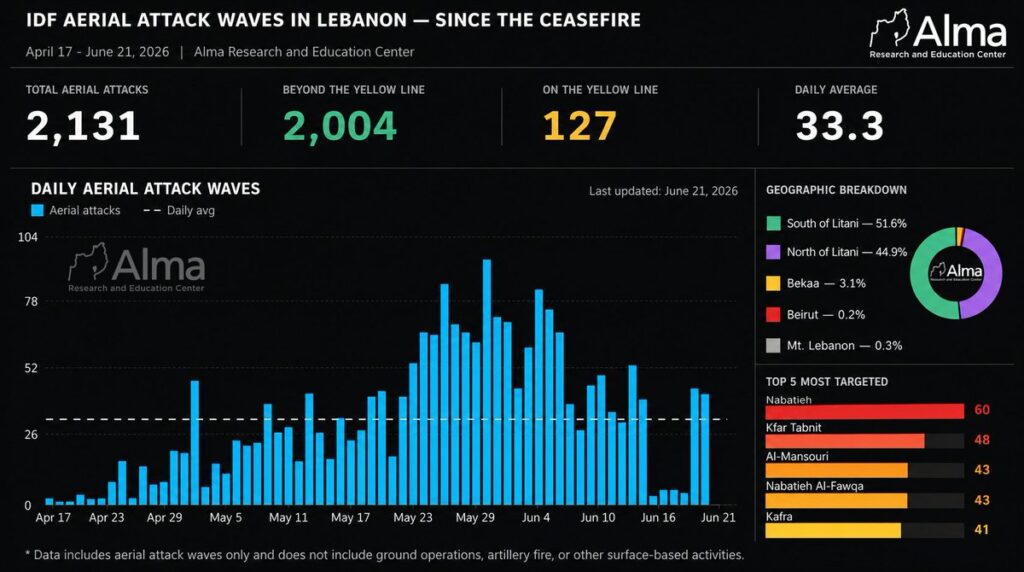
During the past week (15–21 June), the IDF conducted 103 waves of airstrikes across Lebanon. This represents a significant decrease of 63.3% compared to the previous week (8–14 June), during which 281 airstrike waves were carried out.
Since 20 June, the IDF has not conducted any airstrikes in Lebanon. The increase in IDF strikes during the weekend (19–20 June) followed Hezbollah attacks in which five IDF soldiers were killed.
Geographically, 75 strikes (72.8%) were conducted north of the Litani River, 24 strikes (23.3%) south of the Litani, and four strikes (3.9%) in the Bekaa Valley.
This week, the IDF’s offensive effort was concentrated primarily north of the Litani River, in the areas of Nabatieh, Kfar Tebnit, and Nabatieh al-Fawqa, which are adjacent to the Ali al-Taher Ridge, where the headquarters of Hezbollah’s Badr Unit is located.
The concentration of strikes in this area coincided with IDF ground operations on the ridge, which is considered one of Hezbollah’s most important strategic assets in southern Lebanon. Dominating extensive areas of the Nabatieh sector and key transportation routes, the ridge has served for years as a fortified military zone containing underground infrastructure, firing and launch positions, and command-and-control facilities.
We discussed the strategic importance of this area in greater detail in our article published on 21 June: “Hezbollah’s Land of Tunnels: The Assault on One of Southern Lebanon’s Strategic Assets.”
Most strikes were conducted outside the Yellow Line, with 99 out of 103 weekly airstrike waves taking place in these areas. Only four strikes were conducted within the Yellow Line.
Cumulative Data Since the Ceasefire
Since the beginning of the ceasefire, between 17 April and 21 June 2026, the IDF has carried out 2,231 airstrike waves in Lebanon, averaging 33 airstrike waves per day.
Most strikes were conducted south of the Litani River—1,099 airstrike waves, accounting for 51.6% of all strikes. An additional 957 strikes (44.9%) were conducted north of the Litani, 65 strikes (3.1%) in the Bekaa Valley, six strikes (0.3%) in Mount Lebanon, and only four strikes (0.2%) in Beirut.
The geographic areas that sustained the highest number of strikes since the beginning of the ceasefire are Nabatieh (60 strikes), Kfar Tebnit (48), Al-Mansouri (43), Nabatieh al-Fawqa (43), and Kafra (41).
Note: The data presented refer solely to IDF airstrikes and do not include ground operations, artillery fire, or other military activities conducted during the period under review.


One Response
Dear Alma Staff,
The Sovereign State of Israel will defend itself against all terrorists!! Hezbollah is a cancerous terror tumor that must be destroyed for healthy life to be restored in Lebanon. We can show no mercy for this parasitic disease. To all terrorists: The USA policy will be fully enforced: “We will find you, and we will kill you.” This disease now ends.