
Key Trends This Week
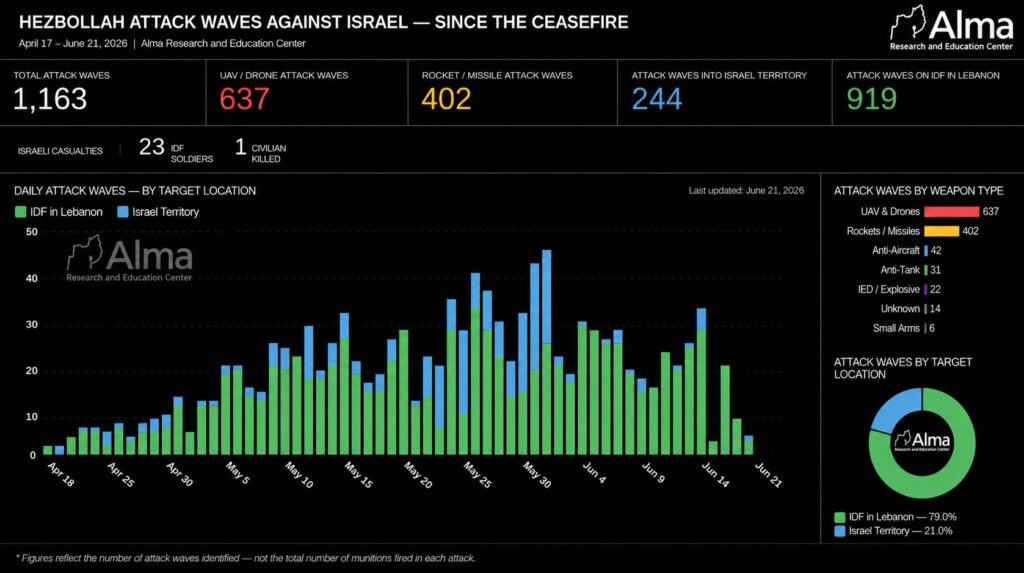
During the past week (15–21 June), Hezbollah carried out 36 attack waves against Israel and IDF forces, marking a significant decrease compared to the previous week (8–14 June), during which 134 attack waves were recorded.
Of the total attacks this week, 35 were directed against IDF forces operating in southern Lebanon, while only one attack targeted Israeli territory. This attack involved an explosive drone near the community of Zar’it and apparently crashed in an open area.
Hezbollah’s offensive activity was concentrated within only five of the seven days of the week. On 17 June, the organization recorded an exceptional peak of activity, carrying out 20 attacks—approximately 56% of all attacks conducted during the week.
Beginning on 16 June, Hezbollah ceased publishing its daily claims of responsibility, through which it had routinely detailed all attacks carried out against Israel and IDF forces. However, the actual level of operational activity remained significant. During the week, six IDF soldiers were killed as a result of Hezbollah attacks in southern Lebanon, five of them on 19–20 June.
Between 17 and 20 June, Hezbollah continued to publish one or two daily statements focusing on clashes with IDF forces in the areas of Kfar Tebnit and the Ali al-Taher Ridge. This area constitutes an operationally significant asset for Hezbollah. No Hezbollah attacks were recorded on 21 June.
In terms of weapon systems, High trajectory fire (rockets, mortars, and artillery) accounted for the majority of attacks this week, with 20 attacks (55.6% of all attacks), followed by UAVs and drones with 9 attacks (25%). In addition, the organization carried out two anti-tank guided missile (ATGM) attacks, two IED attacks, and one incident in which the type of weapon used could not be identified.
Cumulative Data Since the Ceasefire
Since the beginning of the ceasefire (17 April – 21 June 2026), Hezbollah has carried out 1,163 attack waves against Israel and IDF forces.
Of these attacks, 919 attack waves (79%) were directed against IDF forces operating in southern Lebanon, while 244 attack waves (21%) targeted Israeli territory.
The breakdown of attacks by weapon type highlights the continued centrality of UAVs and drones within Hezbollah’s offensive campaign. Since the beginning of the ceasefire, Hezbollah has carried out 637 attack waves using UAVs and drones, accounting for approximately 55% of all attacks. In addition, the organization conducted 402 attack waves using High trajectory fire weapons.
The remaining attacks included 42 anti-aircraft fire incidents, 31 ATGM attacks, 22 IED attacks, 14 incidents in which there was insufficient information to determine the weapon type, and 6 incidents involving small-arms fire.





One Response
Dear Dana,
So 1,163 attack waves by hezbollah during what is supposed to be a ceasefire is even under any consideration as credible? Lying, thieving terrorist pirates will continue their lies until the silence of death takes them away from the face of the earth. Now is the time to finish the job, and clean up the earth.