
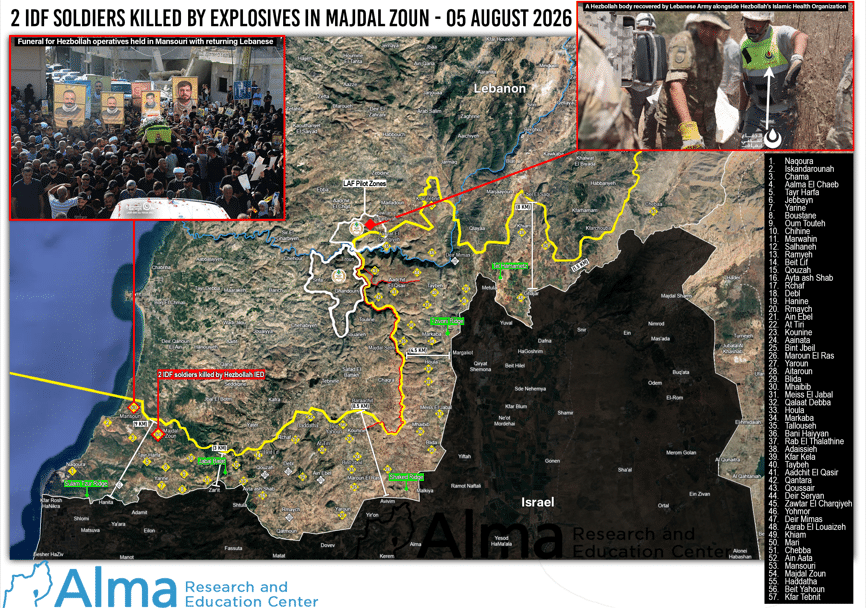
Yesterday (August 5, 2026), two IDF soldiers were killed, and four additional soldiers were seriously wounded as a result of the detonation of an explosive device inside a structure where an IDF force was operating in the village of Majdal Zoun in southern Lebanon.
The circumstances of the incident are still under investigation, but it already raises a broader question: how do explosive devices continue to pose a threat in the area of the Yellow Line?
At this stage, four main possibilities can be identified regarding the origin of the explosive device:
- An explosive device that was emplaced as part of the defensive array built by Hezbollah in southern Lebanon before the war.
- An explosive device that was emplaced during the war.
- An explosive device that was emplaced by Hezbollah operatives who remained (“were trapped”) in the area of the Yellow Line.
- An explosive device that was recently emplaced by Hezbollah operatives who returned to the area under the cover of the return of the civilian population.
The last possibility gains additional weight in light of the recent developments in southern Lebanon. Recently, residents began returning to the village of Al-Mansouri, adjacent to Majdal Zoun, even though it is an area designated as a military zone where the return of civilians had not been permitted. The return of the residents took place under the protection of the Lebanese Army, which established a military post there.
At the same time, Hezbollah has held mass funerals for its operatives in the village Al-Mansouri, events that also enable the organization’s operatives to return to the area under the cover of civilian activity.
At the same time, in the pilot area of Zawtar al- Gharbiyah in the eastern sector, alongside the deployment of the Lebanese Army, activity by the “Islamic Health Organization,” a body identified with Hezbollah, was also recorded in the area.
These two developments raise questions regarding the ability of the Lebanese Army to prevent Hezbollah’s return to the area, and regarding its ability to prevent the organization from exploiting the return of the civilian population in order to renew its activities.
The incident in Majdal Zoun does not stand alone. It joins additional indications that Hezbollah continues to seek opportunities to target IDF forces operating in southern Lebanon. On July 29, the organization launched an explosive drone at an IDF engineering vehicle operating in the Ali al-Taher Ridge area. There were no casualties in the incident, but it demonstrated that Hezbollah continues to attempt to target IDF forces operating in southern Lebanon.
It is also appropriate to examine the timing of the incident, which occurred against the backdrop of the contacts between Israel and Lebanon regarding the implementation of the framework agreement, and the possibility that its timing was intended to disrupt the negotiations and the continuation of the contacts.
Accordingly, the central question is not only when the explosive device was emplaced, but whether the incident in Majdal Zoun reflects a threat that remained from the defensive array built by Hezbollah before the war, or whether it indicates its ability to return and operate in the area of the Blue Line even today.





One Response
Dear Dana,
The root cause of the problem is the axis of resistance policy of death to Israel, and their policy to destroy the nation and the Jewish people. The first requirement should be for Lebanon to recognize the existance of the State of Israel to rule in their ancestral homeland. The second requirement should be that hezbollah be designated as a terror force of infiltration and destabilization that must be destroyed. Problem solved!