
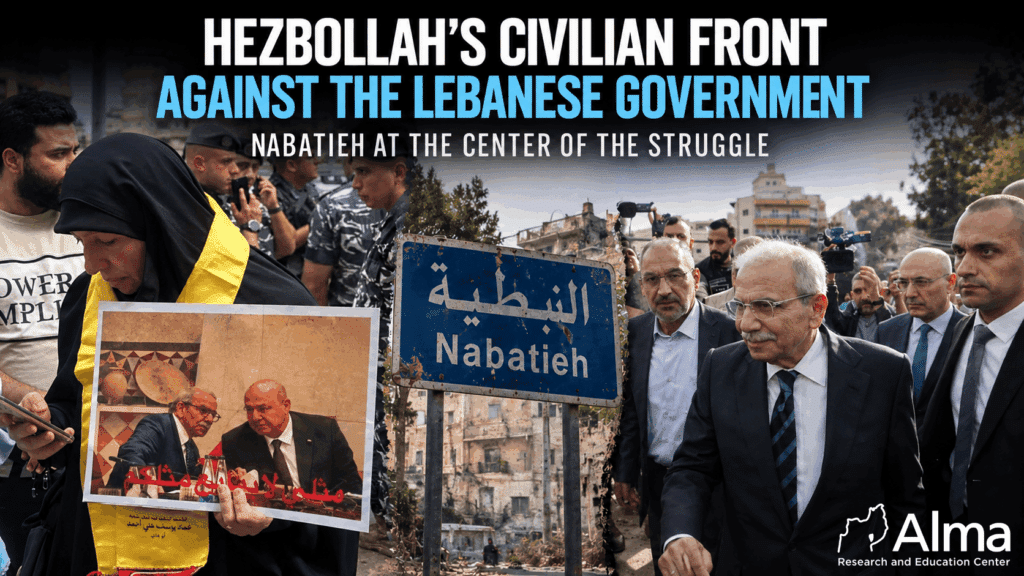
On October 2, Lebanese Prime Minister Nawaf Salam visited Nabatieh, accompanied by the ministers of interior and finance. During the visit, he announced 23 reconstruction tenders, laid the cornerstone for a new Civil Defense center, and visited state institutions and security agencies.
The visit also carried a clear political message. Salam sought to present a state that is returning to function in the south, providing services, rebuilding the area, and working to facilitate the return of residents. At the same time, he reiterated his vision of “one state, one army, and one decision,” particularly that the decision over war and peace must rest with the state.
The visit effectively followed President Joseph Aoun’s visit to Nabatieh on September 12, when he arrived in the city with the army commander and the heads of the security agencies and stressed that the state stands with the residents of the south and will work to provide them with security and services. Both visits reflect an effort by Lebanon’s leadership to reassert the state’s presence in the area.
This time, however, Hezbollah and the local system affiliated with it worked to create a different picture. A group presented as “residents of Nabatieh al-Fawqa” marched into the village, led by the mayor, who is affiliated with the list supported by Hezbollah and Amal.
The move was presented as a civilian initiative by residents seeking to return to their homes, but in practice it reinforced the message Hezbollah seeks to promote, that the government is failing to return the displaced, rebuild the south, or address the needs of its residents. The march also carried a provocative dimension, placing the state and the Lebanese Armed Forces in confrontation with “residents” demanding to return. In practice, this was not a permanent return to the village, but a temporary entry.
The visit was also accompanied by an effort to frame these messages through personal and emotional stories. Footage showed women and mothers carrying photographs of their sons who were killed in the war, one woman complaining that she could not reach her son’s grave in the south, as well as women carrying protest messages against Aoun and Salam. Placing women and mothers at the forefront gave the protest a civilian and human character and helped reinforce the message that Hezbollah and its environment are the ones expressing the distress of southern residents.
It is important to note that this was not the only picture that emerged from the visit. Voices were also heard in Nabatieh supporting Salam, strengthening the state and the army, and restoring the decision over war and peace to state institutions.
One of the more prominent voices supporting Salam was Abir Marwa[1], a political activist from Nabatieh District and an opponent of Hezbollah. In a video circulated on social media, she was seen shaking Salam’s hand and calling for the recovery of territory through negotiations and for security to be achieved through the state. Her remarks were followed by a broad online campaign against her by Hezbollah supporters, who sought to portray her as part of a small and unorganized Shiite opposition that does not represent the majority of southern residents.
The campaign did not focus only on her political positions. Photographs of her alongside well-known Hezbollah opponents were circulated, and attempts were also made to undermine her local and sectarian identity. It was emphasized that she is not from the city of Nabatieh itself, but from Ain Qana in Nabatieh District. Details from her private life were also circulated, including the claim that she is married to a Christian and a photograph from her daughter’s baptism ceremony in a church. In doing so, her opponents sought to portray her as an outlier politically, locally, and sectarianly, and to reduce the legitimacy of her statements within the Shiite community in the south.
This reflects a recurring pattern in Hezbollah-affiliated discourse, in which opponents of the organization, particularly Shiite voices that speak out against it, are often portrayed as traitors, outliers, or as individuals who do not represent their own community.
The case illustrates the struggle over who is entitled to speak in the name of the south. The very appearance of a southern Shiite voice supporting Salam and negotiations with Israel prompted an effort to portray that voice as exceptional, marginal, and even as not truly belonging to the “base” that Hezbollah seeks to present as the exclusive representative of the region.
Salam’s visit to Nabatieh received extensive coverage in the Lebanese media, giving the images and messages generated around it political significance. In this sense, Hezbollah sought to use an event intended to strengthen Salam and the state’s presence to promote a competing narrative, one of a state that is unable to address the needs of the south and of a population that is supposedly forced to take the initiative into its own hands.
This Hezbollah activity joins a series of protests over the past month that were presented as civilian protests by displaced persons, residents, or local organizations, but were promoted by actors affiliated with Hezbollah. The messages vary, reconstruction, displacement, returning to villages, or relations with Iran, but the common denominator is the use of a civilian framework to advance Hezbollah’s messages through its own support base.
See our article published on September 27, “The Plight of the Displaced as Political Leverage: How Hezbollah Channels Anger Toward the Lebanese Government.”
At this stage, these are not mass protests. In most cases, the groups involved are relatively small, sometimes numbering in the dozens and, in certain events, several hundred. Their significance lies less in the number of participants and more in their ability to create a media image of “popular pressure” and of a southern street opposed to government policy.
Nabatieh is therefore becoming one of the central arenas in the current struggle between the Lebanese government and Hezbollah, not only over weapons and security authority, but also over who represents the south and who is perceived as caring for its residents.
This raises a broader question: Is Hezbollah choosing, at this stage, to use the civilian street as a central tool in its struggle against government policy?
The limited protests we are currently seeing may serve as a way to test Hezbollah’s ability to mobilize its base, portray opposition to government policy as a “popular” voice rather than the organization’s own position, and signal to Salam and the government that attempts to strengthen state authority at Hezbollah’s expense will encounter resistance on the ground.
The question is whether this tool will remain limited to small-scale protests or expand as the confrontation over the future of Hezbollah’s weapons and the authority of the Lebanese state progresses.
[1] https://x.com/Chreif12/status/2106084066793525285?s=20


One Response
Dear Dana,
Hezbollah must be designated as a terrorist force of infiltration and destabilization and declared by LAW to be ILLEGAL!!! Their snake tongued deceptions, manipulations and lies are not compatable with good governance. NO FUNDING OR REBUILDING CAN PROCEED UNTIL HEZBOLLAH IS DEFUNDED AND OUTLAWED IN LEBANON!!!!