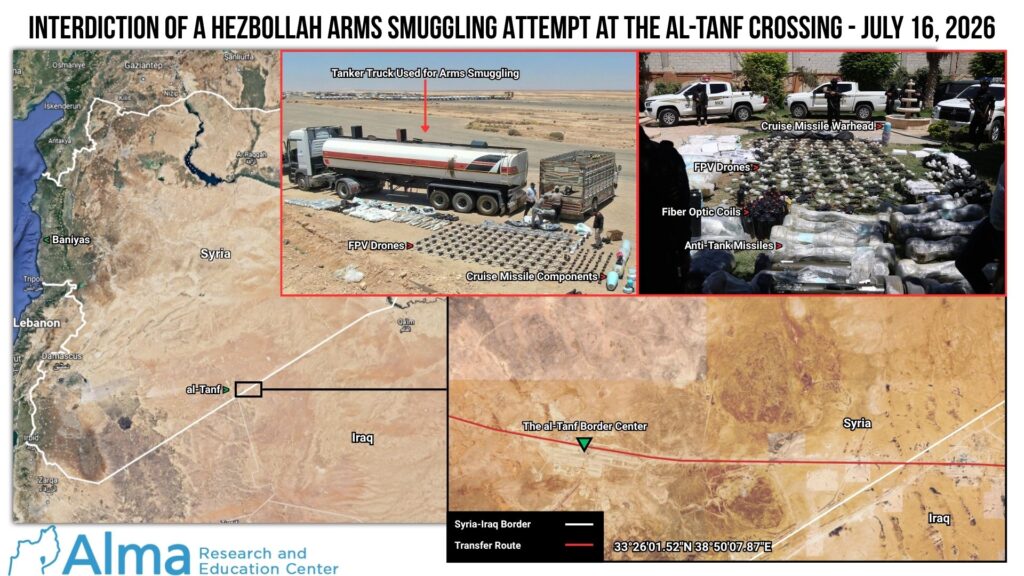
On July 16, the Syrian authorities announced that they had foiled an attempt to smuggle weapons intended for Hezbollah through the al-Tanf border crossing on the Iraq–Syria border (the Iraqi side of the crossing is known as al-Waleed).
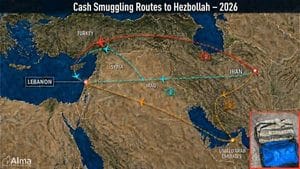
The Iran-Iraq-Syria-Lebanon land corridor continues to serve as a route for transferring weapons even after the fall of the Assad regime.
The weapons were concealed inside an oil tanker truck that was reportedly en route to the city of Baniyas in northwestern Syria. This route is routinely used to transport fuel from Iraq through the al-Tanf crossing to Baniyas, likely for refining or export via the Mediterranean Sea. Hezbollah exploited this legitimate civilian route and the truck’s cover story to smuggle the weapons. The shipment was likely intended to be unloaded at one of the smuggling hubs along the Syria–Lebanon border and then transferred into Lebanon.
The al-Tanf crossing is of strategic importance. It constitutes the shortest and fastest overland route from Iran, through Iraq, into Syria, and onward to Lebanon. During the U.S. military presence in the area, alongside the activities of the opposition force Maghawir al-Thawra, Iran’s ability to use this route was significantly constrained. Following the U.S. withdrawal and the transfer of security responsibility to the al-Sharaa government, Iran has likely resumed its smuggling efforts along this route while exploiting the cover of legitimate civilian truck traffic.
Among the items visible in the images released by the Syrian authorities are:
– At least 100 UAVs (drones).
– Optical fiber spools.
– RPG warheads that appear to have been factory-prepared for mounting on UAVs, equipped with dedicated electrical release mechanisms and mounting bolts, rather than improvised adaptations as seen in the past.
– Anti-tank guided missiles (ATGMs).
– And, most likely, Paveh-family cruise missiles.
This shipment is consistent with Hezbollah’s current force build-up priorities, particularly the strengthening of Unit 127 (the aerial unit), alongside the Radwan Force and its weapons production, logistics, and supply networks.