Over the weekend, IDF activity in Lebanon intensified. At the same time, Hezbollah continued its attempts to target IDF forces in the security zone using explosive drones, and these attacks led to an extensive Israeli aerial response, focused primarily on the Nabatieh area.
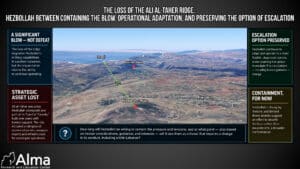
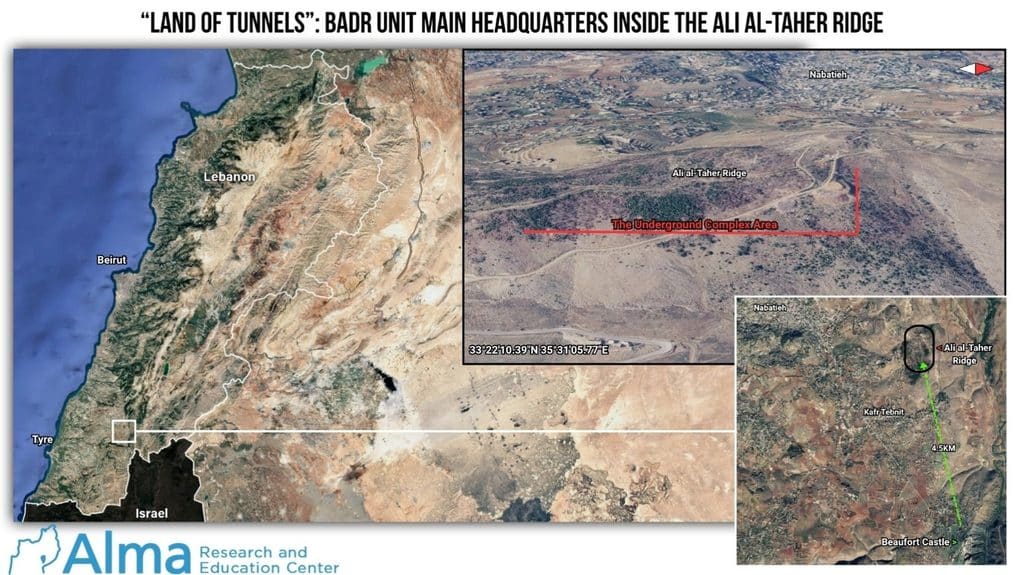
These developments came against the backdrop of the conclusion of the campaign over the Ali al-Taher Ridge (September 3), which in recent months had become one of the main points of friction between the IDF and Hezbollah. Over the weekend, the IDF announced that it had achieved operational control of the ridge area both above and below ground and had completed the clearing of its two main strategic underground infrastructures.
Ali al-Taher Ridge – A Strategic Hezbollah Asset
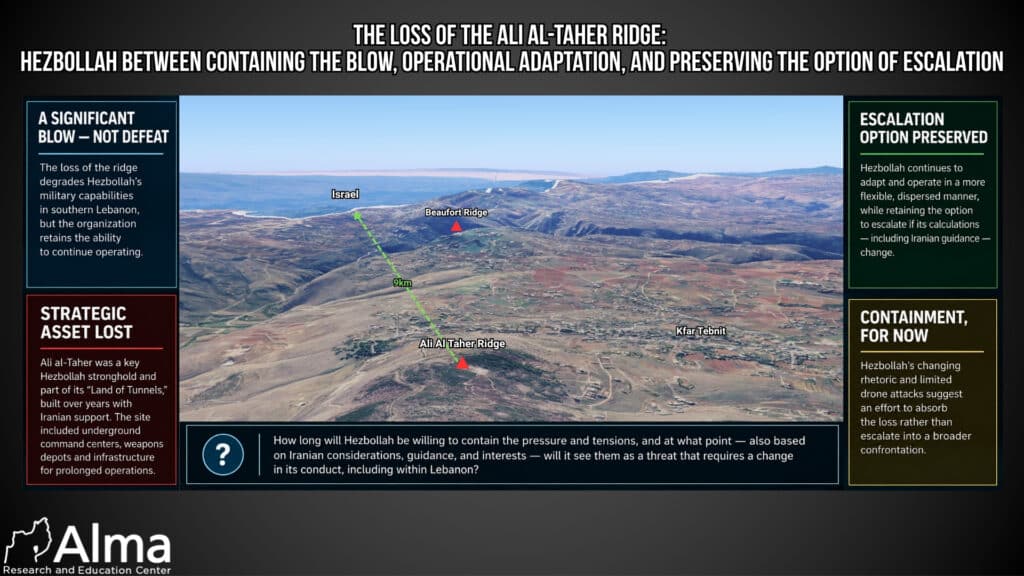
The completion of the clearing of the two underground routes on the ridge marks the completion of the IDF’s operational takeover of the complex. During the operation, Hezbollah operatives were eliminated, while others apparently fled the site. The scale and nature of the infrastructure- command-and-control rooms, weapons rooms, generator systems, and facilities enabling prolonged stays – indicate that this was not a localized tactical infrastructure, but rather a complex designed to support the conduct of prolonged combat.
The complex was part of Hezbollah’s “Land of Tunnels” network and was built over the course of years with Iranian assistance and funding. It was struck several times from the air, but the ground operation enabled the IDF to physically reach the infrastructure and act to thoroughly neutralize it. Hezbollah’s efforts to maintain its hold on the ridge through combat, resupply attempts, and explosive-drone attacks demonstrated the great importance Hezbollah attached to the complex.
A further indication of the ridge’s strategic importance is the Iranian involvement surrounding its fate. In mid-August, it was reported that Iran had warned the United States that an Israeli takeover of Ali al-Taher would be met with a large-scale Iranian attack against Israel – an explicit threat that underscores the importance attributed in Tehran as well to preserving the complex.
For further reading, see: Hezbollah’s “Land of Tunnels”: A Strike on One of Its Strategic Assets in Southern Lebanon, Ali al-Taher: Israel Must Not Turn a Military Victory into a Hezbollah Victory Narrative.
Hezbollah’s Continued Attempts to Target IDF Forces
Even after the completion of the clearing of the infrastructure at Ali al-Taher, Hezbollah continued its attempts over the weekend to target IDF forces in the security zone. On Friday (September 4), an explosive drone was launched toward IDF forces and was intercepted. On Sunday morning (September 6), two additional explosive drones were launched; one was intercepted, and there were no casualties. In total, Hezbollah launched three drones toward IDF forces over the weekend.
It should be noted that on Wednesday (September 2), Hezbollah also launched two explosive drones against IDF forces in the Ali al-Taher area.
The IDF’s Aerial Response
In response to Hezbollah’s attacks, the IDF intensified its airstrikes, and during September 4–5, 17 waves of airstrikes were documented, targeting Hezbollah operatives and the organization’s military infrastructure, including weapons depots.
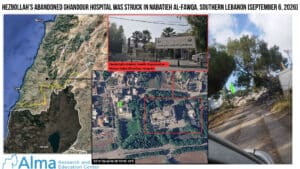
This pattern of strikes continued on Sunday morning (September 6), following the launch of the two explosive drones. During the morning hours, airstrikes were carried out at several locations in the Nabatieh area: Kfar Rumman, Nabatieh, Nabatieh al-Fawqa, and Arab Salim. In Arab Salim, north of Nabatieh, an evacuation warning was issued prior to the strike for a building used by Hezbollah. The warning was intended to allow civilians to move away from the target and reduce the risk of harm to them before the organization’s military infrastructure was struck.
Is Hezbollah Preparing for Escalation Following the Loss of Its Strategic Asset on the Ali al-Taher Ridge?
The shift in the messaging of senior Hezbollah officials regarding Ali al-Taher may indicate that the organization had prepared in advance for the possibility of losing the complex and sought to lay the groundwork for containing the event. As the Israeli operation progressed and the prospect of losing the ridge became more tangible, senior Hezbollah officials began emphasizing that even its loss would not decisively alter Hezbollah’s ability to continue fighting.
In late August, Mahmoud Qamati, deputy chairman of Hezbollah’s Political Council, stated that “Ali al-Taher is important, but if it is lost, that does not mean the end of Hezbollah,” and stressed that refraining from responding to every Israeli strike does not indicate weakness or a lack of capability. Following the Israeli advance on the ridge, a similar message was voiced by Ihab Hamadeh, a member of Hezbollah’s Loyalty to the Resistance parliamentary bloc, who argued that the loss of the site does not constitute “a disaster in the military reality.”
These messages, alongside Hezbollah’s continued limited attacks using explosive drones, appear at this stage to point more toward an effort to contain the loss of the complex than toward preparations for a broader escalation. This does not diminish the significance of the blow, but rather points to Hezbollah’s ability to adapt its operational pattern to the new reality and continue its struggle even after the loss of a significant asset.
This conduct forms part of a broader process of Hezbollah adapting to the new operational reality. The organization has sustained a significant blow to its capabilities, but it has not been defeated and has not relinquished its objectives. It is increasingly relying on flexible and dispersed operational patterns that enable it to continue fighting over time.
See article: Hezbollah – Situation Assessment: From a Large-Scale Terrorist Army to a Persistent Dispersed Threat
Therefore, from Hezbollah’s perspective, the loss of the Ali al-Taher Ridge does not necessarily require a large-scale response. At this stage, Hezbollah can contain the blow and continue operating in more limited patterns, while preserving the option of escalating at a later stage if its calculations – including Iranian guidance or direction – change.
Hezbollah Between Pressure on the Government and Criticism Within Lebanon
Hezbollah’s statement over the weekend also reflects the growing tensions in the domestic Lebanese arena. Alongside condemning the Israeli strikes, Hezbollah sharply criticized the Lebanese government and the political track with Israel, arguing that the government has failed to bring about an end to IDF activity against it.
In effect, Hezbollah is asking the Lebanese state to act to stop the military pressure Israel is exerting against it, while Hezbollah itself refuses to accept the state’s demand that it dismantle its independent military force.
This conduct has drawn criticism within Lebanon from Hezbollah’s opponents. Among other things, the question has been raised as to why the organization refused to hand over the Ali al-Taher Ridge and its underground infrastructure to the Lebanese Armed Forces when the option was on the table, yet after the IDF took control of the complex, it directed its criticism toward the government.
At the same time, Hezbollah’s opponents have also criticized the shift in the organization’s messaging described above – from emphasizing the importance of Ali al-Taher during the campaign to downplaying the significance of its loss afterward.
For Hezbollah, its weapons are not merely a tool in the struggle against Israel, but a central component of its power and standing within Lebanon. Therefore, a scenario in which it fully and voluntarily disarms appears unlikely at this stage. If the organization comes to view efforts to disarm it as a genuine threat to its continued existence as an independent military force, the pressure could also be directed against actors within Lebanon that oppose the organization.
Hezbollah has already demonstrated in the past that when it perceived a direct threat to the foundations of its power, it was prepared to use force in the domestic Lebanese arena as well, including military moves to seize control of public institutions and assassinations of senior figures.
The question is how long Hezbollah will be willing to continue containing the pressure and tensions, and at what point – also in accordance with Iranian considerations, guidance, and interests – it will view them as a threat requiring a change in its conduct within Lebanon as well.