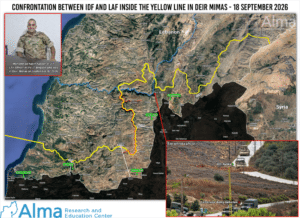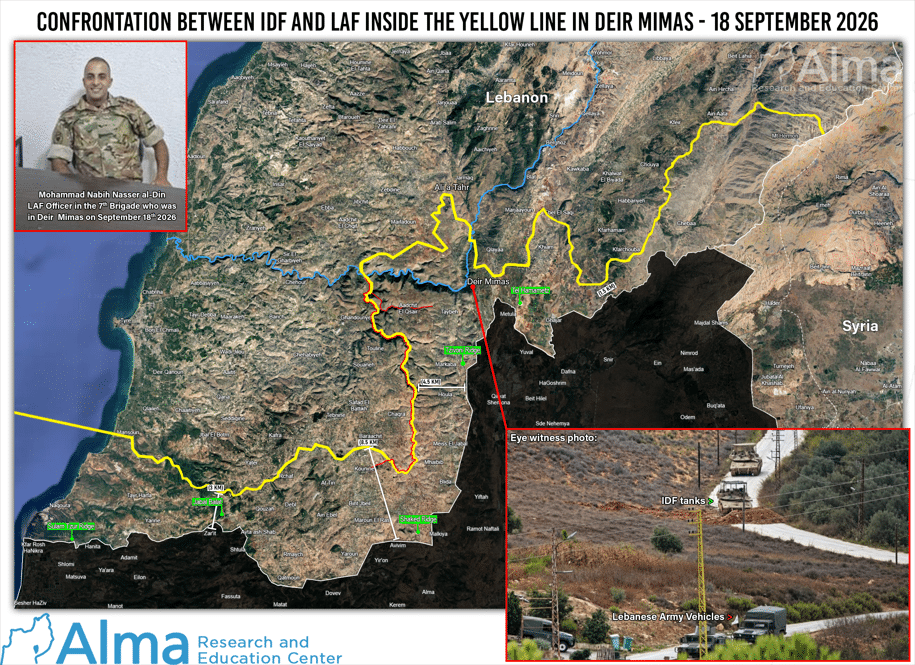
According to a statement issued by the Lebanese Armed Forces, its soldiers from the 7th Brigade established a temporary observation post near the village of Deir Mimas, approximately three kilometers north of Kfar Kila and four kilometers northwest of Metula, “in order to secure local farmers who had arrived to inspect the condition of their lands.”
When an IDF force arrived in the vicinity of the post, tensions developed between the Israeli troops and the Lebanese soldiers. During the confrontation, stun grenades were thrown toward the area where the Lebanese soldiers were positioned, prompting them to withdraw and evacuate the post. Deir Mimas lies within the IDF security zone and has not been designated as a pilot area. According to the Lebanese Armed Forces, the deployment of its troops had been coordinated with the international coordination mechanism.
The commander of the Lebanese Army position was Mohammad Nabih Nasser al-Din, an officer in the 7th Brigade and a Shiite from the Hermel area of the Beqaa Valley, an area widely regarded as part of Hezbollah’s core Shiite support base.
The sectarian identity of al-Din cannot be ignored in this context. Hezbollah-affiliated media outlets did not miss the opportunity to exploit both the incident itself and, in particular, the officer’s Shiite identity in order to criticize the process of direct negotiations with Israel and, in effect, to challenge the government and the president. At the same time, they praised the officer and the Lebanese Army soldiers for their “insistence on defending their land and homeland.”
Hezbollah will continue to make use of Shiite officers within the Lebanese Armed Forces for its own purposes, both operationally and in the information and influence sphere.
We do not know whether the presence of the Lebanese force in Deir Mimas was in fact coordinated. What is clear, however, is that a tactical incident of this kind carries significant potential for escalation and for strategic damage to the diplomatic process currently underway between Israel and Lebanon. This is precisely in Hezbollah’s interest.
The tone set by Lebanese Armed Forces Commander Rodolphe Haykal, together with the conduct of many Shiite officers operating on the ground, serves Hezbollah’s interests.