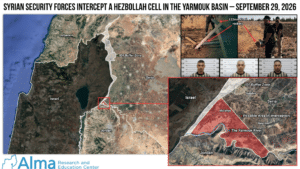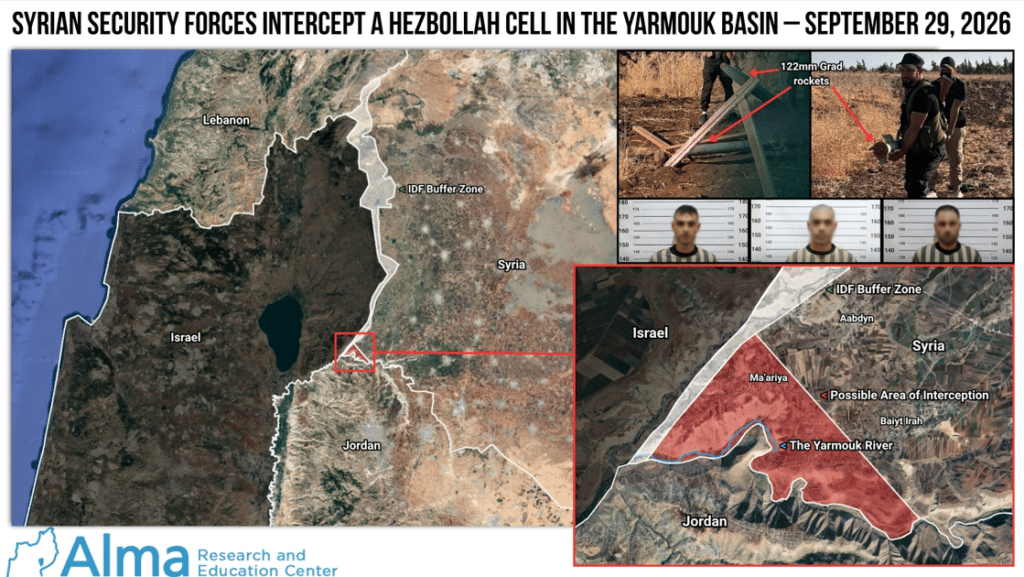
On September 29, Syrian Internal Security forces announced the arrest of a three-member Hezbollah-affiliated cell in the Yarmouk Basin, in western Daraa. The cell was engaged in establishing infrastructure for launching rockets toward Israel, and footage released after the arrest showed 122 mm Grad rockets seized at the site.
The identities and backgrounds of the detainees have not yet been disclosed. It remains unclear whether they are local residents, operatives who arrived from other parts of Syria, members of longstanding Hezbollah and Iranian networks, or a combination of these possibilities. All of these scenarios are consistent with Hezbollah’s established patterns of activity in southern Syria.
The Yarmouk Basin, near the Israel-Jordan-Syria border triangle, is an unstable area where local armed groups, smuggling networks, and longstanding terrorist infrastructures operate. In the past, the area was a center of activity for ISIS’s southern Syria branch, and it has also served as a corridor for operations against Israel and for weapons smuggling through Jordan. Last June, armed residents in Abidin even opened fire on IDF forces operating in the area.
The threat of rocket fire toward Israel from southern Syria is not new. In April 2026, Syrian authorities announced that they had thwarted a Hezbollah-operated cell in Quneitra, in southern Syria near the Israeli border, which possessed a civilian vehicle carrying launchers and rockets ready to be fired. In June 2025, two rockets were actually launched from southern Syria toward the southern Golan Heights, apparently from the area of Tasil in western Daraa.
From Hezbollah’s perspective, launching rockets from Syria may have significance beyond the direct damage inflicted on Israel. Such fire could trigger an Israeli response inside Syrian territory, increase friction between Israel and Damascus, and complicate efforts to reduce tensions between the two sides. This is compounded by Hezbollah’s interest in undermining the stability of Syria’s new government.
The incident illustrates the security challenge in southern Syria. In this case, rockets and launch equipment had already been brought into the area in preparation for fire toward Israel. Even a small cell and a limited number of rockets can generate a broader effect and create an additional pressure point against Israel.
Iran and Hezbollah continue to seek to preserve and expand their activity against Israel from Syrian territory, while relying on local networks and infrastructure built over the years in southern Syria.