
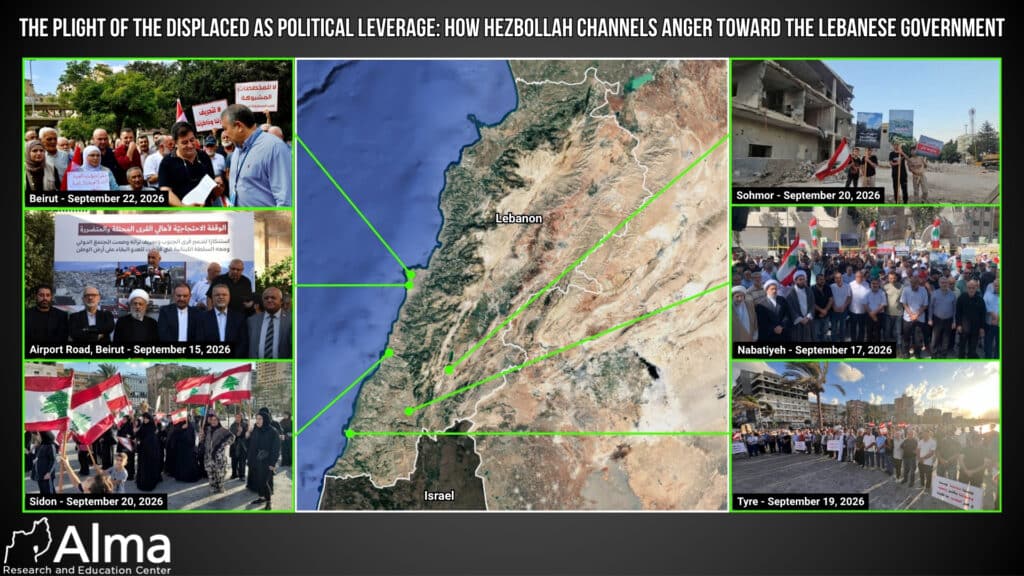
In recent weeks, a series of protests has spread across Lebanon that, on the surface, appear to be civilian demonstrations by displaced persons and residents of areas affected by the fighting. In practice, however, Hezbollah is directly involved in managing these protests, with the aim of redirecting criticism toward the Lebanese government.
The demands raised at these protests are first and foremost civilian and economic: housing allowances for families whose homes were destroyed, compensation, the reconstruction of homes and infrastructure, the resumption of operations at public institutions, and ensuring that residents are able to return to their villages. Yet alongside the residents’ genuine hardship, the way the protests are framed is also striking: the finger of blame is repeatedly pointed at the Lebanese government and state institutions, rather than at Hezbollah.
On September 15, the “Committee of Residents of the Occupied and Affected Villages” held a protest at the premises of the Supreme Islamic Shiite Council on the airport road in Beirut. The invitation to the event also included explicit criticism of the “Lebanese authorities.” Participants included senior officials from the Shiite Council, municipal heads, and local representatives from southern Lebanon. Al Manar and Al Noor Radio, Hezbollah media outlets, provided coverage of the event.
Two days later, on September 17, another protest was held outside the government Serail in Nabatieh. Dozens of residents from the area and from affected villages demanded reconstruction, compensation, and housing allowances. In this case, the political connection to the event was clearer. Former Labor Minister Mustafa Bayram, a Hezbollah member, participated in the protest and addressed the crowd.
In the following days, protests continued in Tyre and the Western Beqaa. In Tyre, the demand for housing was expressed through the slogan, “It is my right for my homeland to provide me with a roof over my head,” while in Sohmor, in the Western Beqaa, demands for reconstruction and compensation were accompanied by the presence of political figures from Hezbollah and Amal. In this way, a consistent messaging framework gradually emerged: residents present themselves as Lebanese citizens who have suffered harm, while their demands are directed at the state.
The Civilian Framing of the Protests
One of the most notable characteristics of these events is the gap between their civilian appearance and the political environment in which they take place. At some of the protests, Hezbollah flags or party symbols were not prominently displayed. Instead, Lebanese flags, images of destroyed villages, and slogans focused on civil rights, reconstruction, and compensation were used.
The accumulation of indicators points to the involvement of political, municipal, and social networks affiliated with Hezbollah, while some of the events also show the presence of figures from the Amal Movement. The events take place at institutions associated with the Shiite community, are attended by municipal heads, clerics, and politicians affiliated with the Shiite political base, and are covered and promoted by Hezbollah’s media outlets.
Therefore, it is more accurate to view these protests not only as a spontaneous expression of the plight of the displaced, but also as an arena through which existing hardship can be channeled into political pressure on the state and the Lebanese government.
This framing is particularly significant. Residents of the Shiite areas that were severely affected are not presented as demanding that Hezbollah account for the price of the confrontation or for its role in the situation that has emerged. Instead, the central demand is that the state rebuild, provide compensation, finance housing, and facilitate the return to the villages.
The State Fails to Provide a Response, Hezbollah Steps into the Vacuum
This pattern is linked to the persistent weakness of the Lebanese state. Although the government is advancing reconstruction and assistance programs, its ability to address the scale of the needs remains limited. As of the end of August, more than 334,000 people remained displaced in Lebanon, while reconstruction programs continued to depend heavily on external funding that was not fully guaranteed.
This gap enables Hezbollah to strengthen its social role. On September 19, Lebanon24 reported that the organization was preparing to pay housing allowances to families whose homes had been destroyed and was working to establish a distribution mechanism[1]. Thus, when the state struggles to provide a response, Hezbollah can step into the vacuum and present its institutions as a practical alternative.
Hardship as a Tool for Preserving Legitimacy
The use of a civilian framework, Lebanese flags, residents’ committees, and social demands allows Hezbollah to support and participate in the protests without having them presented as party demonstrations organized on its behalf.
In doing so, the organization can attempt to create the appearance of a spontaneous popular protest against the state and its institutions, while at the same time extending the message beyond its traditional support base and mobilizing broader public identification with demands perceived as civilian rather than partisan.
Hezbollah is currently required to contend with a population that has paid a heavy price in the war it initiated against Israel. Families have lost their homes, villages and infrastructure have been damaged, and hundreds of thousands have been displaced. Such circumstances could theoretically also direct criticism toward the organization itself.
However, the sequence of protests in September presents a different pattern. The anger exists, but Hezbollah redirects it toward the state.
As a result, Hezbollah can operate on both levels simultaneously. On the one hand, it demands that the state fulfill its obligations. On the other, the state’s weakness allows it to justify the continued existence of its parallel social system.
The more the Lebanese state struggles to provide an effective response, the more Hezbollah gains another opportunity to present itself as an actor for which there is no substitute.
It is precisely the state’s failure to fill the vacuum that helps Hezbollah preserve dependence on it, redirect public frustration away from itself, and reinforce the legitimacy of its continued activity within Shiite society.
[1] https://www.lebanon24.com/news/lebanon/1573401/%D9%87%D9%84-%D8%B3%D8%AA%D8%AF%D9%81%D8%B9-%D8%A8%D8%AF%D9%84%D8%A7%D8%AA-%D8%A7%D9%84%D8%A7%D9%8A%D9%88%D8%A7%D8%A1%D8%9F


One Response
Dear Dana,
There can be no recovery of Lebanon without removing the hezbollah cancer. The corrupted metasticized civil infrastructure must also be totally removed and replaced. Justice and sovereignty must replace terror and oppression. The entire government must be restructured like post WWII Japan. The colonial french dependent government model was designed to require the oversight and rule of the french empire, not the Independence and Liberty of Lebanon.