Two years after Hassan Nasrallah’s elimination, Hezbollah operates in a reality very different from the one it knew under his leadership. The organization has suffered severe losses among its leaders and in its military capabilities. Its support base is bearing a heavy toll of destruction and displacement, and calls in Lebanon for its disarmament are being voiced openly.
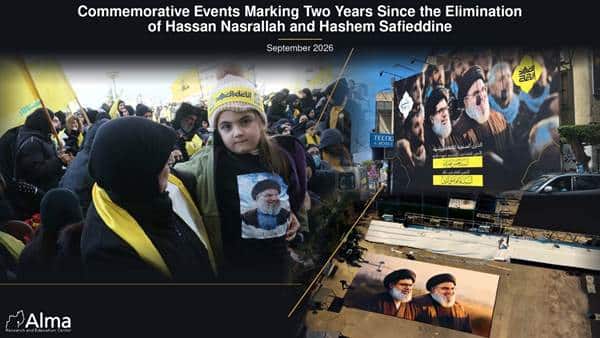
Yet the commemorative events Hezbollah held this week for Nasrallah and Hashem Safieddine point to another dimension of its power: despite the blows it has sustained, Hezbollah can still mobilize supporters, establish a public presence, and shape the meaning its community gives to its losses.
The Void Left by Nasrallah and Criticism of the Organization
Nasrallah’s elimination on September 27, 2024, followed by Safieddine’s elimination in early October, formed part of a series of severe blows to Hezbollah’s command structure.
For more than three decades, Nasrallah was the organization’s face, voice, and central authority. He connected its leadership to its support base and, to a considerable extent, shaped how his supporters understood its successes and failures. Naim Qassem inherited a damaged organization, but he does not command comparable personal standing.
Hezbollah’s opponents in Lebanon argue that the organization has weakened since Nasrallah’s elimination and that Qassem has failed to fill the void he left. They hold Hezbollah responsible for the renewed war and for the destruction and displacement that have also affected its Shiite support base. They demand that the authority to decide on war and peace rest with the state. Criticism is also being voiced among Shiites in the south.
This criticism reflects the changed environment in which Hezbollah operates. It has become harder to present the price paid by residents of the south, the Dahiyeh, and the Beqaa as an achievement. Still, the existence of criticism, even if it is growing, does not prove that Hezbollah’s support base has abandoned it. Assessing the organization’s position also requires examining its continuing ability to organize the community around it.
A Week of Commemoration as a Display of Presence and Control
Hezbollah marked the anniversary of Nasrallah’s and Safieddine’s eliminations with a series of events over several days. Images and banners appeared in the Dahiyeh, processions and local ceremonies were held, and Al-Manar released archival footage of Nasrallah meeting members of the public. An exhibition of his personal belongings opened at his tomb complex in Bir Hassan, emphasizing his image as a leader close to his supporters.
The events culminated in a rally near the tomb on September 27. According to foreign media reports, thousands attended, and Naim Qassem delivered a speech broadcast on screens. Through the commemorations and messages about continuing the path of the two leaders, Hezbollah sought to demonstrate cohesion and strengthen the loyalty of its support base.
The Power That Remains and Its Limits
A special report by the Alma Research and Education Center on Hezbollah’s media ecosystem published in Sept. 2026 examined the role of speeches, media outlets, posters, ceremonies, and community institutions in shaping a shared narrative for the organization’s support base. This week’s events show how that system operates in a time of crisis. Hezbollah cannot erase the loss of its leaders, the destruction, or the displacement; it seeks to give them meaning through sacrifice, loyalty, and continuity. In this way, loyalty to Nasrallah and Safieddine becomes loyalty to the organization as it exists today and to its continued course, including its opposition to disarmament.
The dispute over expanding the tomb complex also reveals the tension between symbolic displays and the community’s needs. According to information published ahead of the anniversary, plans for the expansion had already been prepared and donations collected, but work has not begun. Jawad Nasrallah, Hassan Nasrallah’s son, said that a grand complex should not be built while residents’ homes in the south, the Dahiyeh, and the Beqaa remain unreconstructed. His remarks are a reminder that commemoration does not meet the needs of displaced people or resolve the economic hardship facing Hezbollah’s support base.
The ceremonies are not evidence that Hezbollah has restored its military capabilities, and attendance does not amount to support for every decision its leaders make. They do show that, despite the blows it has suffered and the growing criticism it faces, the organization retains the social, media, and symbolic infrastructure to mobilize people and shape discourse within its support base.
Two years after Nasrallah’s elimination, Hezbollah’s weakened position coexists with its ability to continue interpreting for its supporters the price they have paid. As long as it can turn loss into loyalty and commemoration into a justification for continuing its course, the damage to its power will not necessarily produce a comparable decline in its hold over its support base.