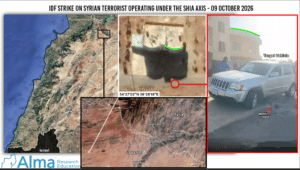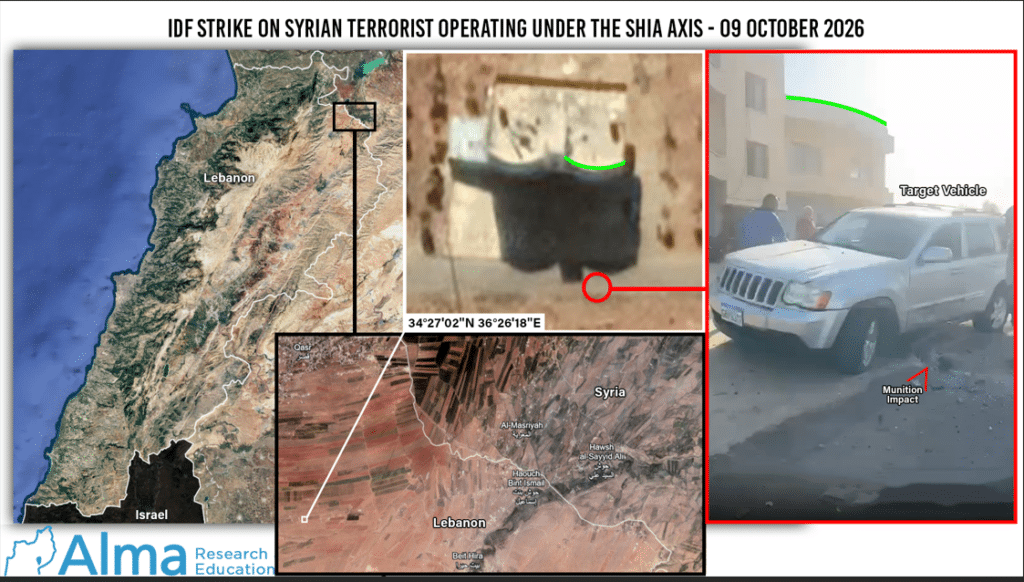
On Friday (October 9), the IDF targeted a vehicle carrying Yusuf Ali al-Hassoun (يوسف علي الحسون), a Syrian terrorist operative involved in advancing terrorist activities against IDF forces in southern Syria, including preparations involving rockets and explosive drones. Based on the reports, our understanding is that he was operating under Iranian direction.
The strike took place near the Syrian-Lebanese border, on Lebanese territory, west of Hawsh Bint Ismail, in the northeastern Beqaa Valley (northeast of al-Hermel). At this stage, the outcome of the strike remains unclear, and al-Hassoun may have been wounded rather than killed. No further details regarding his identity have been released.
Assuming that he operated under Iranian direction and based on Iran’s known operational patterns in southern Syria, al-Hassoun may have been part of one of the Iranian operational networks in Syria, particularly those associated with Unit 840, the Quds Force’s special operations unit, or Branch 4000 of the IRGC Intelligence Organization. Hezbollah may also have been involved in directing al-Hassoun.
Given the geographical location of the strike, it is possible that al-Hassoun was on his way to meet his Iranian handlers based in Lebanon and/or his Hezbollah handlers in Lebanon.
Over the years, Hezbollah and Iran have operated local cells in southern Syria, both directly and through Syrian intermediaries (to provide separation and cover), as well as through remote direction from Iran and Lebanon.
These networks were established and consolidated during the Assad regime, with the involvement of personnel from the Syrian military and security apparatus. However, their activities did not cease following Assad’s fall in December 2024. Since then, Iran and Hezbollah have continued attempting to activate local networks, including through connections and infrastructure remaining from the former regime.
It is important to emphasize that these Iranian networks did not rely exclusively on Shiite operatives. They also recruited Sunni and Druze Syrians, and in some cases, recruitment was driven by financial incentives rather than ideological identification.
This case joins a series of incidents indicating continued attempts to activate these networks. In July 2025, the IDF arrested local operatives in southern Syria who had been directed by the Quds Force. In September 2025 and April 2026, cells preparing to launch rockets toward Israel were uncovered in the Quneitra area.
On June 28, two armed operatives, Syrian Shiites who had arrived from northern Syria to carry out terrorist activities, were killed by the IDF near the village of Hader in southern Syria. They had apparently been dispatched under the direction of Iran and/or Hezbollah.
More recently, on September 29, Syrian security forces arrested a three-member cell affiliated with Hezbollah in the Yarmouk Basin in western Daraa. The cell had been working to establish infrastructure for launching rockets toward Israel.
These developments are accompanied by two unusual incidents that occurred in southern Syria last week. On the night of October 4–5, a 22-year-old Palestinian resident of Damascus was killed while attempting to infiltrate an IDF position in the al-Hamidiyah area. Later, on October 5, shots were fired at two individuals who approached another IDF position in the area on a motorcycle under unusual circumstances. These incidents raise suspicions of attempts to test the alertness of IDF forces and their response patterns.
The recent incidents, even if they are unrelated, illustrate the continuing threat emanating from southern Syria, both through Iran and Hezbollah’s attempts to activate local networks against Israel and through possible efforts to test the alertness of IDF forces operating in the area.