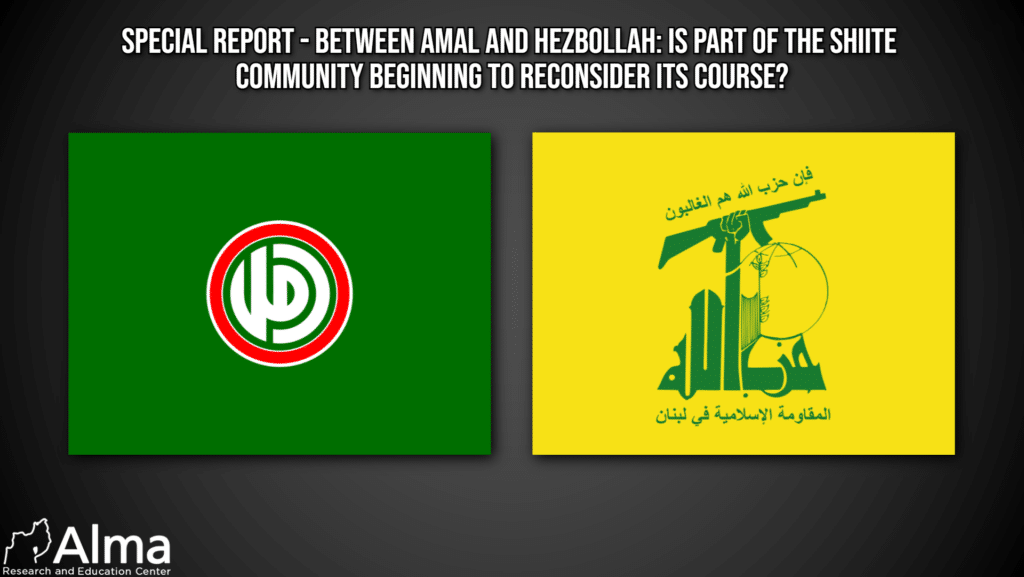
Is the realization sinking in among Nabih Berri and the Amal movement that Hezbollah has turned from an asset into a burden on the Shiite community as a whole? Is the realization beginning to sink in that Hezbollah endangers them more than it protects them?
A series of events in recent months, alongside possible tension between Hezbollah and Amal, may indicate a shift in the balance of fear and power within Lebanon’s Shiite community. In the background may lie the realization that Israel has changed, and that another war could bring the IDF into areas north of the Litani as well :the Nabatiyeh area and farther north.
Shiites are not necessarily ceasing to support Hezbollah, but parts of the Shiite community may be beginning to fear the price it exacts from them. A clear distinction must be made here. This refers particularly to Shiites who do not belong to the base within the Shiite community identified with Hezbollah. When discussing Lebanon’s Shiite community, at least half of it does not belong to the base identified with Hezbollah, but rather to the base identified with the Amal movement.
The Shiite base identified with Hezbollah is a “captive audience”. A population that, in our assessment, will not “revolt” against Hezbollah under any circumstances. This is due to indoctrination, the ideology of the “resistance society”, the state-within-a-state systems Hezbollah has established: welfare, healthcare and the like, economic dependence and internal deterrence.
As of this writing, Hezbollah is not losing the base identified with it. We do not identify even the beginnings of a process in which support for Hezbollah is collapsing within this base, despite the considerable challenges and difficulties facing the organization.
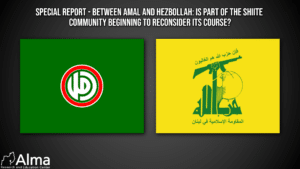
The “Shiite duo”, which relies on the two bases of Hezbollah and Amal, shares a sectarian common denominator and common political interests. Interests can change, especially when the interests of one (Hezbollah) adversely affect the interests of the other (Amal).
Is sentiment against Hezbollah developing within Amal’s base? What is its nature ?
Some three years after Hassan Nasrallah’s decision to launch a war against Israel on 08 October 2023, and some two years after his elimination, are there indications of a possible change in the attitude of some Shiite residents of southern Lebanon toward Hezbollah?
For decades, Hezbollah established its standing as the “defender of Lebanon” and as the defender of the Shiite community as a whole. The organization presented itself as guaranteeing Lebanon’s security, alongside the Lebanese Army, against Israel.
However, the reality created by the war undermines this narrative.
The extensive destruction in the villages of southern Lebanon, particularly within the security zone currently held by the IDF (an area of approximately 700 square kilometers containing some 60 villages that served as one large Hezbollah military terrorist infrastructure, with thousands of destroyed homes that were part of Hezbollah’s military terrorist infrastructure), the prolonged displacement of some 200,000 residents who lived within the security zone and served as a human shield for the aforementioned terrorist infrastructure, the damage to property and livelihoods, and the fear of renewed fighting raise questions that were previously harder to voice publicly: Is Hezbollah indeed the “defender of Lebanon”, or is its military presence what endangers the future of the population and the future of Lebanon?
As of this writing, there is no Shiite uprising against Hezbollah, and certainly no wholesale disengagement of the Shiite community from the organization. However, a series of local events, mainly in areas identified with the Amal movement’s base, may possibly indicate the development of sentiment favoring the removal of Hezbollah from parts of civilian and residential areas, out of a desire to distance the security risk it brings with it.
This sentiment does not necessarily stem from ideological opposition to Hezbollah. In certain cases, it may stem from a simple consideration of survival: the desire to prevent another war and the destruction of one’s home.
Zawtar al-Gharbiyeh – A Case Study in Tarnishing Hezbollah?
On 11 September, the Lebanese newspaper This Is Beirut published an article concerning the activities of the “Help One Another” (Wataawanou Association Charity) in Zawtar al-Gharbiyeh, run by Afif Shuman (Hajj Fadl), and its ties to Hezbollah.
The article revealed details and photographs of several Hezbollah operatives in the village area, foremost among them Qassem Abd al-Karim Alik, who was presented as Hezbollah’s Rabbit in the village. The Rabbit is considered a senior Hezbollah operative in the relevant area and serves as Hezbollah’s representative and liaison to the civilian population in the area.
Other Hezbollah operatives were also exposed, such as Ali Abd al-Hassan Ezzeddine, who is responsible for social affairs in the village on Hezbollah’s behalf, Ali Abd al-Hadi Alwa, Hezbollah’s representative on the local council, and Hafez Najib Ismail, who is connected to financial affairs.
One of the key pieces of documentation showed Shuman and the association’s activists alongside Alik, at a meeting held on 29 July 2026, in connection with the establishment of a temporary municipal center to support displaced persons.
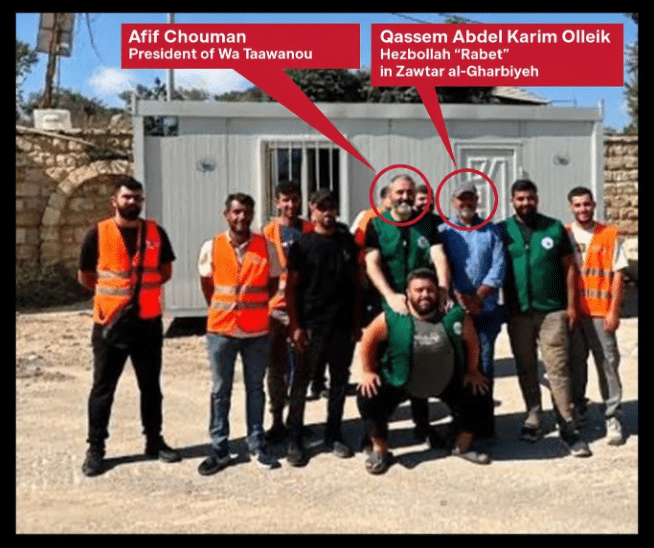
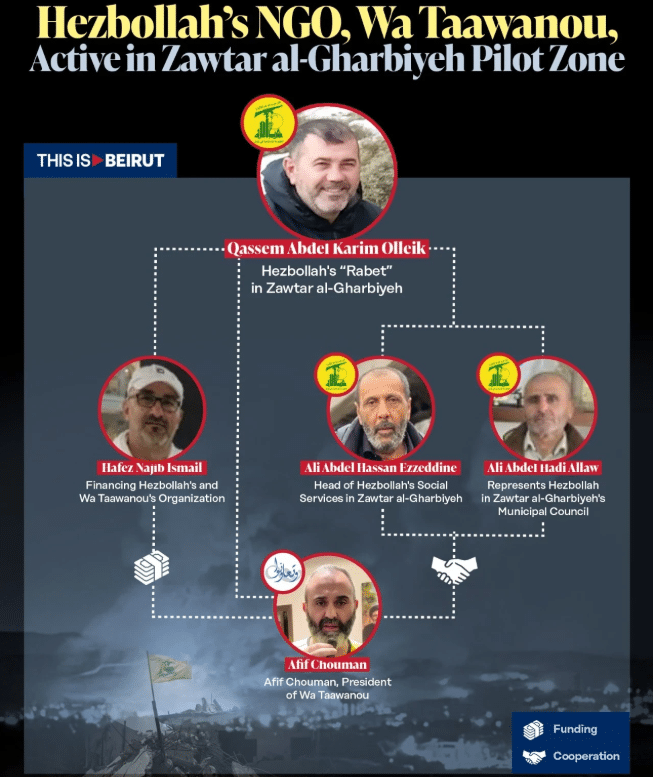
The significant story is not the connection itself (which is proven and well known to us) between the association and Hezbollah, but the possible identity of the parties who brought about the exposure of Hezbollah operatives and highlighted the clear connection between them and the association.
On 20 August, political and civic activist Ahmad Sami Ismail posted a photograph on Facebook showing him alongside This Is Beirut reporters and other residents. Ismail, a former prisoner incarcerated in an Israeli prison and a native of the nearby village of Zawtar al-Sharqiyeh, is known for his public opposition to Hezbollah’s activities and his support for strengthening the sovereignty of the Lebanese state. Ismail regularly publishes articles and other material in the media reflecting his political leanings in support of state sovereignty and describing how government bodies have been taken hostage by destructive organizations (Hezbollah).
The documentation raises the possibility that information about Hezbollah’s activities and the identities of a senior Hezbollah operative in the village and other operatives was leaked and reached the newspaper through local figures opposed to the organization’s presence. However, the photograph alone does not prove who provided the information.
If this was indeed a deliberate disclosure by local residents, its significance extends beyond the event itself. Publishing the identities of Hezbollah officials effectively constitutes activity against the organization, and its security implications are clear. At the same time, the publication may also deter civilian actors from cooperating with the organization.
In fact, this may be a case of local opponents of Hezbollah exposing a Hezbollah operative in the media, with the aim of distancing Hezbollah from involvement in the area.
Following the publication, Afif Shuman was quick to deny the allegations of improper ties with Hezbollah. He emphasized that the association’s activities are humanitarian and conducted in accordance with the law. Shuman argued that spreading lies such as a connection to Hezbollah harms the reputation of the “Help One Another” association and even endangers it.
Shuman’s current claims contradict his usual statements and conduct known to us from the past. We know that Shuman and the association’s activists did not bother or make any effort to obscure their affiliation with Hezbollah. Quite the contrary.
The municipality of Zawtar al-Gharbiyeh also issued a denial of the claims concerning residents’ affiliation with Hezbollah.
We recall that several portable structures placed by the Help One Another association during 2025 near the line of contact in southern Lebanon were attacked from the air and destroyed because they were intended for Hezbollah’s military use.
Why has identification with Hezbollah become a matter requiring public denial ? Could the connection with Hezbollah, once a source of power and status, become a public and security burden in some places ?
From September to October: Does a Series of Friction Incidents Indicate a Change in Local Dynamics Within the Shiite Base Identified with the Amal Movement?
The incident in Zawtar al-Gharbiyeh does not stand alone. During September 2026, a series of additional incidents were reported in villages in southern Lebanon, involving confrontations between local residents identified with the Amal movement’s base and figures identified with Hezbollah. It is important to note that these are communities known primarily as supporters of the Amal movement rather than clear Hezbollah strongholds.
It should be noted that additional friction between figures identified with Amal and Hezbollah was also reported in January and June 2026, for example in the village of Hatta (January 2026) and in al-Bissariyeh (June 2026). The friction occurred against the backdrop of Hezbollah’s activities and the presence of its infrastructure within civilian areas.
On 6 September, in the village of Arab Salim, exchanges of fire were reported between figures identified with Hezbollah and supporters of the Amal movement. The confrontation stemmed from Hezbollah’s attempt to move operatives and weapons between village houses, which prompted opposition from figures identified with Amal out of concern that Hezbollah’s military activity would expose residents’ homes to Israeli strikes.
That morning, the IDF issued a targeted evacuation warning for a building in Arab Salim and adjacent buildings, stating that a Hezbollah facility was located nearby; shortly afterward, the building was struck.
On 18 September, in the village of al-Qseibeh, north of the Litani, residents opposed the placement of a shipping container in a residential area by Hezbollah’s Islamic Health Organization and the “Help One Another” association. Following the opposition, the shipping container was moved to another location.
On 26 September, in the village of Hanawiyah, a man presented on social media as a Hezbollah operative was filmed firing shots near a resident during a confrontation with him in the village center. According to the report, the man was arrested by a Lebanese Army force.
On 30 September, a Lebanese Army force was hit by an explosive device or from another mechanism in the Nabatiyeh al-Fawqa area. The incident was initially attributed to an Israeli strike, but a Lebanese Army engineering examination raised the possibility that it involved an explosive device planted at the site. The possibility was also raised that Hezbollah was involved in planting it, following friction with residents, but based on the publicly available material, we have no information enabling us to establish this with certainty.
These events differ in their circumstances and in the degree to which the reported occurrences have been verified. Nevertheless, the accumulation of events may point to the possibility of increasing friction between the local Shiite population (in communities known primarily as supporters of the Amal movement) and Hezbollah’s presence in civilian areas.
It should be remembered that relations between Hezbollah and the Amal movement have been characterized over the years by a combination of cooperation and rivalry. The two movements cooperate both politically and militarily. Since October 2023, Amal operatives have fought alongside Hezbollah against Israel, with some killed in the fighting. Nevertheless, behind the unity of the “Shiite duo” lies a longstanding competition for power, influence and control within Lebanon’s Shiite community.
We are not certain that the very willingness of local figures identified with Amal to confront Hezbollah operatives, and in some cases even engage in physical or armed confrontation, can be defined as unusual.
We recall that even in the years before the war, when Hezbollah’s standing was unchallenged, violent confrontations (including the use of weapons) occasionally broke out between Amal supporters / operatives and Hezbollah supporters / operatives over control of local centers of power and influence. For example, struggles over the identity of council members, struggles over operating and providing medical services, and more.
As noted above, the villages of Hatta, al-Bissariyeh, Zawtar al-Gharbiyeh, Hanawiyah, al-Qseibeh and Arab Salim are identified with the Amal movement in the municipal arena. However, this affiliation does not necessarily establish that the Amal movement is organizing the opposition to Hezbollah.
At this stage, it is our understanding, that these events do not indicate a fundamental change in the balance of power between the organizations or a significant rift between the leaderships of Amal and Hezbollah. They appear to be isolated events that did not develop into a broader confrontation. However, the question arises whether these events may point to a broader political context: Could the local tension surrounding Hezbollah’s presence combine with and intensify the rivalry (and perhaps emerging cracks) between Lebanon’s two principal Shiite movements ?
Nabatiyeh: The Demand for the State’s Return
On 02 October, during Lebanese Prime Minister Nawaf Salam’s visit to Nabatiyeh, a video circulated online showed local social activist Abir Hani Marwa, a Shiite opponent of Hezbollah, addressing Salam with a demand to restore state governance, end the war and advance negotiations with Israel.
The footage circulated widely on social media and triggered a fierce campaign against Marwa by Hezbollah supporters. The campaign sought to portray her as part of a small, unorganized Shiite opposition that does not represent most residents of the south.
The campaign did not focus solely on her positions. Photographs of her alongside well-known opponents of Hezbollah were circulated, and an attempt was made to cast doubt on her local and sectarian belonging as well. It was emphasized that she is not a resident of the city of Nabatiyeh itself but of Ain Qana (Nabatiyeh Governorate), and details of her personal life were also circulated, including the claim that she is married to a Christian and a photograph of her daughter’s baptism ceremony in a church.
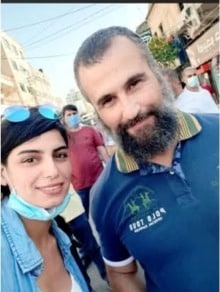


Among other things, it was claimed that she dishonors the memory of members of her family killed during the war, including her brother who was killed in Syria.
In this way, her opponents tried to portray her as an outsider, politically, locally and in sectarian terms, and to diminish the legitimacy of her statements among the Shiite public in the south.
Conversely, publications appeared emphasizing precisely the price her family had paid, a price that lends validity to her arguments and her right to demand change.
The significance of the event lies not only in Marwa’s words, but in the place where they were spoken.
The city of Nabatiyeh, one of the most important centers of the Shiite population in southern Lebanon, a center of gravity and a historical power base for Hezbollah and Amal, became a platform for a public call to restore state authority, place security responsibility with the army and advance a political solution with Israel.
This does not necessarily constitute a wholesale rejection of the concept of “resistance”, but it may well be another expression of declining confidence in Hezbollah’s ability to ensure security and stability and in the organization’s image as the “defender of Lebanon”.
On the other hand, is it not in Hezbollah’s interest for the Lebanese Army to deploy extensively in the Nabatiyeh city area and effectively serve as an additional human shield for Hezbollah’s military activities in the city?
Nabatiyeh is becoming a central arena in the struggle between the Lebanese government and Hezbollah, and not only over weapons.
Prime Minister Nawaf Salam’s visit to the city (and President Aoun’s as well) was intended to present a state returning to the south, rebuilding and strengthening its institutions. At the same time, figures identified with Hezbollah used the visit to promote the opposite picture: a state failing to meet residents’ needs, facing “residents of the south” demanding reconstruction and a return to their homes.
Nabih Berri and the Amal Movement – Is Hezbollah Turning from an Asset into a Burden?
The local events described above take on added significance in light of various reports of growing tension between Hezbollah and Nabih Berri, Speaker of the Lebanese Parliament and leader of the Amal movement.
For years, Hezbollah’s political standing relied on its alliance with the Amal movement, which created a united Shiite front and gave both movements significant power in Lebanon’s political system.
However, the interests of the two movements are not necessarily identical.
On 30 September, reports were published of a widening gap between Hezbollah and Berri regarding Nawaf Salam’s government.
According to the reports, beyond intensifying its criticism of the government, Hezbollah also examined options for exerting public pressure against it. Berri, by contrast, opposed moves that could bring down the government or open another political front.
It was also reported that when the possibility of coordinating protest activity against the government arose, Berri instructed Amal movement members not to participate.
According to those publications, Berri made clear to Hezbollah that Lebanon’s condition does not allow for another political crisis, and that he had committed to Saudi and Western officials to work to preserve the government’s stability.
In addition, a decline in direct coordination between Berri and Hezbollah was reported, as was Berri’s dissatisfaction that Hezbollah does not inform him in advance of some of its moves.
These reports should be treated with caution, as some concern behind-the-scenes contacts. Nevertheless, they are consistent with the evident differences between Amal’s more state-oriented and pragmatic approach and the hard line presented by Hezbollah.
Is the realization beginning to sink in among Nabih Berri and his people that Hezbollah’s continued military dominance does not necessarily serve the interests of the Amal movement and the Shiite population it represents ?
From Amal’s perspective, another war could bring further destruction of communities, mass displacement, harm to its Shiite support base and a deepening of the economic and social crisis.
Conversely, preserving government stability, strengthening state institutions and ensuring the flow of international reconstruction funds may serve Berri’s political and public interests, particularly when he and his organization, the Amal movement, control the “Council for the South”, which is responsible on the state’s behalf for rebuilding the south and serves as a means of potentially controlling substantial budgets for this purpose.
This does not mean that Berri seeks to dismantle the alliance with Hezbollah or confront it head-on. At this stage, it is more likely an attempt to preserve political room for maneuver and prevent Hezbollah from dragging the entire Shiite community into another confrontation.
However, if the trend continues, the tactical differences between the two movements may develop into a deeper dispute over who determines the future of the Shiite community, and what price it is required to pay for Hezbollah’s continued military activity.
North of the Litani: Fear of the Next War
In our assessment, one of the main factors that may drive a significant change within Amal’s Shiite base is fear of the war expanding northward.
Residents of villages north of the Litani see the consequences of the war in southern Lebanon: destroyed communities, a displaced population, damaged infrastructure and an Israeli military presence in areas where Hezbollah operated for years.
They understand that the area north of the Litani is not immune to a similar scenario.
Israeli operational control in the Nabatiyeh area and the IDF’s presence in the security zone have psychological and security significance that extends beyond the territory itself. For residents, the possibility that Israel will decide to expand its maneuver northward, whether following escalation or as part of an initiated operation, is no longer merely a theoretical scenario.
This reality may create a fundamental change in the balance of fear.
In the past, residents who opposed Hezbollah had to take into account its military power, its mechanisms of influence and the social and personal price of confronting it.
Today, in some communities, particularly those affiliated with the Amal movement, another, greater fear may be growing: fear of an Israeli military operation that would destroy the village, displace the family and cause the loss of one’s home.
In other words, part of the Shiite population may be beginning to fear the consequences of Hezbollah’s presence more than the price of opposing it.
This does not mean that residents support Israel. Far from it. It means that they may understand that Hezbollah’s continued military presence near their homes directly endangers them.
This understanding may also be growing clearer in light of the shift in Israel’s operational approach evident since 07 October 2023.
Israel has demonstrated that it is prepared to use force on a large scale, strike Hezbollah’s strategic infrastructure and establish a prolonged ground presence deep inside Lebanese territory when it considers this necessary for its security.
The implication for the local population is clear: as long as Hezbollah continues to operate from within civilian areas, the risk of renewed and expanded fighting remains real.
The Israeli Warning: The Nabatiyeh and Litani Areas in the Crosshairs
On 14 October 2026, Defense Minister Israel Katz addressed the possibility of Hezbollah joining Iran in an attack on Israel, as it did on 02 March.
Katz warned that in such a case, Hezbollah would suffer a severe blow and lose additional territory in southern Lebanon, in the Nabatiyeh and Litani areas, which would become part of Israel’s permanent security zone.
According to him, the IDF is prepared to carry out another maneuver.
He further warned that Beirut’s Dahieh district would be evacuated, Hezbollah infrastructure would be attacked, and more than a million Shiites could become displaced within Lebanon.
It must be clarified that this is an Israeli warning and a conditional scenario, rather than a decision already taken to carry out such a move.
Nevertheless, the warning may have a significant impact on the Shiite population, particularly in areas north of the security zone (“yellow line”) and also north of the Litani River.
Residents do not need to imagine what this means. They have already seen what happened in the villages to their south.
From their perspective, Hezbollah’s military presence in a village could turn it into a future combat area.
Under these circumstances, the demand to distance Hezbollah from Shiite residential areas identified with the Amal movement’s base may become an existential demand.
The Lebanese State Returns to the Villages – Is an Alternative Emerging?
Alongside local opposition to Hezbollah’s presence, an effort can be identified to try to highlight the presence of Lebanese state institutions.
In recent months, Zawtar al-Gharbiyeh has become a focal point for visits by senior officials:
On 22 July, Prime Minister Nawaf Salam visited the village, together with the defense minister, the chief of staff and other senior officials.
On 23 July, Lebanese Army Commander Rodolphe Haykal was documented visiting units deployed in the area.
On 12 September, Lebanese President Joseph Aoun arrived in the village, accompanied by the army commander and other senior officials.
On 15 September, the United States Ambassador to Lebanon, Michel Issa, visited the site, against the backdrop of the return of security responsibility in the area to the Lebanese Army as part of the pilot zones program.
These visits may indicate an attempt to present residents with a state alternative to Hezbollah’s mechanisms.
Nevertheless, the mere presence of senior officials does not guarantee a change in the local balance of power. The real test will be the state’s ability to provide security, rebuild infrastructure, deliver services and prevent the return of Hezbollah’s military infrastructure.
This is particularly important because Hezbollah continues to maintain significant civilian and social systems that allow it to preserve influence even when its military presence is limited.
Summary and Situation Assessment: Are We Approaching the Emergence of a Sentiment Favoring the Exclusion of Hezbollah?
The series of events in southern Lebanon, local opposition to Hezbollah’s presence, calls to strengthen state institutions and the emerging political differences between Hezbollah and the Amal movement may point to a new development within the Shiite community as a whole.
We have no basis for determining that this is the beginning of a “Shiite revolt” against Hezbollah or an overall change in the community’s position. On the contrary, as of this writing, we are far from that, if it is happening at all. Hezbollah continues to possess deeply entrenched mechanisms of power, influence and dependence, and the alliance with the Amal movement remains a central component of Lebanon’s political system.
However, the war and its consequences may be beginning to change the priorities of part of the Shiite public that does not belong to Hezbollah’s base.
The struggle is not necessarily between support for Hezbollah and ideological opposition to it, but between the Shiite community’s continued commitment as a whole to the “resistance” and the desire to protect one’s home, family and livelihood.
Within this reality, the Amal movement and Nabih Berri face a significant dilemma: Should they continue to preserve the alliance with Hezbollah even at the cost of another war, or increase their political distance from Hezbollah in order to protect the interests of the Shiite support base identified with Amal ?
Nabih Berri and his people may be beginning to understand that Hezbollah, once perceived as a force strengthening the Shiite community’s political power, could become a force endangering its future.
In this respect, the current events in villages identified with Amal, described in this document, may be particularly important. Could they indicate the development of local pressure from below, which over time may also influence the leadership of the Amal movement ?
The understanding that Israel has changed, and that another war could bring the IDF to the Nabatiyeh area and farther north, may accelerate the process.
Sentiment favoring the exclusion of Hezbollah does not necessarily require its political or ideological exclusion. At the first stage, it may be expressed in a demand to distance its military activities from the villages, reduce its involvement in civilian areas and transfer security responsibility to the state.
Such a change, if it materializes, would have strategic significance. Is such a change realistic?
For decades, Hezbollah built its power on the claim that it is the defender of Lebanon and protects the Shiite community as a whole. Is it possible that the prospect is now emerging that some members of the community are beginning to see it instead as the force endangering them ?
If fear of Hezbollah once helped preserve its control over Shiite areas, today fear of the next war with Israel may have some potential to constrain its actions in places that are indeed controlled by the Shiite community, but are not controlled by Hezbollah’s base.
The central question is whether these are local, isolated events, or are they the beginning of a deeper change in the balance of power within the Shiite community, between Hezbollah, Amal and Lebanese state institutions?