General:
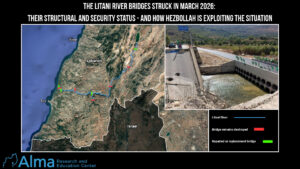
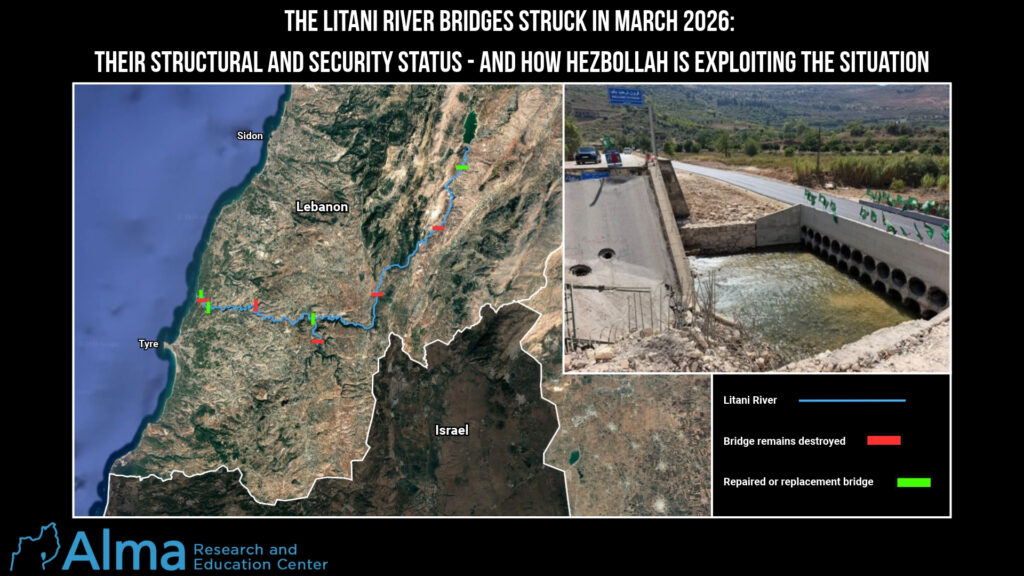
During March 2026, as part of Operation Roaring Lion, six bridges along the Litani River were struck, according to IDF publications. These bridges served Hezbollah as vital routes for moving operatives and weapons under civilian cover across the Litani River and into southern Lebanon.
The current situation indicates that the strikes on the Litani bridges in March 2026 significantly disrupted movement along routes connecting the areas north and south of the river, as well as the Beqaa Valley and southern Lebanon. However, their impact was not fully sustained over time.
The Lebanese Army, the Ministry of Public Works, the National Litani River Authority, and other local bodies gradually worked to reopen the routes through emergency repairs, temporary crossings, and improvements to alternative bridges.
The construction of temporary crossings and the diversion of traffic to alternative bridges reduced the isolation caused by the strikes and restored much of the capacity to cross the Litani River. Hezbollah is, of course, exploiting this situation. It is once again using civilian routes to move operatives, equipment, and weapons into the area of southern Lebanon south of the Litani and north of the IDF security zone (the “Yellow Line”).
Hezbollah also benefits from the absence of continuous military monitoring on the ground at most crossings, although we seriously doubt that even if such monitoring were in place, it would effectively stop the organization.
The remarks made on October 15, 2026, by Hezbollah MP Hassan Fadlallah regarding the vehicle carrying Hezbollah explosives seized at the Dahr al-Baydar checkpoint leave no room for doubt. He explained that, as soon as the vehicle was stopped, the relevant parties within the resistance [Hezbollah] contacted Lebanese security forces and judicial authorities, informed them that the vehicle and its cargo belonged to the resistance, and demanded the immediate release of the detainees and the return of the vehicle and its contents, stating that the materiel was used by the resistance against Israel for the sake of their land in southern Lebanon (we have previously published extensively on the “revolving door” practice, whereby Hezbollah detainees are released and seized equipment and weapons are returned to Hezbollah).
Another contributing factor is the topographical and geographical conditions along the river, particularly during the dry seasons, when the river can be crossed at certain points without a bridge.
Purpose of the Report:
We aim to review the current status of the bridges struck in March 2026. Specifically, we examine their structural status (whether the bridges have been rebuilt, repaired, or remain destroyed, and whether a temporary bridge has been built in their place or an alternative bridge is being used) and their security status (whether the Lebanese Army and Lebanese security forces are present nearby or have established a security checkpoint). At the time of writing, renewed traffic has been documented on some routes crossing the Litani River following road repairs and the establishment of alternative or temporary crossings.
Bridge Strikes and Current Status – Overview:
According to our review published on March 24, 2026, the sequence of strikes on the bridges was as follows:
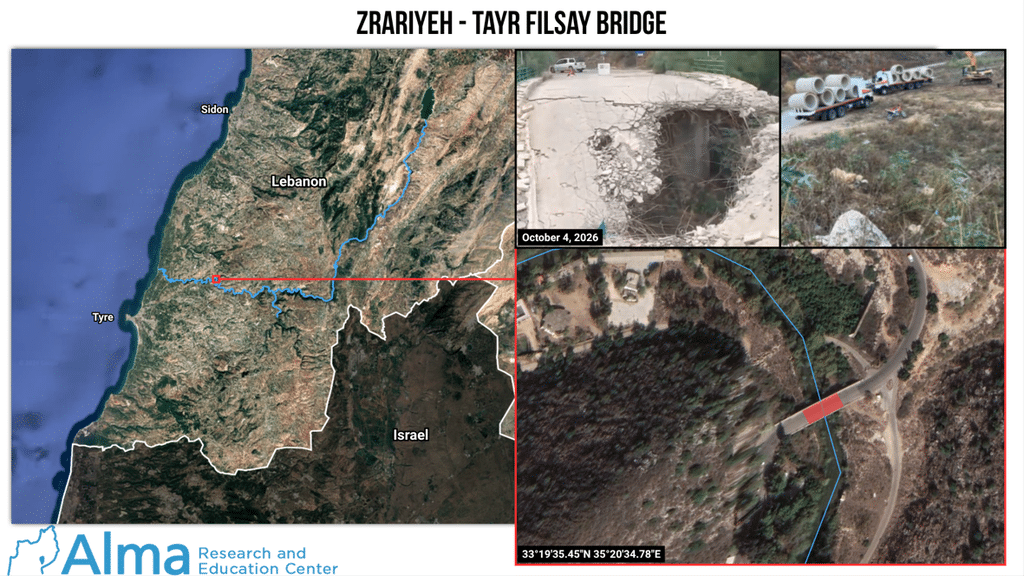
On March 13, 2026, the Zrariyeh – Tayr Filsay Bridge was struck. The following day, March 14, another strike targeted a road leading to the Khardali Bridge, which connects the village of Marjaayoun with Nabatieh.
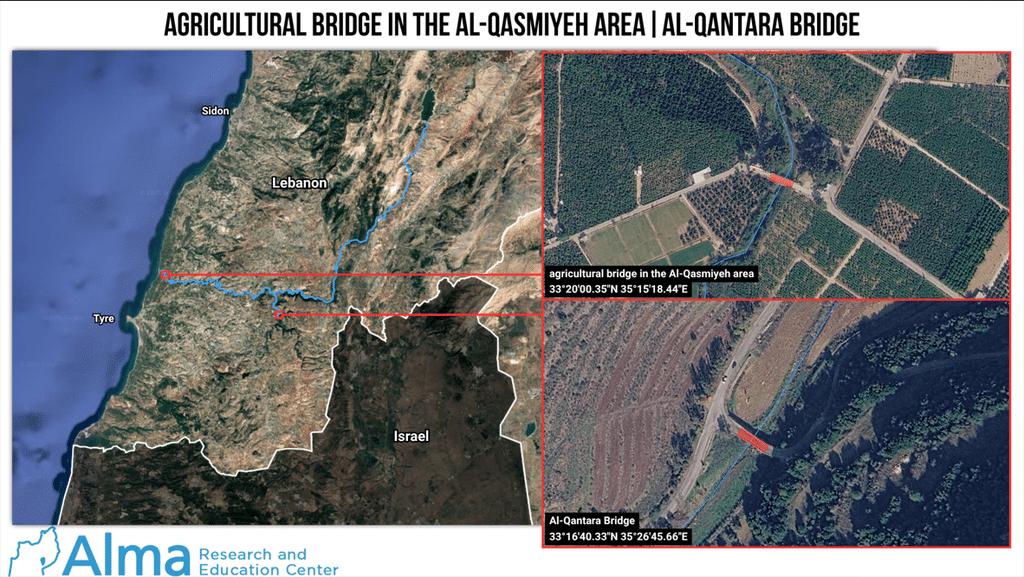
On March 18, 2026, the IDF announced that two additional bridges of importance to Hezbollah had been struck: an agricultural bridge in the al-Qasmiyeh area (Qasmiyeh Bridge) leading to the city of Tyre, and a bridge south of the village of Qaaqaaiyet El Jisr (Qaaqaaiyet El Jisr Bridge).
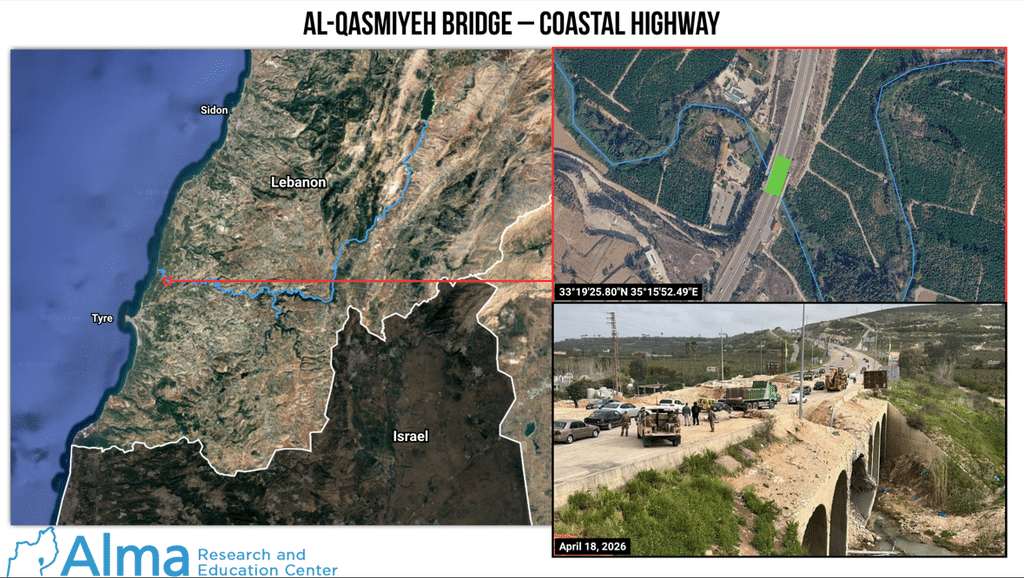
On March 22, 2026, the IDF struck the Qasmiyeh Coastal Highway Bridge, located in the Burj Rahal area and connecting Sidon with Tyre.
On March 23 and 24, 2026, the IDF struck the Dlafy Bridge twice. It is the largest bridge in southern Lebanon and serves as a major transit route from the Beqaa Governorate to southern Lebanon (the Beqaa serves as Hezbollah’s strategic depth and an operational and logistical center of gravity).
At the end of March, local sources reported on the full status of the bridges that had been struck. According to these sources, the IDF had also struck the Al-Qantara Bridge on March 12, 2026, which provides a crossing over the southward branch of the Litani River. [1]
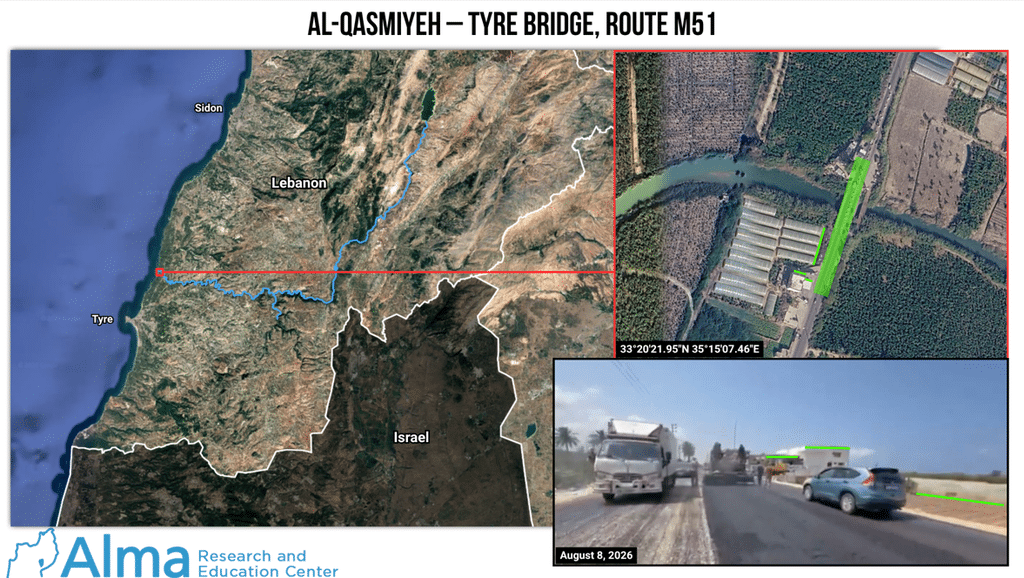
Although sources did not list it among the bridges struck in March–April, the al-Qasmiyeh – Tyre Bridge on Route 51M was also reportedly destroyed in an Israeli strike. The latest footage of the bridge, dated August 10, shows that rehabilitation work had been carried out. No military checkpoint is visible nearby. [2]
On April 18, the Lebanese Ministry of Public Works described the temporary, partial reopening of the Qasmiyeh Coastal Highway Bridge in the Burj Rahal area following emergency repairs. According to the statement and corroborating photographs, traffic was already flowing in both directions in April while work continued.[3] This is the latest evidence of the bridge’s condition. A Lebanese Army statement documents work to reopen the route but does not describe the presence of a permanent military checkpoint at that time. The footage showed traffic moving freely in both directions.
On April 19, the Lebanese Army announced rehabilitation work on the Zrariyeh – Tayr Filsay Bridge. On April 20, its announcement that an alternative bridge had been completed and opened to vehicles was published, while reconstruction of the bridge that had been struck remained unverified. The Lebanese Army’s statements provide no information on the establishment of a military checkpoint.[4] On October 4, it was reported that the National Litani River Authority had announced the construction of an alternative crossing to replace the destroyed bridge. The authority also published a video from the site, showing that the bridge remained destroyed and that tractor work was underway along the riverbank.[5] The alternative bridge has not yet been documented as open to traffic.
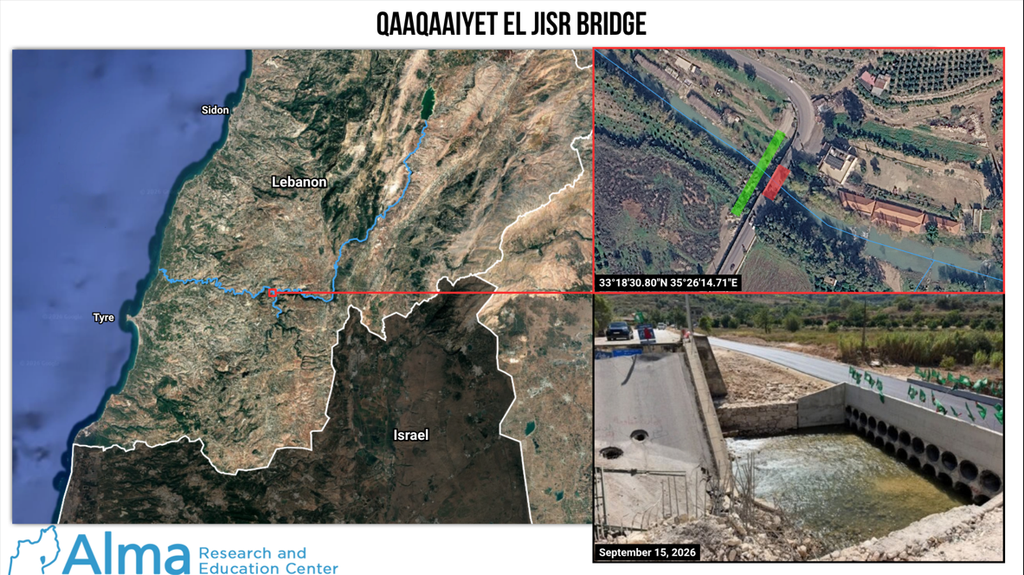
According to a July 7 report by “Al-Araby Al-Jadeed”, a military checkpoint was located beside the Qaaqaaiyet El Jisr Bridge. The report stated that the road ended at the bridge itself and that traffic across it was prohibited. This describes the situation as of July, before the work and reopening.[6] On August 13, the Litani River Authority announced that construction of an alternative crossing had begun with assistance from the Lebanese Army. On August 15, the Ministry of Public Works described the construction of a crossing over the river, comprising two rows of pipes and filling material on which the road would be built.[7] On September 15, the Lebanese Ministry of Public Works confirmed its opening as a temporary vehicle crossing. The statement described its completion, with permanent rehabilitation of the original bridge planned for a later stage. A Ministry of Public Works statement on September 16 reiterated its status as a temporary solution.[8]
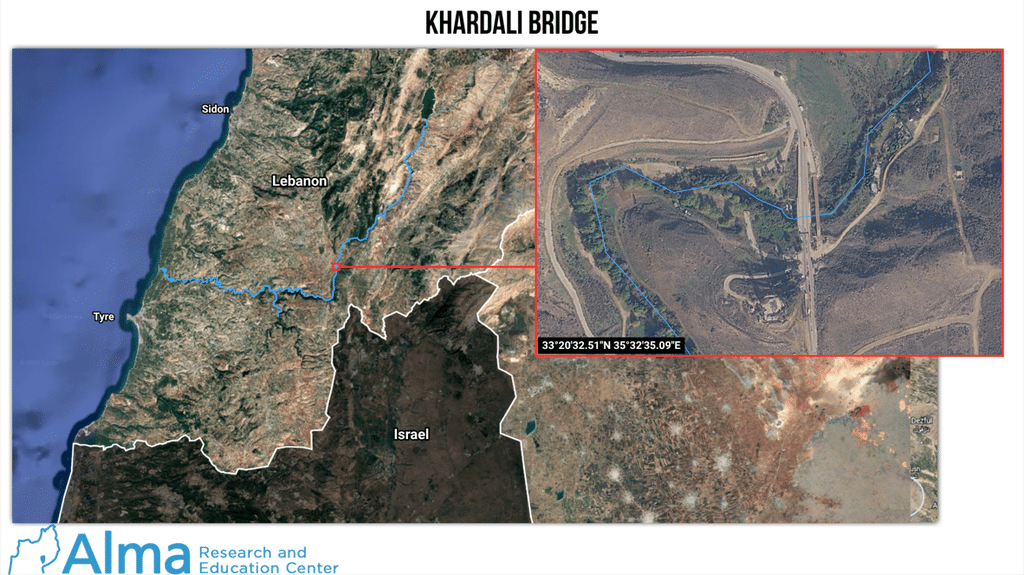
On March 18, “Lebanon24” clarified that the strike four days earlier had hit the road leading to the Khardali Bridge, rather than the bridge itself. According to the same report, the Lebanese Army and UNIFIL had begun reopening the access road, and the military position on the bridge remained in place. On April 19, the Lebanese Army confirmed that the route had reopened following cooperation with the Ministry of Public Works.[9] On July 22, a UAV strike was reported in an open area near the military checkpoint in the Khardali Bridge area. This may indicate the presence of a permanent checkpoint on the route to the bridge.[10] Later, on September 11, the route was reportedly completely blocked by a rockslide that, according to the same report, had been caused by an explosion on the Ali al-Taher ridge.[11] The resumption of traffic across this bridge has therefore not yet been documented.
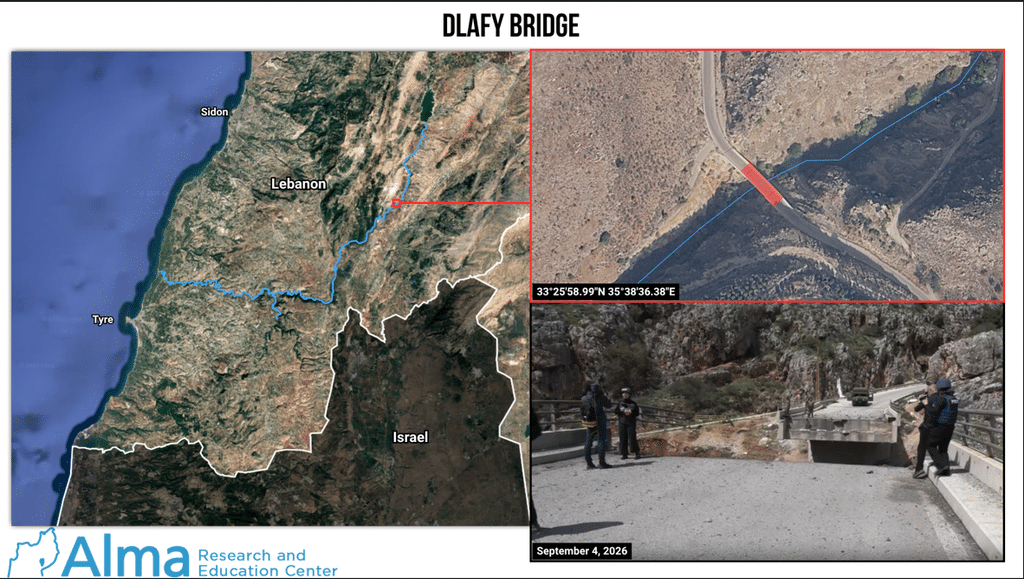
In an April 25 report on the Dlafy Bridge, Jihad Yassin, the mayor of Dlafy and deputy head of Hezbollah’s municipal affairs apparatus, said that Lebanese Army technical teams had inspected the site to assess the strength of the concrete connections that had anchored the bridge to the two cliffs.[12] The Dlafy Bridge hyis a major bridge in Lebanon, linking the Beqaa Valley (Hezbollah’s strategic depth) with southern Lebanon. The strike left a chasm between the two cliffs.
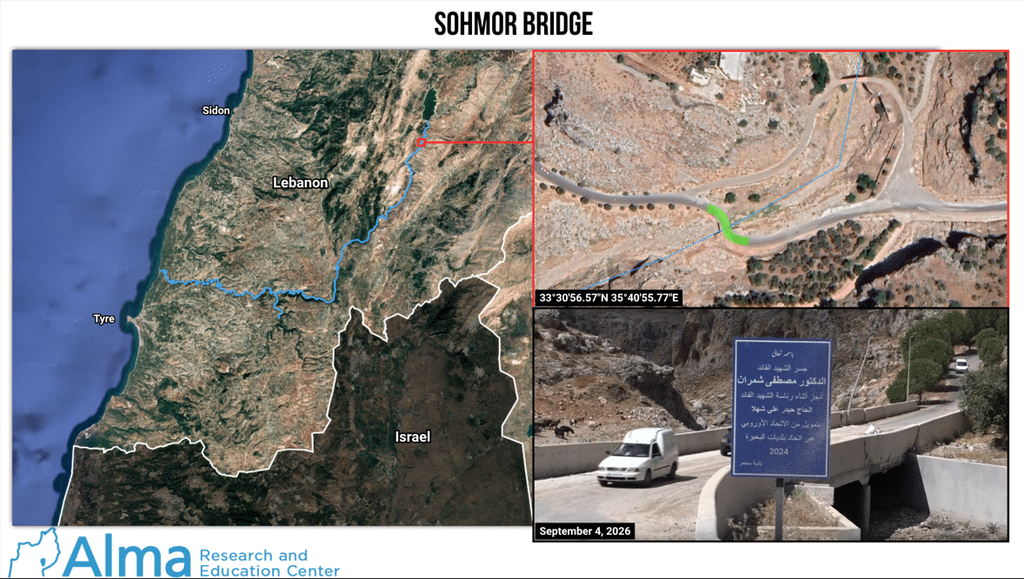
An Al-Manar video report published on September 4 documented traffic on the Sohmor – Mashghara Bridge, which local sources claimed had also been struck but serves as a principal alternative crossing to the Dlafy Bridge. This report supports the assessment that the Dlafy Bridge had not yet returned to use as a crossing by early September. No military checkpoint has been verified at the alternative bridge.[13]
The only two bridges struck in March–April 2026 for which no evidence of rehabilitation or reopening to traffic has been recorded are the agricultural bridge in the al-Qasmiyeh area and the Al-Qantara Bridge.
Summary:
The current situation indicates that the strikes on the Litani bridges in March 2026 significantly disrupted movement between the areas north and south of the river and between the Beqaa Valley and southern Lebanon. However, their impact was not fully sustained over time.
The Lebanese Army, the Ministry of Public Works, the National Litani River Authority, and local bodies gradually worked to reopen the routes through emergency repairs, temporary crossings, and improvements to alternative bridges. As a result, traffic resumed on the Qasmiyeh Coastal Highway Bridge and the temporary crossing at Qaaqaaiyet El Jisr, while the Sohmor–Mashghara Bridge serves as an alternative to the destroyed Dlafy Bridge. Rehabilitation work has been documented on the al-Qasmiyeh–Tyre Bridge on Route 51M.
However, the crossing network has not yet been fully restored to its previous condition. The Dlafy Bridge remains destroyed, traffic on the Khardali route has not been documented as resuming since it was blocked in September, and no evidence has been found of the rehabilitation of the Al-Qantara Bridge or the agricultural bridge in the al-Qasmiyeh area. Reconstruction of the original Zrariyeh Bridge has also not been verified, and footage from October indicates that work on an alternative crossing is continuing.
From a security perspective, the Lebanese Army has been extensively involved in reopening and rehabilitation work and in supervising these efforts. However, it cannot be established that continuous military monitoring on the ground is in place at all active crossings. Checkpoints were documented in the Khardali area and at Qaaqaaiyet El Jisr at specific points in time, but their continued operation has not been verified. Announcements about the reopening of crossings also did not specify whether vehicles undergo regular inspections. Conversely, the absence of documentation of a checkpoint does not necessarily prove that the army is not present.
At the operational level, the construction of temporary crossings and the diversion of traffic to alternative bridges reduced the isolation caused by the strikes and restored much of the capacity to cross the Litani River. This development may allow Hezbollah to resume exploiting civilian routes to move operatives and materiel into southern Lebanon, particularly at crossings where permanent security monitoring has not been verified.
Timing is another factor to consider. During the dry seasons, particularly in late summer and early autumn, the volume of water in the Litani decreases significantly. Shallow areas form in certain sections of the river, and the riverbed sometimes dries out almost completely, potentially allowing it to be crossed without a bridge. However, this is possible only at specific points and depends on water depth, ground conditions, and water releases from dams and hydroelectric facilities. This is a localized and variable possibility, rather than a permanent alternative to a bridge.
The issue of the Litani River bridges presents a paradox: facilitating civilian movement across Lebanon also effectively enables Hezbollah operatives to move freely throughout the country, transport equipment and weapons, and rebuild their capabilities. The state’s lack of intent or effective capacity to secure the crossings assists Hezbollah’s efforts to rebuild south of the Litani.
[1] https://x.com/arabic_post/status/2039054177704316984?s=20
[2] https://x.com/nbntweets/status/2086144470676910528?s=20 ; https://x.com/Alhadath_Leb/status/2086097819237068962?s=20
[3] https://www.annahar.com/lebanon/politics/301560/
[4] https://web.archive.org/web/20260420044130/https://www.lebarmy.gov.lb/ar/content/; https://www.elnashra.com/news/show/1776052?ocid=Nabd_App; https://www.annahar.com/lebanon/302227/
[5] https://www.nidaalwatan.com/article/400975; https://x.com/LRALitani/status/2106765948548223144?s=20
[6] https://www.alaraby.co.uk/politics/
[7] https://www.lebanonfiles.com/2026/articles// ; https://www.elnashra.com/news/show/1795149/ –
[8] https://www.elnashra.com/news/show/1800013 – ; https://www.elnashra.com/news/show/1800184
[9] https://web.archive.org/web/20260420044130/https://www.lebarmy.gov.lb/ar/content/ ; https://www.lebanon24.com/news/lebanon/1499371
[10] https://www.aljadeed.tv/news/
[11] https://www.mtv.com.lb/news/1735697
[12] https://iconnews.net/post/131212/#google_vignette
[13] https://www.elnashra.com/news/show/1791778 ; https://beiruttime-lb.com/2026/09/