Over the past month, several indications have emerged suggesting that Turkey is establishing itself as a mediator and influential actor between the al-Sharaa regime in Damascus, Hezbollah, and the Lebanese government in Beirut, while also consolidating its role as a tangible infrastructure actor on Syrian territory.
On October 1, 2026, Reuters reported that representatives of the Syrian government and Hezbollah had held at least one direct meeting in Turkey during the month preceding publication. The sources cited included two Syrian officials, a US official, and a senior Lebanese security source close to Hezbollah. According to the report, the Syrian participants included intelligence and Foreign Ministry officials, and the meeting took place at the invitation of Turkey’s security and intelligence services to reduce tensions between the parties. Hezbollah and Hayat Tahrir al-Sham, led by Ahmed al-Sharaa, fought for years during the Syrian civil war, before al-Sharaa’s forces came to power in December 2024.
According to one Syrian official, the parties agreed that they bore no hostility toward one another, and Damascus assured Hezbollah that it would not intervene militarily in Lebanon to disarm it. However, according to the sources, no final agreement was reached, and the parties had not intended to announce the meeting publicly.
Following publication, Syria’s Information Ministry publicly denied that the meeting had taken place, writing in a post on X: “These claims are false. No such meeting took place.” The Turkish Presidency’s Directorate of Communications, through its Center for Countering Disinformation, also denied the report, calling it “completely unfounded” and stating that the claims regarding the timing, location, content, and participants “do not reflect any reality and are entirely fabricated and speculative.”
Hezbollah itself neither confirmed nor denied the report, and no response was received from its media apparatus. The occurrence of this specific meeting should therefore be treated as information that has not been independently confirmed.
A further report by the London-based newspaper Asharq Al-Awsat cited Lebanese sources who claimed that the meeting reported by Reuters was actually the second of its kind. An “initial ice-breaking contact” had already taken place in Istanbul in December 2025, on the sidelines of the “Pledge to Jerusalem” conference hosted by Turkey. A Hezbollah delegation headed by Ammar al-Moussawi, who is responsible for the organization’s Arab and international relations, attended the conference.
Reports from December 2025 confirm al-Moussawi’s attendance at the conference, but not the contact with the Syrian side. The Lebanese website Naharnet reported that al-Moussawi visited Turkey on December 6–7 at the head of a delegation to a conference on Jerusalem, and that Ankara subsequently mediated a secret visit by him to Saudi Arabia.
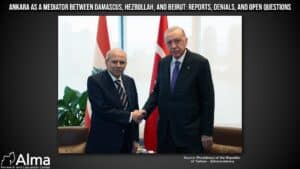
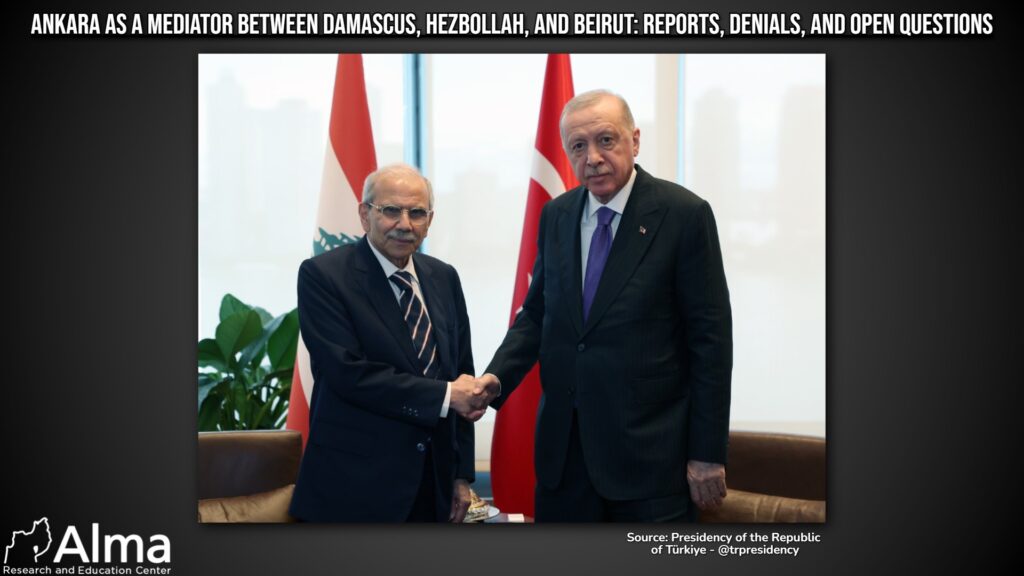
On September 21, 2026, Turkish President Recep Tayyip Erdoğan met with Lebanese Prime Minister Nawaf Salam. The meeting took place in New York at the Turkish House (Türkevi) complex, opposite UN headquarters. According to a statement by the Turkish Presidency’s Directorate of Communications, Erdoğan said that Turkey was working to establish lasting peace and stability in Lebanon, stressed the need for an international initiative to replace UNIFIL, and promised that Ankara would continue providing humanitarian and medical assistance to Lebanon.
These moves appear intended to position Turkey as a central participant in discussions about Lebanon’s future and Damascus–Beirut relations, alongside the development of communication channels between Turkey and Hezbollah. On September 6, 2026, the French-language Lebanese daily L’Orient-Le Jour reported that relations between Ankara and Hezbollah were “gradually and cautiously taking shape away from the spotlight,” ahead of a future role that Erdoğan seeks to play in Lebanon.
It is worth recalling that on August 20, 2026, the US Treasury Department imposed sanctions on ten individuals who, according to Washington, were part of a courier network that transferred up to hundreds of millions of dollars for Hezbollah on commercial flights between Lebanon, Turkey, the UAE, and Iran. According to the Treasury Department, the network is headed by Turkish businessman Yunus Alper Yılmaz, who used exchange houses operating in Turkey as fronts.
According to Lebanese sources quoted in Arab media, contacts through Turkey intensified following US President Donald Trump’s threats that Damascus might undertake the task of disarming Hezbollah, a reference to his statement that Syrian President Ahmed al-Sharaa could carry out this mission.
According to the same sources, the second meeting, reported by Reuters, took place in Turkey during the first ten days of September 2026, with no Hezbollah security or military personnel participating. The sources emphasized that the two meetings, in December 2025 and September 2026, “do not constitute negotiations or understandings,” but instead fall within the framework of an “exchange of messages” between the parties through Turkish mediation.
Conclusion
These three developments – the reported (and denied) Hezbollah – Damascus meeting, Turkey’s growing position in discussions about the post-UNIFIL period, and its stated commitment to continue humanitarian and medical assistance to Lebanon—combine into a consistent picture. Ankara is working to expand its influence in Lebanon and Syria along parallel diplomatic, humanitarian, and security tracks, while avoiding a public commitment to a direct role toward Hezbollah.
Sources:
- https://www.reuters.com/world/middle-east/syrian-government-officials-hezbollah-held-secret-talks-turkey-sources-say-2026-10-01/
- https://www.jpost.com/middle-east/article-910304
- https://www.aljazeera.com/news/2026/10/1/syria-denies-officials-held-secret-talks-with-hezbollah-in-turkiye
- https://english.aawsat.com/arab-world/5324926-syria-hezbollah-exchange-messages-ease-security-tensions-through-turkish
- https://www.naharnet.com/stories/en/317229
- https://www.arabprogress.org/en/hezbollah-envoy-visits-saudi-arabia/
- https://israel-alma.org/turkey-a-nato-member-state-openly-hosts-a-senior-hezbollah-official/
- https://www.aa.com.tr/en/politics/turkiye-continuing-efforts-to-help-establish-lasting-peace-and-stability-in-lebanon-president/4063776
- https://dailybeirut.com/en/lebanon-news/erdogan-meets-salam-in-new-york-we-emphasize-the-need-for-an-international-initi/
- https://today.lorientlejour.com/article/1548249/lebanon-needs-international-force-after-peacekeepers-leave-salam-tells-un-chief.html
- https://today.lorientlejour.com/article/1546692/how-far-do-the-new-turkey-hezbollah-communication-channels-reach.html
- https://home.treasury.gov/news/press-releases/sb0611
- https://www.annahar.com/en/region/lebanon/291310/president-aoun-meets-jumblatt-urgent-dialogue-on-security-and-shelter-crisis
- https://www.arabnews.com/middle-east/prefabricated-homes-arrive-in-destroyed-south-lebanon-town-3003075
- https://www.jpost.com/middle-east/article-910651