
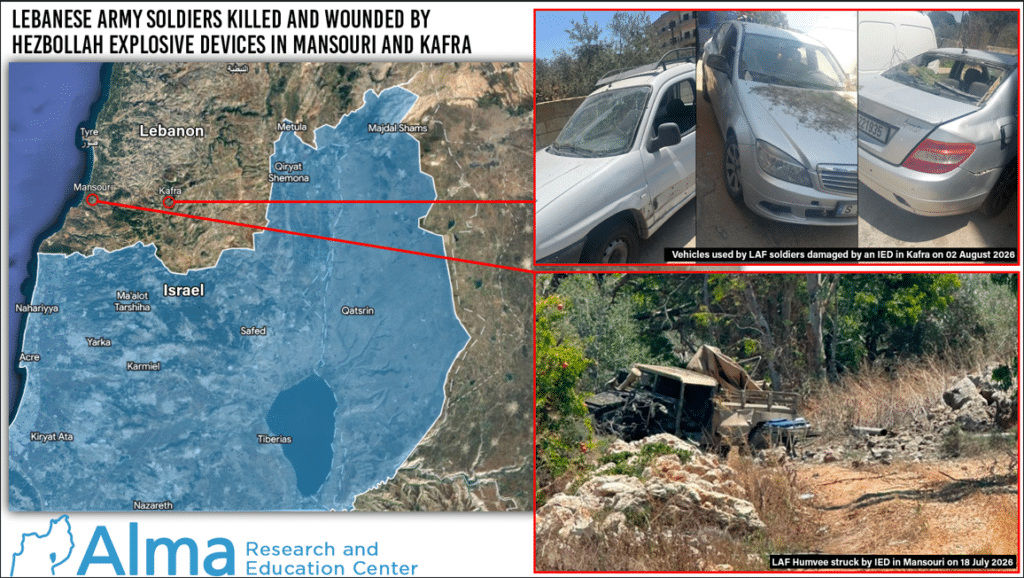
Within less than three weeks, Lebanese Army forces were hit twice by IEDs planted by Hezbollah in southern Lebanon.
On July 18, in the Al-Mansouri area, one Lebanese Army soldier was killed and two others were wounded after an IED exploded. On August 2, in the Kafra area, five additional Lebanese Army soldiers were wounded in another IED explosion.
In both incidents, the IEDs detonated against Lebanese Army vehicles.
Against the backdrop of progress in the negotiations with Israel and the issues surrounding the implementation of the framework agreement regarding southern Lebanon and the concentration of weapons, these two IED incidents raise a broader question. Are these merely Hezbollah IEDs that remained in the area from the period of the fighting, or do they constitute a deliberate, clear, and lethal message from Hezbollah to the Lebanese Army and the Lebanese state, precisely at the stage when they are expected to be required to confront Hezbollah more directly?
It is worth recalling that, alongside coordination mechanisms intended to prevent friction between Hezbollah and the Lebanese Army, the Lebanese Army has received instructions and guidance from Hezbollah regarding which routes and areas it should avoid in order not to interfere with Hezbollah’s activities (of course, in complete contradiction to the Lebanese Army’s mandate under UN Security Council Resolution 1701).
At the same time, Hezbollah has many collaborators within the Lebanese Army, at all ranks, who assist Hezbollah’s activities. This relationship has enabled Hezbollah for years to preserve its freedom of action in southern Lebanon.
Over the years, Hezbollah has succeeded in preserving its military and political power in Lebanon by creating deterrence against internal confrontation. The threat of descending into civil war has been, and continues to be, one of the organization’s most significant sources of power vis-à-vis the Lebanese state.
It is possible that Hezbollah’s IEDs are not merely remnants of the fighting left in the area, but also a reminder that any attempt to change the internal balance of power in Lebanon could entail a heavy internal price.
This week, Lebanese Army Commander Rodolphe Haykal (“Mr. Nice Guy” toward Hezbollah) emphasized that the army would not allow Lebanon to be dragged into a civil war and would continue to preserve internal stability. Haykal’s statement sharpens a fundamental question: If preventing a descent into civil war is the Lebanese Army’s highest priority, how will the army be able to implement the government’s decision to disarm Hezbollah in practice?




One Response
Dear Dana,
The answer to your last question is that the LAF cannot implement disarming hezbollah alone. Lebanon is the bedridden sick patient and hezbollah is the parasitic cancerous disease. The patient must request help to remove ALL the disease or die. To pretend things will be fine is delusional.