
The Iranian Arena
Following the Iranian attack against Israel on June 7, Israel carried out two waves of strikes in Iran during the morning hours of June 8.
The first wave included strikes against air defense systems, missile launchers, and military infrastructure in central and western Iran, including targets in Isfahan (including a UAV production facility), Kermanshah, Karaj, Tabriz, and the area surrounding Mehrabad Airport.
The second wave focused on a petrochemical plant in the Ahvaz area in southwestern Iran. The facility belongs to the Iranian petrochemical company “Karun” and is located in Mahshahr, Khuzestan Province. One of the plant’s products is nitric acid, which can be used by Iran’s weapons industry, including for the production of explosives and components related to ballistic missiles.
In an additional wave of strikes, the Aerospace University in Tehran and Basij positions were targeted. Additional strikes were also reported in Isfahan, Kermanshah, and Karaj.
In the afternoon, the Khatam al-Anbiya Headquarters announced a ceasefire but conditioned it on Israel halting its strikes in Lebanon, including southern Lebanon.
Iran is attempting to establish a new equation.
In response, Israel announced that it was halting its strikes in Iran, but that strikes in southern Lebanon would continue.
The strikes in southern Lebanon continued throughout the escalation with Iran and are ongoing as of the time of writing, even after the Iranian announcement.
Iranian Activity in the Regional Arena
An attack was carried out against Prince Sultan Air Base in Saudi Arabia. According to reports, the attack was launched from Yemen rather than from Iran.
The Strait of Hormuz is completely closed.
The Houthis announced the closure of the Bab el-Mandeb Strait to vessels associated with Israel.
Iraq
The Shiite militias in Iraq declared a general mobilization. In addition, they issued threats against the United States.
The Israeli Arena
From the evening of June 7 until the morning hours of June 8, Iran launched seven barrages of ballistic missiles toward northern, central, and southern Israel. In total, Iran fired more than 20 missiles.
In addition, the Houthis launched two missiles. One was intercepted, while the other fell before reaching Israel.
Minor damage was caused to buildings by interception debris.
Hezbollah Attacks Against Israel
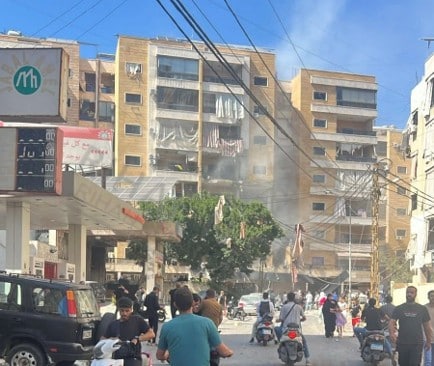
On June 7, Hezbollah launched rockets toward Israeli territory. In response, the IDF struck a Hezbollah command center in the Dahiyeh district of Beirut, killing two operatives.
The incident led to the current escalation and to direct Iranian involvement through the launch of ballistic missiles toward Israeli territory.
Lebanon and Hezbollah
Lebanese Prime Minister Nawaf Salam met with the United States Ambassador to Lebanon, Michel Issa. During the meeting, Salam emphasized that “no one negotiates on behalf of Lebanon except the Lebanese state.”
Lebanese Information Minister Paul Morcos stated that the Prime Minister warned of the consequences of the escalation between Iran and Israel, particularly the possibility of additional waves of displaced persons. According to Morcos, Beirut, Sidon, and other areas are nearing the limits of their absorption capacity, while northern Lebanon and the Beqaa Valley still retain some capacity to accommodate additional displaced persons.
Hezbollah-affiliated Lebanese Member of Parliament Hussein al-Hajj Hassan sharply criticized the Lebanese government and the emerging agreement with Israel. Speaking at a meeting in Baalbek, he argued that under the “achievement” announced by the government, Hezbollah would withdraw from southern Lebanon, while there was no mention of an IDF withdrawal from the area. Al-Hajj Hassan mocked the government and senior Lebanese officials, claiming they were presenting this as a “major national and sovereign achievement,” even though they were calling for Hezbollah’s withdrawal without any reference to an Israeli withdrawal.
Al-Hajj Hassan further questioned whether this could be considered an achievement, noting that there was no mention of the return of displaced persons, the release of Lebanese prisoners, or the reconstruction of Lebanon. According to him, the government’s statement failed to address the promises that had been made to the public.
Following the Iranian attack, the headline of the Lebanese newspaper Al-Akhbar, which is affiliated with Hezbollah, read: “Iran to the World: Lebanon Is Not Alone!” In contrast, the headline of Nidaa Al-Watan, which is associated with the anti-Hezbollah camp, read: “Iran Is Trying to Revive the Unity of the Fronts.”
The International Arena
Qatari Prime Minister and Foreign Minister Mohammed bin Abdulrahman Al Thani held a telephone conversation with Iranian Foreign Minister Abbas Araghchi and emphasized Qatar’s support for all efforts aimed at preventing escalation and reducing tensions in the region.
UK Foreign Secretary Yvette Cooper wrote on X that “the resumption of conflict between Iran and Israel is in no one’s interest.” She stated that both sides must exercise restraint and act immediately to calm the situation and prevent further escalation.
European Union High Representative for Foreign Affairs and Security Policy Kaja Kallas announced that EU member states had approved sanctions against Iranian individuals and entities for their involvement in threats to freedom of navigation and maritime traffic.


One Response
Dear Alma Staff,
Thank for your report, and congratulations on your facilities upgrades too!! I hope to visit with all of you soon.
It is interesting that the Qatari and UK ministers are now promoting de-escalation! It is good to know that Kaja Kallas has announced the approval of additional sanctions against Iran and Iranians who threaten freedom and freedom of navigation.
The reality of facts in the Straits however requires that we recognize that Iran is a bad actor in every sense of the word. The hoped for M.O.U. from the IRGC is like waiting to recieve counterfeit money. President Trump is displaying before the world in plain view, how corrupted and diabolical this regime is at its core. Regrettably, the illusion of de-escalation must soon give way to the reality that these terrorist pirates must be destroyed by force of “domination by escalation” until they have no more power to threaten and terrorize the world. Europe must now wake up from DEI (Delusional Egotistical Insanity) elitist false peace lies and delirium. We cannot afford another Chaimberlain “Peace in our day.”