The Iranian Arena
In the past 24 hours, waves of attacks were reported across Iran, including extensive strikes in Tehran, Isfahan, Bandar Abbas, Karaj, Shiraz, Tabriz, and Kermanshah. In Tehran, an additional intelligence headquarters of the regime was targeted, as well as the main headquarters of the Navy of the Revolutionary Guards, alongside other military and security facilities.
According to U.S. Central Command data, since the start of the campaign, more than 7,000 targets have been attacked, over 6,500 air sorties have been carried out, and more than 100 Iranian ships have been destroyed or damaged.
Eliminations
The IDF eliminated Ali Larijani, Secretary of the Supreme National Security Council, who served as the de facto leader of the Islamic Republic, while he was near Tehran.
Additionally, Khalam Reza Soleimani, commander of the Basij unit for the past six years, was eliminated.
It was also reported that in recent days Israel attempted to eliminate Akram Al-Ajouri, head of the military wing of the Palestinian Islamic Jihad organization. He operated from Iran after leaving Syria following an elimination attempt in Damascus in November 2019. As of this writing, no official confirmation from the IDF spokesperson has been released regarding the elimination, but it appears to have succeeded.
Iran Attacks Targets in the Middle East
Over the past 24 hours, a series of attacks and threats by Iran against Gulf countries were reported, alongside interceptions and defensive responses.
In the United Arab Emirates, strikes were reported at Dubai Airport, which led to a temporary closure of the airspace. The UAE Ministry of Defense announced that it intercepted a missile and UAV attack originating from Iran. Earlier today, an Iranian strike targeted the industrial area of Sharjah, the third-largest city in the UAE. One person was killed in Abu Dhabi due to shrapnel from intercepted missiles.
Additionally, the British Maritime Trade Center reported that a tanker was attacked near the Port of Fujairah.
In Qatar, attacks were reported in the Doha area, with no further details regarding casualties or damage.
In Kuwait, authorities uncovered a Hezbollah cell that was recruiting individuals and attempting to destabilize the local government. Sixteen suspects were arrested – 14 Kuwaiti citizens and 2 Lebanese nationals. Weapons, drones, encrypted communication devices, and maps were seized. The investigation is ongoing, and legal measures are being taken against those involved.
Iraq
A strike was reported on a pro-Iranian militia camp in Jurf al-Sakhar, southern Baghdad. In a separate U.S. military strike on the “Iranian Consultation Headquarters” in the Al-Jadriya area of Baghdad, six fatalities were reported. It has also been reported that Abu Ali Al-Askari – spokesperson and security leader of the Hezbollah Brigades militia in Iraq – was eliminated.
In response, Shiite militias in Iraq attacked several targets, including the U.S. Embassy in Baghdad, the U.S. Victoria Base near Baghdad International Airport, U.S. bases in Erbil in the Iraqi Kurdistan region, and the Al-Rashid Hotel in Baghdad, where a European diplomatic delegation was staying.
The Israeli Arena
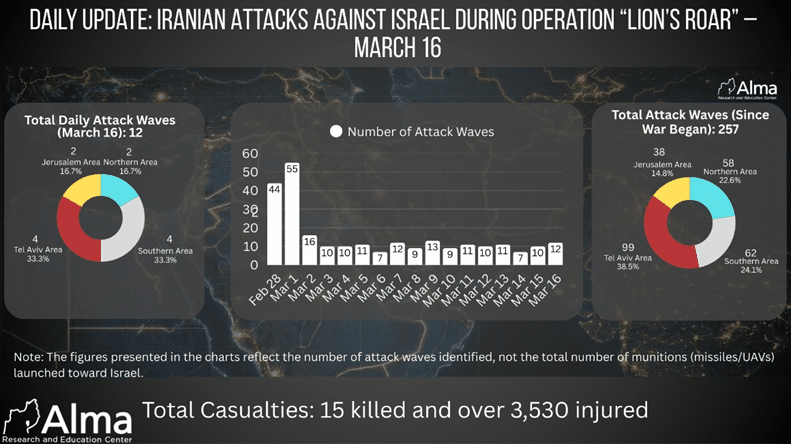
On March 16, twelve waves of Iranian attacks against Israel were identified using ballistic missiles. Geographically, the attacks were distributed across several regions: four waves (33.3%) targeted the Tel Aviv area, four additional waves (33.3%) targeted southern Israel, two waves (16.7%) targeted the north, and two more waves (16.7%) targeted the Jerusalem area.
Since the start of the campaign, a total of 257 waves of Iranian attacks against Israel have been identified. In the cumulative geographic distribution of all attacks, the central region—primarily the Tel Aviv metropolitan area—remains the main target, with 99 waves of attacks (38.5%), followed by the south with 62 waves (24.1%), the north with 58 waves (22.6%), and the Jerusalem area with 38 waves (14.8%).
Daily trend analysis indicates that after the peak at the beginning of the campaign (44 waves on February 28 and 55 waves on March 1), there has been a significant decline in the number of attacks, stabilizing at an average of approximately 10 waves per day.
Since the start of the war, 15 civilians have been killed in Israel, and more than 3,530 people have been injured to varying degrees due to direct strikes, falling missile fragments, and secondary damage.
The data indicate that Iran continues to combine a focus on central Israel with a broad geographic distribution of attacks, including the south, north, and Jerusalem areas, aiming to expand the threat zone, complicate a return to routine, and maintain sustained pressure across all parts of the country.
The pattern of Iranian attacks shows that Iran is currently operating under a strategy of attrition, relying on a steady pace of continuous strikes over time.
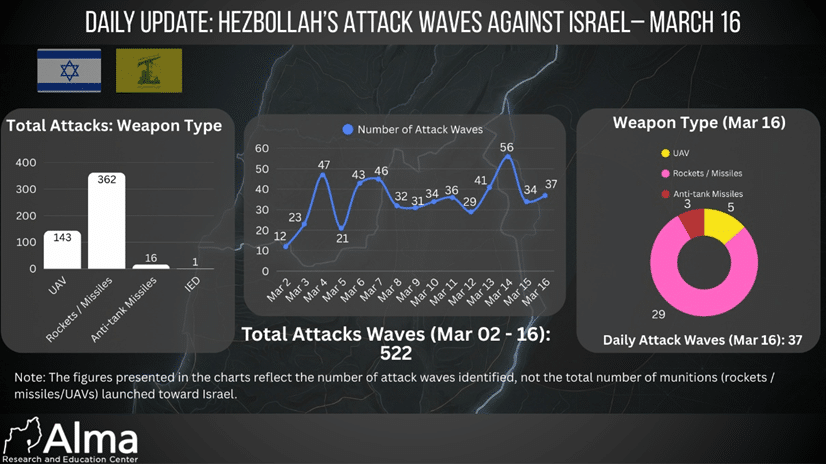
On March 16, 37 waves of attacks by Hezbollah against Israel were identified. By type of weaponry, 29 waves (approximately 78.4%) were carried out using rockets and missiles, 5 waves (approximately 13.5%) using UAVs, and 3 attacks (approximately 8.1%) using anti-tank missiles. These figures refer to the number of attack waves identified, not the total number of munitions actually launched.
Most attacks were directed at settlements along the border and the Galilee region. In one attack, rockets and UAVs were launched toward the city of Nahariya, with a rocket striking the heart of a residential neighborhood.
Additionally, nine of the day’s attacks targeted IDF forces operating in southern Lebanon. It should be noted that information regarding attacks within Lebanon is based solely on claims of responsibility published by Hezbollah; except for one attack, no further indications were identified from other sources.
Since Hezbollah joined the fighting on March 2, a total of 522 waves of attacks against Israel have been identified. Analysis by weapon type shows that rockets and missiles continue to constitute the main attack method, with 362 waves, alongside 143 waves using UAVs, 16 attacks using anti-tank missiles, and one explosive device attack.
Daily trend analysis indicates fluctuations in the scale of attacks throughout the campaign. After a decrease on March 15 (34 waves), there was a renewed increase to 37 waves. Despite this variability, the volume of attacks continues at dozens of waves per day, indicating Hezbollah’s maintenance of a sustained offensive pace, primarily through rocket fire, supplemented by UAV usage.
Lebanon and Hezbollah
Political Activity and International Efforts:
The political system in Lebanon is operating alongside international efforts to curb escalation, but so far there has been no significant progress. The President of Lebanon, Joseph Aoun, stated that there is no prospect for a military solution and emphasized the need to stop the ongoing losses among the population. According to him, Lebanon has been drawn into “the war of others,” and he expressed hope for a breakthrough through an initiative he led to halt the fighting. As of now, no official response has been received from Israel regarding the initiative.
Negotiations and Diplomatic Contacts:
The “Shia duo” continues to oppose negotiations under fire. Nevertheless, U.S.-French contacts with Parliament Speaker Nabih Berri are underway to advance a negotiation track, including discussions regarding the composition of the Lebanese delegation. The U.S. Ambassador to Lebanon, Michele Isaac, recently met with Berri to discuss the reliability of the country’s commitments to disarm Hezbollah and ensure compliance with future agreements. U.S. sources stated that negotiations with Israel are not expected at this stage, and Washington will mediate at the appropriate time through President Trump’s senior advisor, Massad Boulos. Meanwhile, the UN Security Council is expected to discuss the situation in a session on the implementation of Resolution 1701.
In Lebanon, a negotiation committee was established, headed by former ambassador Simon Karam, with additional members including Paul Salem, Shauki Bou Nassar, and Abd al-Sattar Issa. Conversely, senior Lebanese political sources reported that the committee will not be formed and will not conduct negotiations unless a Shia representative joins, subject to the approval of Hezbollah and the Amal movement.
Hezbollah’s Position:
Hezbollah continues to maintain a firm political and military stance, emphasizing the continuation of fighting and refusing concessions. Member of Parliament Hassan Ezzedine stated that “the resistance will not raise a white flag” and that the decision will be made on the ground. The organization continues military operations in response to developments on the ground and rejects demands to cease its military activity. Hezbollah rules out any possibility of negotiations under fire, and military decisions are made independently.
Internal Tensions and Threats to Media Outlets:
An unusual incident was reported involving threats and attacks against MTV after it republished a 2020 article concerning Hezbollah’s activities, including claims about illegal detention facilities in Lebanon. Following the republishing, threats were reported against the channel and its staff. The Christian Kataeb Party responded to the threats, calling them a severe violation of press freedom. Calls were made to protect media outlets and prevent attempts at intimidation and silencing. The incident forms part of a broader context of tensions surrounding critical media coverage of Hezbollah during the fighting.
At the same time, evidence from the field indicates attempts by Hezbollah to control public discourse among the displaced population. According to reports, activists affiliated with Hezbollah are operating within reception centers and refugee camps, working to prevent statements against Hezbollah and to limit media interviews that include criticism of the organization or the plight of the displaced.
Military Situation and Attacks:
Over the past 24 hours, extensive attacks continued in southern Lebanon and the capitals. The IDF are expanding ground maneuvers in southern Lebanon to strengthen forward defense. Two Israeli strikes in Kawkabiyat al-Jisr resulted in injuries to five Lebanese army soldiers, two of them in serious condition, and one fatality.
A further update reports that two additional Lebanese army soldiers were attacked in Zabadin.
To date, more than 400 Hezbollah operatives have been eliminated in the current round of fighting since March 2.
According to Israeli estimates, close to 1,000 operatives from the Radwan unit are located south of the Litani River.
Humanitarian Situation and Displaced Persons:
The number of displaced persons in Lebanon has surpassed one million, reaching 1,049,328. Reception centers are at full capacity, and many displaced individuals are staying in tents, vehicles, or open areas. There is a shortage of basic infrastructure, including sanitation, showers, and medical supplies.
Energy:
According to Al-Arabi Al-Jadeed newspaper, fuel shipments intended for Lebanon from Iraq to operate the country’s power plants will not reach Lebanon due to the closure of the Strait of Hormuz.
The International Arena
Following President Trump’s initiative to establish a multinational force to secure the Strait of Hormuz, the German Chancellor announced that Germany will not participate in the initiative. Greece also stated that it does not intend to take part in security operations in the Strait.
The head of the International Maritime Organization noted that naval escort of ships through the Strait of Hormuz does not provide full assurance of vessel safety, and that military assistance is not a sustainable solution for opening the shipping route.
The British Ministry of Defense announced that the United Kingdom is conducting defensive operations in the airspace over Qatar, Bahrain, Jordan, and the eastern Mediterranean.
In a joint statement, the United Kingdom, France, Canada, Germany, and Italy called on Israel to refrain from a broad ground maneuver in Lebanon, warning that such action could have prolonged and destructive consequences. The statement also emphasized that these countries support the Lebanese government’s efforts to disarm Hezbollah.
The German Chancellor called on Israel not to attack civilian targets or UNIFIL forces in Lebanon, stressing that a ground offensive could further worsen the existing humanitarian situation. He addressed Israel, stating: “Do not take this path. It would be a mistake.”
At the same time, the Chancellor expressed that the current Iranian regime must come to an end and be replaced by a government with democratic legitimacy. He emphasized that the solution in Iran is solely diplomatic and not military.
The Iraqi Minister of Oil announced that agreements exist with Iran to allow safe passage of Iraqi oil tankers through the Strait of Hormuz.