The Iranian Arena
Over the past two days (April 1–2), extensive waves of strikes continued across Iran. In Tehran, the IDF targeted weapons production sites, including a central complex of the Iranian Ministry of Defense, a base of the Islamic Revolutionary Guard Corps, and a mobile headquarters. In addition, air defense systems, launch sites, and facilities for the production and storage of ballistic missiles, as well as missiles intended to target aircraft, were struck. Central headquarters of the Islamic Revolutionary Guard Corps in Tehran were also targeted, which were used for managing the budgets of security bodies and financing terrorist activity worldwide.
In Isfahan, the “Khordad 15” missile base was struck.
An additional strike was carried out on fuel storage facilities at the international airport in the city of Mashhad.
In Mahshahr, targets of the Islamic Revolutionary Guard Corps were struck.
In Shiraz, the electronics company “SA-Iran,” considered a central entity in Iran’s defense industries, was struck once again.
According to the United States Central Command, the U.S. military has deployed advanced electronic attack aircraft of the Compass Call EA-37B type in the Middle East, which disrupt communications, early warning radars, and navigation systems.
In addition, the United States military struck Bridge 1B connecting Tehran to Karaj, as well as additional targets in the Azima area in Karaj.
Eliminations
The commander of a central missile unit in the Kermanshah area, Makram Atimi, was eliminated, along with several battalion commanders in the ballistic missile unit.
In addition, Jamshid Eshaqi, commander of the oil headquarters of the Iranian regime, was eliminated; he had been responsible for years for financing and budgeting the regime’s forces and Iran’s proxies.
Mohammad Ali Fath Ali Zadeh, commander of the “Fatehin” unit—the commando unit of the IRGC ground forces—was also eliminated.
Iranian Activity in the Region:
United Arab Emirates – The Islamic Revolutionary Guard Corps announced that it had attacked American steel industries in the UAE (Abu Dhabi). Authorities in Abu Dhabi reported that operations at the gas facilities in Habshan were halted following a missile strike. According to the UAE Air Defense Ministry, as of April 2, 19 ballistic missiles and 26 UAVs launched from Iran were intercepted. Since the beginning of the war, 457 ballistic missiles, 19 cruise missiles, and 2,038 UAVs have been launched toward the UAE.
Bahrain – An Iranian strike targeted Batelco, the largest telecommunications company in the country, which hosts Amazon servers. The Islamic Revolutionary Guard Corps also announced that it had attacked aluminum industries in Bahrain.
Kuwait – One of the country’s power generation and water desalination facilities was hit in an Iranian attack, causing damage.
Qatar – QatarEnergy reported that its fuel tanker Aqua 1 was attacked at sea north of Qatar.
In response to the strike on the bridge in Karaj, the Iranian Fars News Agency published a list of important bridges in the region that could be targets for retaliatory actions, including in Kuwait, Jordan, the United Arab Emirates, and Bahrain.
Iraq
Three people were injured in a U.S. military strike against pro-Iranian militia forces in the Mosul area in northern Iraq.
On April 1, explosions were reported at a U.S. base in Baghdad.
According to a report in the Lebanese newspaper Al-Akhbar, Iraqi authorities are conducting negotiations with the kidnappers of American journalist Shelly Kittleson in order to secure her release.
The Israeli Arena
Iranian Attacks Against Israel (as of April 3)
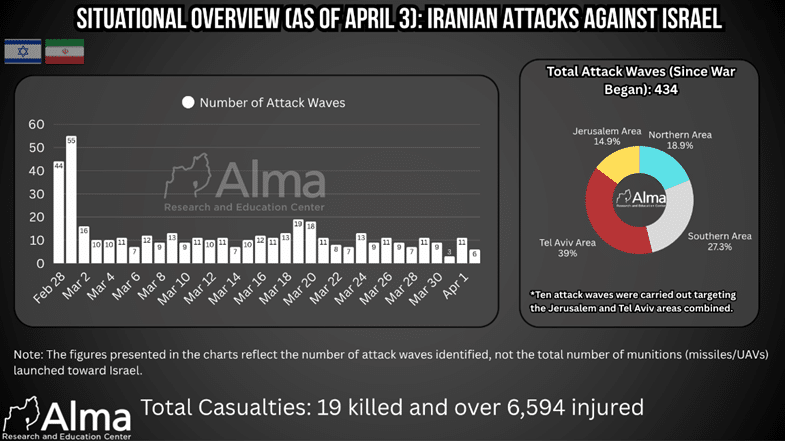
Iran continues to operate a consistent attack pattern as part of a strategy of sustained pressure against Israel, using ballistic missiles while maintaining a relatively moderate pace of attacks, alongside localized fluctuations in the scale of attack waves.
During the holiday evening (April 1), a relative increase in the scope of attacks was recorded, with most attack waves directed at the Tel Aviv area and including missiles with dispersal warheads. This reflects an attempt to intensify harm to the civilian rear and increase the potential for damage. However, the increase in the number of attacks remained within the daily average range and does not constitute a significant deviation from the established pattern of activity.
As a result of the attacks, impacts were recorded in the civilian sphere: a girl was critically injured in the city of Bnei Brak. In addition, two infants were injured by shrapnel, also in Bnei Brak.
During the holiday period (April 1–2), the Houthis, an Iranian proxy, carried out two attacks against Israeli territory using ballistic missiles—one targeting the southern region and one targeting the Tel Aviv and Jerusalem areas.
In recent days, a total of 434 Iranian attack waves against Israel have been identified. In cumulative distribution, the central region—particularly the Tel Aviv metropolitan area—continues to be the primary target, alongside complementary activity in the south, the north, and the Jerusalem area.
Since the beginning of the war, 19 civilians in Israel have been killed, and more than 6,594 people have been injured to varying degrees as a result of direct hits, falling interception debris, and secondary damage. In addition, extensive damage has been caused to residential buildings and civilian infrastructure, and the ongoing fire continues to disrupt daily life.
Hezbollah Attacks Against Israeli Territory (as of April 3)
Hezbollah continues to operate an intensive pattern of attacks against Israel, maintaining a high and sustained level of activity. During the Passover holiday (Wednesday April 1 – Thursday April 2), an increase in the scope of attacks was recorded, during which approximately 150 rockets were launched from Lebanon toward communities in the Galilee and along the border.
As a result of Hezbollah’s attacks, impacts were recorded in civilian areas:
• A residential house in Kiryat Shmona was hit by a rocket—the family members were in a protected space and were not harmed.
• A kindergarten in the city of Nahariya was hit, but it was empty due to the holiday and there were no casualties.
• In addition, several civilians were injured as a result of the attacks.
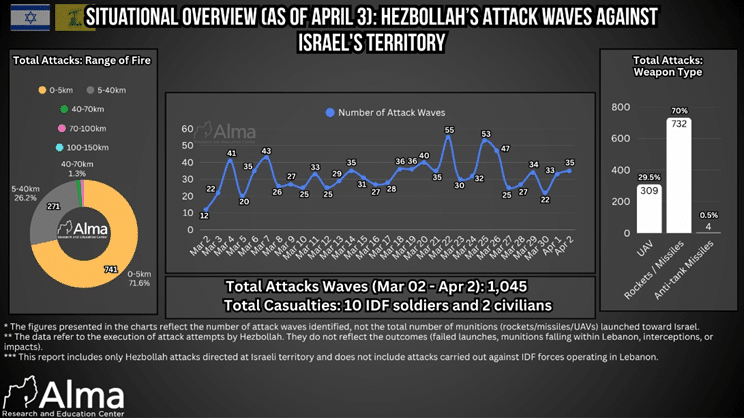
In terms of overall scope, since the beginning of the fighting on March 2, a total of 1,045 waves of Hezbollah attacks toward Israeli territory have been identified. So far, 10 IDF soldiers and 2 civilians have been killed as a result of the attacks.
In terms of types of weaponry, there is a clear dominance of rockets and missiles (approximately 70%), alongside significant use of UAVs (approximately 29.5%), and relatively limited use of anti-tank missiles.
Geographically, the majority of attacks continue to focus on northern Israel, particularly on border communities:
741 attack waves (approximately 71.6%) were directed at communities within up to 5 km of the border.
271 attack waves (approximately 26.2%) targeted ranges of 5–40 km, up to the Haifa area.
A very small proportion of attacks reached longer ranges.
This distribution indicates Hezbollah’s consistent focus on northern communities, alongside limited attempts to expand the range of fire.
Note: This report includes only Hezbollah attacks toward Israeli territory and does not include attacks carried out by the organization against IDF forces operating in Lebanon.
Lebanon and Hezbollah
Lebanese Prime Minister Nawaf Salam emphasized his government’s commitment to using all available means to bring the war to an end. According to him, Lebanon is working to mobilize Arab and international support, against the backdrop of a volatile regional situation that has once again turned the country into a conflict arena. He noted that Lebanon has become a victim of a war whose outcomes and end date are unpredictable, and stressed that this reality requires intensified political and diplomatic efforts, alongside calls to end the ongoing violations of Lebanon’s sovereignty and territorial integrity and to condemn violations of international law and international humanitarian law.
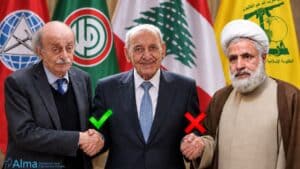
Parliament Speaker Nabih Berri stated that the issue of Iran’s ambassador in Beirut is a serious problem that must be resolved, noting that there are several possible formulas for a settlement. In this context, it was reported that ministers of the “Shiite duo” have resumed participation in government meetings, after the crisis surrounding the Iranian ambassador issue was addressed outside the framework of the official session.
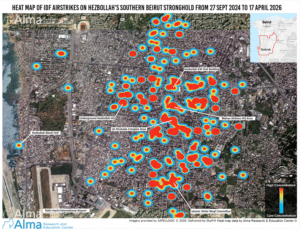
Over the past two days (April 1–2), the IDF struck dozens of Hezbollah infrastructure targets in southern Lebanon. Among the targets were headquarters, weapons depots, launch sites, and anti-tank missile launching positions.
In addition, the IDF struck two currency exchange sites that had continued transferring funds to Hezbollah.
On April 3, the IDF Arabic-language spokesperson issued an evacuation warning ahead of a strike on two additional bridges in the Sahmar area in the southern Bekaa district. The objective of the strike was to prevent the arrival of Hezbollah reinforcements to southern Lebanon.
Syria
Protests against Israel and in support of the Palestinians took place in Homs, Daraa, Latakia, Damascus, and other locations. The protests included the burning of Israeli flags and expressions of support for Gaza. One of the main triggers for the protests is the law imposing the death penalty on terrorists that was enacted in Israel.
The International Arena
Russia, France, and China blocked the Gulf states’ initiative to bring the UN Security Council to approve military action against Iran in order to reopen the Strait of Hormuz.
French President Macron stated that reopening the Strait of Hormuz by force is not realistic. He also said that the war in Iran does not provide a permanent solution to the nuclear issue.
UK Prime Minister Keir Starmer stated regarding the war in Iran that this is not our war. At the same time, in a conversation with the Crown Prince of Kuwait, Starmer condemned the UAV attacks on Kuwait. It was also reported that the UK will send Kuwait an air defense system against short-range ballistic missiles.
A Kremlin spokesperson noted that Russia is ready to do its part to bring the conflict in Iran to an end.
China’s Foreign Ministry justified Iran and stated that the strikes by the United States and Israel in Iran are the reason for the closure of the Strait of Hormuz.
According to Agence France-Presse, Austria is refusing to allow the passage of American military flights through its airspace.
Argentina declared the chargé d’affaires of the Iranian embassy in the country persona non grata and decided to expel him from its territory.
Note: The next report will be published on Sunday, April 5.