The Iranian Arena
Over the past 24 hours, the Israeli Air Force completed another wave of strikes against dozens of infrastructures belonging to the Iranian regime. Among the targets was a central headquarters of the Islamic Revolutionary Guard Corps responsible for launching unmanned aerial vehicles. In addition, nuclear laboratories in Tehran were struck, some of which had already been targeted previously during the 12 Days War in June 2025.
Dozens of Israeli Air Force fighter jets attacked regime infrastructure using more than 170 munitions in the cities of Tehran, Isfahan, and Shiraz.
In Tehran, a headquarters of the IRGC’s Quds Force was struck. This unit is responsible for operating the regime’s terrorist proxies, advancing covert activity, as well as planning, assisting, transferring weapons, and financing terrorist operations across the Middle East. Strikes were also reported in the area of Mehrabad Airport.
In Isfahan, a missile production and storage site intended to target Israeli aircraft was struck, along with several air defense systems of the Iranian regime. In Shiraz, the IDF attacked additional military infrastructure belonging to the regime.
Additional strikes were reported in several locations across Iran:
• The Shahramfar base of the IRGC in the city of Sanandaj in Iranian Kurdistan.
• Khorramabad in Lorestan Province, where according to reports warehouses and a sports hall were struck, which apparently served as gathering sites or weapons storage facilities.
• The area of the governor’s building and the Ministry of Intelligence in Tabriz.
• The Basij base “Mayon Vila” in the city of Mohammadshahr (Karaj).
• Sites in Parchin and Kerman.
In addition, it was reported that a second vessel of the “Shahid Soleimani” class, one of the flagship ships of the IRGC, was destroyed in strikes at the port of Bandar Abbas.
According to the IDF spokesperson, since the beginning of the campaign about 1,900 members of the Iranian regime have been eliminated and thousands more have been wounded. Six military airfields in Iran have also been attacked, and 16 Quds Force transport aircraft used to transfer money and weapons have been destroyed.
At the same time, the United States struck Iranian military industry facilities, including underground missile sites and UAV production facilities, using B-2 bombers. According to data from U.S. Central Command, since the beginning of the campaign more than 5,000 targets have been attacked and more than 50 vessels have been damaged or destroyed.
Iran Attacks Targets Across the Middle East
Over the past 24 hours, the pattern of attacks attributed to Iran and its proxies across the Gulf and the region continued. The attacks included a combination of missiles and UAVs against military and civilian targets, alongside interceptions carried out by regional states.
In the United Arab Emirates, two incidents were reported: the UAE’s general consulate in the Kurdistan region of Iraq was attacked, and in Abu Dhabi a fire broke out at one of the facilities in the Al-Ruwais industrial complex following a UAV attack.
In Kuwait, six UAVs launched toward the country were shot down. In Saudi Arabia, authorities reported intercepting four UAVs (two of them in the Al-Kharj province) as well as a ballistic missile that had been launched toward the eastern region of the country.
In Bahrain, on the night of March 9, an Iranian UAV struck the Millennium Tower in the Al-Seef business district in Manama, the capital of Bahrain. The tower houses mainly business companies. As a result of the strike, one woman was killed and eight others were injured.
Iraq
A strike was reported in Mosul in the northwestern part of the country. Another strike (American) targeted the headquarters of Brigade 30 of the Popular Mobilization Forces (al-Hashd al-Shaabi) in Nineveh province.
The Israeli Arena
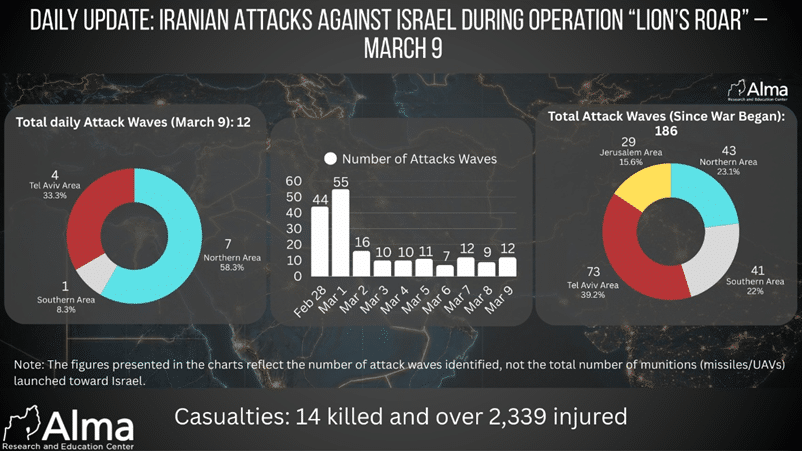
On March 9, 12 Iranian attack waves against Israel were recorded. Unlike previous days, most of the attacks were directed toward the northern region, which absorbed 7 attack waves (58.3%) of the total that day. The Tel Aviv and central region absorbed 4 waves (33.3%), while the south absorbed only one wave (8.3%).
These data indicate a notable change in the pattern of attacks. After several days in which central Israel was the primary target, yesterday saw a broader trend of attacks directed toward the northern region. The increase in attacks toward northern Israel may be linked to the Iranian announcement regarding attempts to strike oil refineries in Israel.
Examining the daily trend, the first two days of the war (February 28 and March 1) were the most intense in terms of the number of Iranian attacks against Israel. From the third day (March 2), a relative stabilization in the number of attack waves can be observed, which in recent days has ranged around approximately 10–12 waves per day.
Since the beginning of the fighting, a total of 186 Iranian attack waves against Israel have been recorded. The Tel Aviv area continues to be the main target with 73 waves (39.2%), followed by the south with 41 waves (22%), and the north with 43 waves (23.1%), a figure that highlights how the extensive fire toward the north on the last day increased its relative share of the attacks. The Jerusalem area has so far absorbed 29 waves (15.6%).
The data refer to the number of attack waves identified and not to the total number of missiles or unmanned aerial vehicles launched.
Civilian impact in Israel from Iranian attacks:
• Since the beginning of the war, 14 civilians in Israel have been killed and 2,339 injured to varying degrees.
• In the past 24 hours alone, two civilians were killed in the Tel Aviv area and about 200 others were injured as a result of missile fire from Iran. According to reports, the missile that caused the deaths carried a warhead that splits in the air into several submunitions, and there were several additional impact sites. Since the beginning of the war, the Iranians have been using missiles of this type that contain small bombs dispersed in the air (with a dispersion radius of up to 8 kilometers) and launching them toward the Tel Aviv area, a region with high population density.
• About 50 percent of the ballistic missiles launched from Iran toward Israel carry cluster submunitions.
• Yesterday there were several impacts in the central region that caused casualties and property damage.
• More than 3,000 residents have been forced to leave their homes due to missile impacts and interception debris.
• The main cities where impacts from Iranian missiles have been recorded are Tel Aviv, Bnei Brak, Ramat Gan, Petah Tikva, Beit Shemesh, and Be’er Sheva.
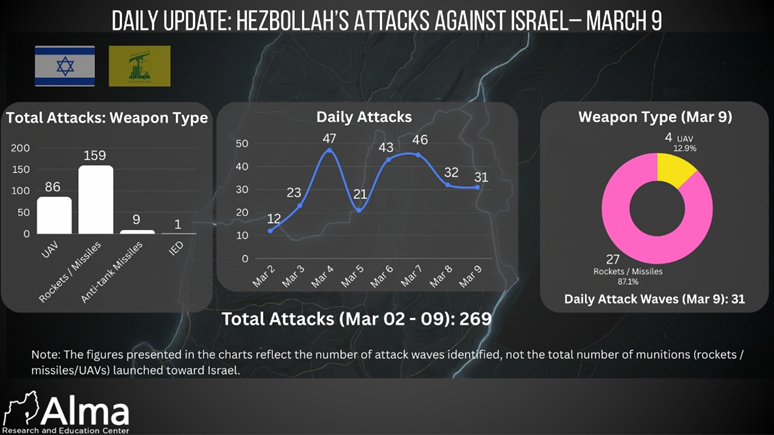
On March 9, Hezbollah carried out 31 attack waves against Israel, making significant use of rockets, missiles, and UAVs.
The prominent trend on March 9 was Hezbollah’s extensive use of rocket weaponry, with 27 of the waves (87.1%) conducted using rockets and missiles, while the number of attack waves using unmanned aerial vehicles was relatively low – only 4 (12.9%).
Examining the daily trend, it appears that after several days of fluctuation in the scope of attacks, Hezbollah’s operational activity stabilized on March 8 and March 9 at around 30 attack waves per day.
Hezbollah focuses its attacks primarily on northern Israel – mainly the border communities, the Galilee, and the Haifa area. However, on March 9 launches were also carried out toward the central region, during which a long-range Fateh-110 missile (up to 350 kilometers with about half a ton of explosives) with precision capability was apparently used. One of the impacts occurred in Ramla, where a kindergarten was hit. According to Hezbollah’s claim, the fire was directed at military bases, but in practice one of the impacts occurred in a civilian area.
Since Hezbollah joined the war (March 2), it has carried out a total of 269 attack waves against Israeli territory. The primary weapons used by Hezbollah are rockets and missiles, accounting for 159 attack waves, alongside 86 attacks using UAVs, 9 attacks using anti-tank missiles, and one incident involving the use of an explosive device (based on Hezbollah’s own publications).
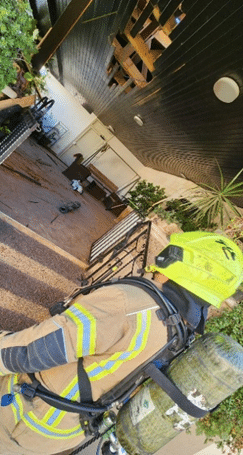
Intercept debris in Iksal. Credit: Fire and Rescue Services.
Lebanon and Hezbollah
Lebanese President Joseph Aoun publicly called for the opening of direct negotiations with Israel. Aoun presented a political framework that includes four main components: the establishment of a full ceasefire with Israel at sea, in the air, and on land; logistical support for the Lebanese Army; the deployment of the Lebanese Army in friction areas and its takeover of areas used by Hezbollah alongside the confiscation of Hezbollah’s weapons depots and military equipment; and the opening of direct negotiations between Israel and Lebanon under international auspices in order to reach an agreement.
According to reports, Israel and the United States received the initiative with reservations, and some reports noted that at this stage there has been no real response to the proposal. At the same time, France is leading diplomatic efforts in an attempt to curb the escalation and requested an emergency meeting of the UN Security Council to discuss developments in Lebanon and examine options for a ceasefire.
Aoun argued that the launch of six rockets toward Israel early Monday morning was an ambush intended to drag Lebanon into chaos and serve Iranian interests, even at the cost of destroying the country. According to him, the rockets were not a significant component in the confrontation between Israel and Iran and did not achieve deterrence or revenge for the assassination of Khamenei.
According to a report in the Lebanese newspaper Nidaa Al-Watan, the Americans conveyed a message to Parliament Speaker Nabih Berri before the Lebanese government meeting on March 2, in which Hezbollah was declared illegal: “Distance yourself and disengage from Hezbollah.” According to the report, Berri accepted the message and his ministers voted in favor of the government decision to ban Hezbollah’s military and security activities and require the organization to hand over its weapons. Berri clarified that he is upset and angry over Hezbollah’s deception after the organization promised him not to involve Lebanon in a bloody war and not to intervene in the war in support of Iran.
On the other hand, Hezbollah continued to demonstrate solidarity with the Iranian leadership. The organization congratulated Mojtaba Khamenei on his selection as Iran’s leader and emphasized its commitment to the Iranian axis. The Amal movement, led by Nabih Berri, issued a similar congratulatory statement. At the same time, some reports in the Lebanese media indicate that Hezbollah opposes the initiative for direct negotiations with Israel and views it as surrender to Israeli and international pressure, although efforts were also reported to maintain political coordination between Hezbollah and Parliament Speaker Nabih Berri.
The fighting in southern Lebanon continues. According to Lebanese reports, Israeli tanks entered the area of the town of Adaisseh in southern Lebanon under fire cover. At the same time, airstrikes were reported in several areas in the south of the country, including Sarifa, Yater, Beit Lif, Kfar Reman, and Braashit.
Strikes carried out on March 9 targeted three additional assets of the Al-Qard Al-Hasan Association in Beirut. In total, about 30 assets of the association have been struck over the past week. According to the IDF spokesperson, approximately 700 Hezbollah targets have been attacked in Lebanon so far, including 35 high-rise buildings in the Dahieh area of Beirut.
According to a report by the Lebanese newspaper Al-Akhbar, the Lebanese Army reached an agreement with residents of the village of Alma al-Shaab in southern Lebanon, according to which the residents will evacuate the village through the Hamra checkpoint accompanied by UNIFIL personnel, ahead of a possible ground advance by IDF forces in the area.
Hezbollah fired an anti-tank missile at a tank being transported on a truck in the Ramim Ridge area. The tank caught fire. No casualties were reported.
According to data from the UN Refugee Agency, the number of registered displaced persons in Lebanon has risen to more than 667,000 people, an increase of about 100,000 within a single day. The unofficial number of displaced persons is estimated to be over one million (from southern Lebanon and the Dahieh area of Beirut).
Syria
President al-Sharaa participated in a regional-European emergency meeting that addressed the escalation in the Middle East. During the meeting he emphasized that the regional escalation poses a threat to the stability of the entire region. Al-Sharaa expressed support for Lebanese President Joseph Aoun’s initiative to dismantle Hezbollah’s weapons. In addition, Damascus condemned the Iranian attacks against Arab states and called for the formation of a joint Arab position against these actions.
According to reports from the Syrian news agency SANA, the Syrian army identified a reinforcement of forces by Hezbollah along the Syria-Lebanon border. It was also reported that artillery shells fired from Lebanese territory landed inside Syria near the town of Saraqaya in the rural Damascus area.
According to the Syrians, Hezbollah fired the shells toward Syrian army positions. Syria is holding contacts with the Lebanese army and examining the options. It was also stated that the Syrian army will not tolerate any aggression against the state.
It is possible that the shooting incident attributed to Hezbollah by the Syrians is related to the exchange of fire with an IDF force that operated in the town of Nabi Sheet in the Beqaa on March 7.
Since March 2, more than 80,000 Syrian civilians have crossed the border from Lebanon into Syria.
The international arena
The United Arab Emirates condemned the attack on the UAE’s general consulate in Iraq and stated that attacks on diplomatic missions constitute a blatant violation of international law, representing a dangerous escalation that threatens regional security.
Iraqi Prime Minister Mohammed Shia al-Sudani spoke with U.S. Secretary of State Marco Rubio. Al-Sudani emphasized Iraq’s commitment to protecting embassies and consulates on its territory but clarified that Iraq is committed to non-involvement in military actions and that it must be ensured that Iraq’s airspace, maritime space, or land territory will not be used for any military action against countries in the region.
Turkey deployed a Patriot air defense system in the city of Malatya in southeastern Turkey in order to strengthen defenses against the Iranian threat (it is recalled that the Iranians have launched two missiles so far toward Turkish territory).
Egypt’s president condemned the Iranian attacks against Arab states and emphasized the need to curb regional escalation.
Russian President Vladimir Putin congratulated Mojtaba Khamenei on his appointment and stated that he is confident he will continue his father’s path and unite the Iranian people. According to Putin, Russia fully supports Iran and stands in solidarity with its Iranian friends. At the same time, it was reported that Putin spoke with U.S. President Donald Trump about possible ways to end the war.
German Chancellor Friedrich Merz stated that Iran is the center of international terrorism and that this center of terror must be shut down. According to him, the United States and Israel are pursuing this goal in their own way.
French President Emmanuel Macron announced that France and its allies are planning a “defensive” move to open the Strait of Hormuz, which will include escorting container ships and tankers in the Gulf. The French defense minister stated that France has provided air defense equipment to its allies in the Middle East.
President of the European Commission Ursula von der Leyen warned that the war is creating broad global instability and called for a more pragmatic European foreign policy in light of the crisis. According to her, Iran bears responsibility for destabilizing the region, but she avoided placing direct blame on the United States or Israel.