The Iranian Arena
Over the past day the Israeli Air Force continued to strike targets throughout Iran, including in Tehran and Isfahan. According to the IDF Spokesperson, more than 2,500 munitions have been used and 600 terror infrastructures of the Iranian regime have been targeted to date.
Since the beginning of the war, four U.S. soldiers have been killed.
Targeted Eliminations
It was confirmed that several additional senior officials were eliminated in the opening strike on February 28, including Mahmoud Ahmadinejad – former President of Iran; Mohammad Basri – a senior official in the Iranian Ministry of Intelligence; Javad Pourhossein– head of the foreign espionage unit; Mohammad-Reza Bajestani– head of the security unit; Ali Kheirandish – head of the counterterrorism unit; Saeed Ehya Hamidi– an adviser on fighting Israel.
Iran Attacks Targets Across the Middle East
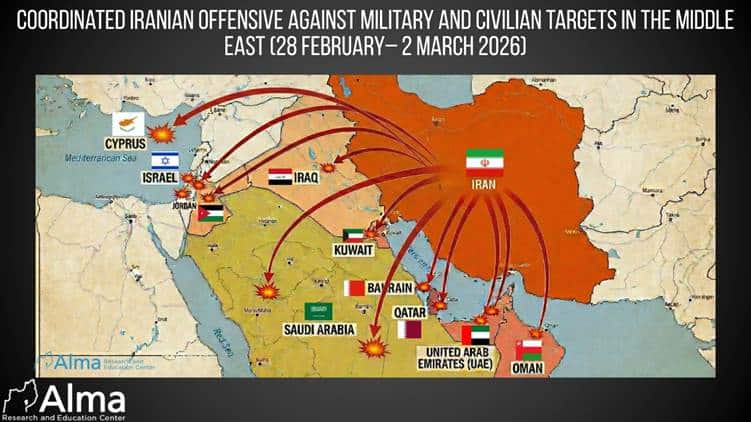
Iranian strikes across the Middle East are continuing. In the first attack on Cyprus, the Akrotiri base—a British Air Force base—was targeted by a UAV, causing property damage but no casualties. Cyprus is a member state of the European Union; therefore, this constitutes an attack against EU member states.
In Saudi Arabia, Aramco oil infrastructure in Ras Tanura was targeted. In Qatar, the U.S. Al Udeid Air Base was attacked once again. Military bases were also targeted in Jordan and Iraq.
In the United Arab Emirates and Bahrain, civilian targets were attacked, including residential buildings, shopping centers, and industrial areas. Three people were killed in the UAE and dozens were injured.
The Israeli Arena
Last night (March 2), seven people were injured by a missile impact in Jerusalem, one moderately and the others mildly. In the early afternoon, there was an impact in Be’er Sheva, resulting in one person moderately injured and 14 mildly injured.
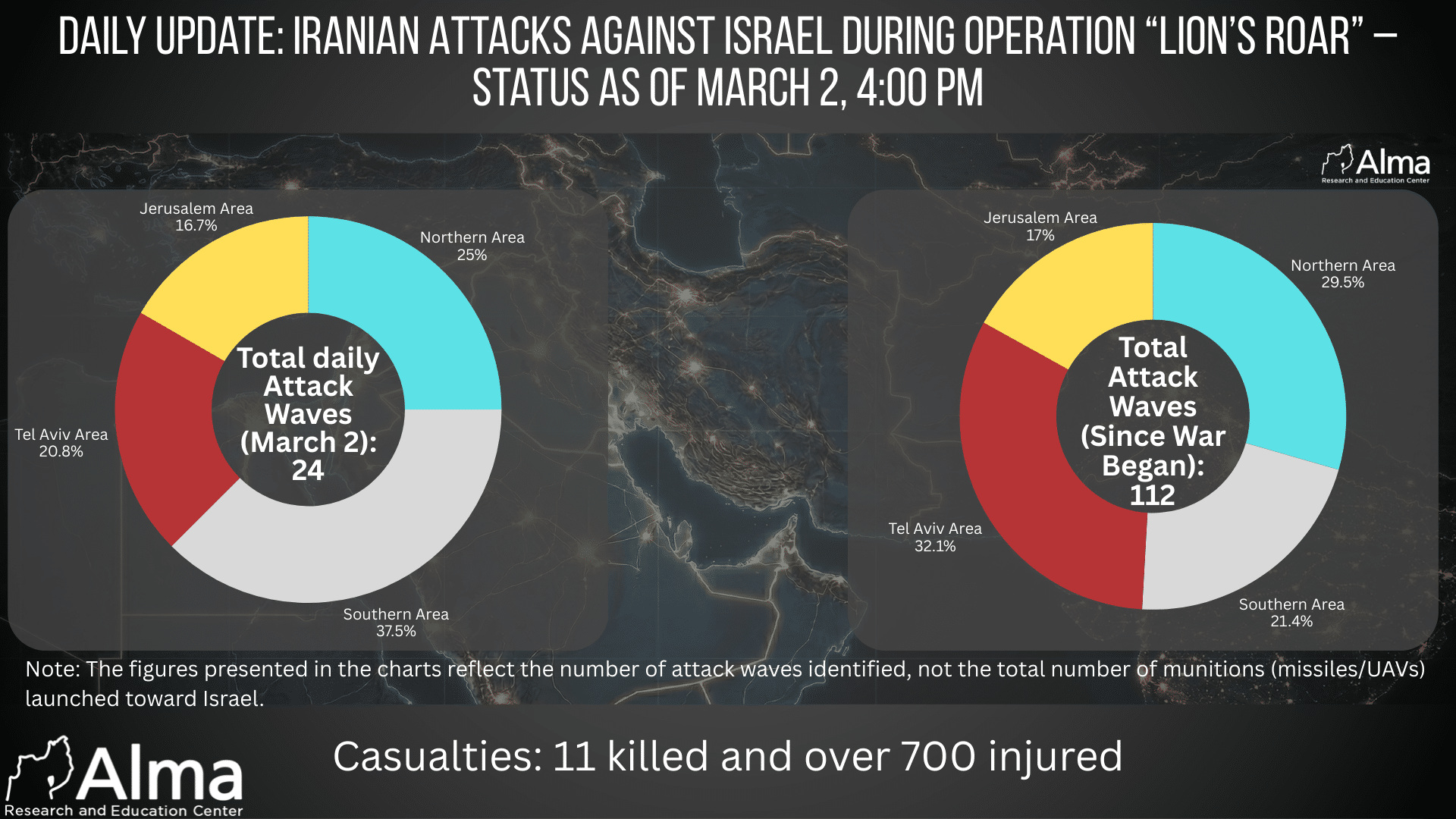
Since yesterday, 24 Iranian waves of attacks have been carried out against Israel, including launches of ballistic missiles and UAVs. The fire was directed at multiple locations across the country and posed a broad threat to the home front and the civilian population. Since the beginning of Operation “Lion’s Roar,” a total of 112 attack waves have been launched against Israel.
Since the start of the operation, 11 civilians in Israel have been killed and more than 700 have been injured to varying degrees. Damage has been caused at several locations in the civilian home front. Hits to residential buildings have been reported, along with damage to homes and property, including as a result of blast waves and interception debris.
Hezbollah
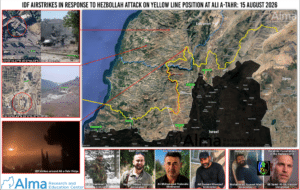
Hezbollah has joined the war. In the early morning hours, Hezbollah launched three rockets and several UAVs toward Israeli territory. The launches were carried out from south of the Litani River. The organization issued an official statement saying it had carried out the fire “in revenge” for the elimination of Ali Khamenei, presenting the move as a response to Israeli-American “aggression.”
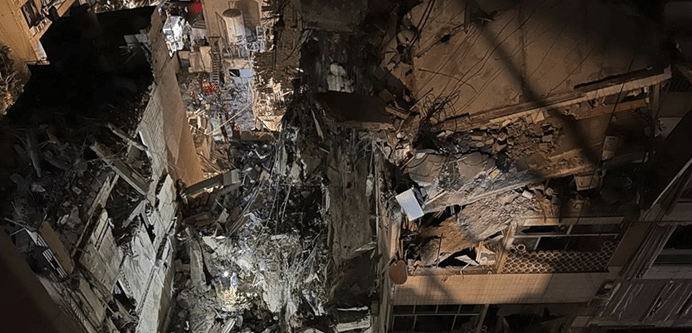
In response, Israel began a sustained wave of strikes in Dahieh in southern Lebanon and in the Beqaa Valley (an evacuation notice was issued to more than 50 villages in southern Lebanon), with the aim of targeting infrastructure, assets, and sites identified with the organization’s military activity, in addition to strikes against senior figures in the organization. As part of the strikes, Hussein Makled, head of Hezbollah’s Intelligence Directorate was eliminated.
The IDF also struck Hezbollah financial infrastructure, including Qard al-Hasan.
A strike in Dahieh, Beirut
Lebanon
Following Hezbollah’s attack, Prime Minister Nawaf Salam convened urgent discussions in the early morning hours and stated that the rocket fire from southern Lebanon was an “irresponsible act” that endangers Lebanon and provides Israel with a pretext to expand its strikes. He later announced a ban on Hezbollah’s military activity and the restriction of its activity to the political sphere.
President Aoun warned against the use of Lebanon as a platform for “support” wars unrelated to the national interest. The Minister of Interior monitored the situation, instructed governors to remain at their posts and assist residents moving from their homes, and ordered measures to ease traffic congestion and coordinate among security agencies.
Reports indicated large-scale movement of displaced persons and evacuees from southern Lebanon and Dahieh, heavy traffic congestion, and a search for shelter and reception centers. The Lebanese Ministry of Education announced the closure of schools and educational institutions for the day due to the security risk and disruption of daily life. In the Dahieh area, heavy damage to buildings and civilian infrastructure was reported as part of strikes on sites linked to Hezbollah activity within a densely populated urban environment.
Syria
President Ahmad al-Sharaa held talks with the Emir of Qatar, the Saudi Crown Prince, and the Prime Minister of Iraq, emphasizing solidarity with the Gulf states affected by Iranian attacks. Foreign Minister Asaad Hassan al-Shibani spoke with Lebanese Prime Minister Nawaf Salam as part of regional coordination regarding the implications of the war. Al-Shibani conducted intensive contacts with Arab foreign ministers as well as with Turkey and Britain. The official Syrian message: a clear condemnation of the Iranian attacks, emphasis on the sovereignty of Arab states, and a call for political solutions.
The war with Iran is also spilling over into Syrian territory, reflected in intensive interceptions of Iranian UAVs in the skies over Daraa province, with more than ten UAVs shot down in the Inkhil and Deir al-Adas areas. At the same time, debris from UAVs and rockets was reported falling in Daraa, Quneitra, and the Damascus countryside, including a strike on the power station in al-Otaiba that put a transformer out of service. In Ein Tarma, four people, including children, were injured by falling rocket debris. Civil defense teams handled several incidents in the south of the country, in most cases involving property damage only. Meanwhile, explosions are intermittently heard in the skies over southern Syria alongside Israeli reconnaissance flights.
Iraq
On March 1, Shiite militias in Iraq announced their entry into the fighting. According to their claims, they have so far carried out 39 attacks using dozens of UAVs against American bases in Iraq and in the region.
The International Arena
The leaders of France, Germany, and the United Kingdom condemned the Iranian attacks, which they described as “indiscriminate and disproportionate,” warning that they could endanger civilians and European interests. They called on Iran to immediately halt the attacks. The E3 expressed commitment to regional stability and the protection of civilians, clarifying that they did not participate in the initial strikes on Iran, while urging diplomacy and de-escalation. European countries, including France, Germany, and the UK, expressed readiness to carry out defensive actions against Iranian threats and to protect their infrastructure and forces in the region. The United Kingdom authorized the United States to use its bases for defensive strikes against Iranian missile sites, citing the protection of British citizens stationed in the Middle East. In addition, following the attacks on its Air Force base, Britain announced that its air force is joining interception efforts. Greece sent two fighter jets and two warships to defend Cyprus.
Gulf states, including the United Arab Emirates, Saudi Arabia, and Qatar, condemned the Iranian attacks, describing them as a blatant violation of sovereignty and international law. The Qatari Foreign Ministry issued a joint statement of condemnation with Saudi Arabia, Bahrain, Jordan, Kuwait, the United Arab Emirates, and the United States against Iran’s unjustified attacks that harmed civilian infrastructure and regional stability. Riyadh summoned the Iranian ambassador and strongly condemned the Iranian attacks on Gulf waters. The Saudi Foreign Ministry described the attacks as violations of sovereignty and emphasized its right to defend its security, including taking “all necessary measures” to protect its security and interests. A spokesperson for the Qatari Foreign Ministry told CNN that Iran must pay a price for its blatant attacks.
Beijing condemned the death of Iran’s leader and the strikes on Iran, describing the events as “unacceptable” and calling for a halt to military operations in the region.