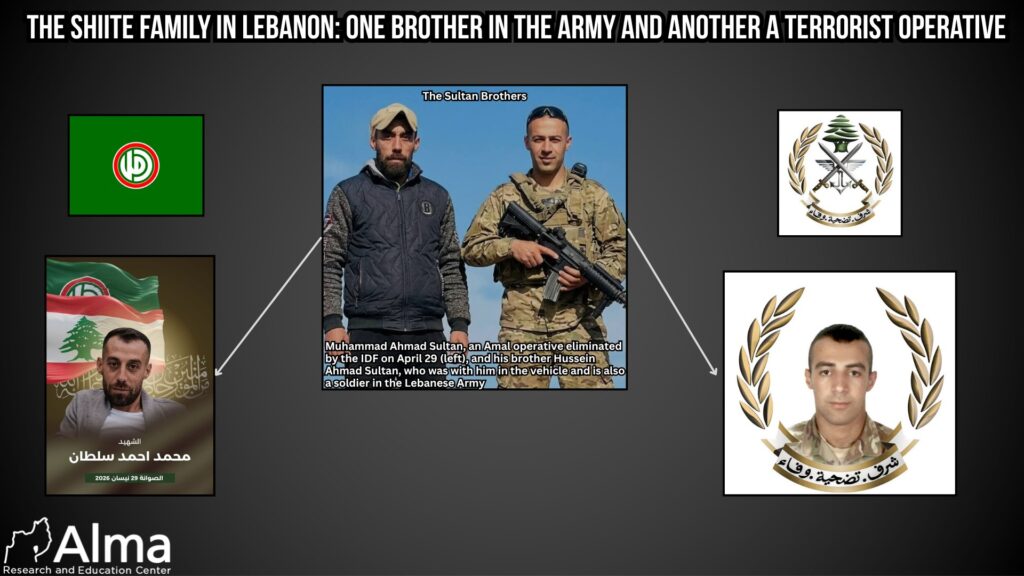
On April 29, the IDF eliminated Muhammad Ahmad Sultan, an Amal operative, in the village of Al-Sawana in southern Lebanon. In the vehicle with him was his brother, Hussein Ahmad Sultan, who serves as a soldier in the Lebanese Army. The IDF did not target a Lebanese Army soldier, but rather an operative in the Amal movement—an organization that actively participates in the fighting alongside Hezbollah against Israel in southern Lebanon. Nabih Berri, leader of the Amal movement and Speaker of the Lebanese Parliament, operates within a dual strategy: outwardly as a state actor and political mediator, while simultaneously leading an organization that is actively involved in combat alongside Hezbollah. This incident is not unusual; rather, it reflects a deep-rooted pattern within Shiite society in southern Lebanon. Members of the same family may belong to different frameworks—some within the Lebanese state (the Lebanese Army), and others within Hezbollah and Amal. This case once again highlights a structural issue within the Lebanese Army. The significant presence of the Shiite population within its ranks, combined with the social and political influence of Hezbollah and Amal over this population, creates a reality of overlapping—and at times conflicting—loyalties. In some cases, the boundary between state service and identification with a terrorist organization becomes blurred. During the war, the Lebanese Army did not take an active part in the fighting and was not designated as a target by the IDF. Nevertheless, the question arises as to why more than 40 Lebanese Army soldiers have been killed so far during the course of the conflict. Some of these cases can be attributed to operational errors. However, others reflect a more complex reality: Hezbollah’s use of areas and infrastructure associated with the Lebanese Army, and at times reliance on the presence of soldiers as a protective element. In other cases, soldiers found themselves, on their own initiative, in areas where Hezbollah and Amal were operating, becoming caught in active combat zones—some even within the framework of operational cooperation on the ground.