The Iranian Arena
Over the past 24 hours, a broad wave of strikes has been carried out across several key locations throughout Iran, including Tehran, Parchin, Kerman, Arak, and Bandar Lengeh. The IDF targeted more than 130 regime infrastructures, including ballistic missile launchers, unmanned aerial vehicles, and air defense systems. In addition, as of March 20 at the time of writing, reports have been received of further strikes in the cities of Yazd, Borazjan, Hormozgan, and Ahvaz.
At the same time, U.S. Central Command announced a targeted strike on a facility for the production and assembly of ballistic missiles in the city of Karaj. According to the statement, the facility was used to assemble missiles that pose a direct threat to American civilians, regional countries, and international trade.
It was also reported that a U.S. Air Force F-35 fighter jet was forced to make an emergency landing at an American base in the Middle East after being hit by anti-aircraft fire during a mission over Iran.
Eliminations
Ali Mohammad Naeini, spokesperson for the Islamic Revolutionary Guard Corps, was eliminated.
General Afshin Nakshabandi, who served as a representative of Iran’s Armed Forces Headquarters in the Basij organization, was eliminated.
In addition, the IRGC confirmed that in the strike in which Basij commander Gholam Reza Soleimani was eliminated, the organization’s head of intelligence, Esmail Ahmadi, was also eliminated.
According to reports in Iranian media, Mehdi Karishi, commander of the IRGC Aerospace Forces in the Isfahan sector, was also eliminated.
Iran Targeting the Middle East
Over the past 24 hours, a series of attacks and threats by Iran have been reported, alongside responses and interceptions by countries in the region.
In Saudi Arabia, alerts were activated in the capital, Riyadh.
In the United Arab Emirates, the Ministry of Defense in Abu Dhabi announced that air defense systems intercepted seven ballistic missiles and fifteen unmanned aerial vehicles throughout the day. It was also reported that since the beginning of the war, 334 ballistic missiles, 15 cruise missiles, and 1,714 UAVs have been launched toward the country, indicating the scale of the ongoing threat.
The UAE State Security apparatus announced that a terrorist network funded and directed by Hezbollah and Iran had been uncovered. Members of the network were arrested after operating under the cover of fictitious commercial activity, with the aim of carrying out subversive actions threatening the country’s economic stability.
It was also noted that additional terror cells linked to Iran have recently been exposed in Kuwait and Bahrain.
Iranian Foreign Minister Hossein Amir Abdollahian Araghchi conveyed a message to Britain stating that any permission granted to the United States to use its bases for operations against Iran would be regarded by Tehran as a direct act of aggression.
Iraq
Media outlets affiliated with pro-Iranian militias reported that a base belonging to one of the militias in the town of Tuz Khurmatu in central Iraq was attacked on March 19.
The Israeli Arena
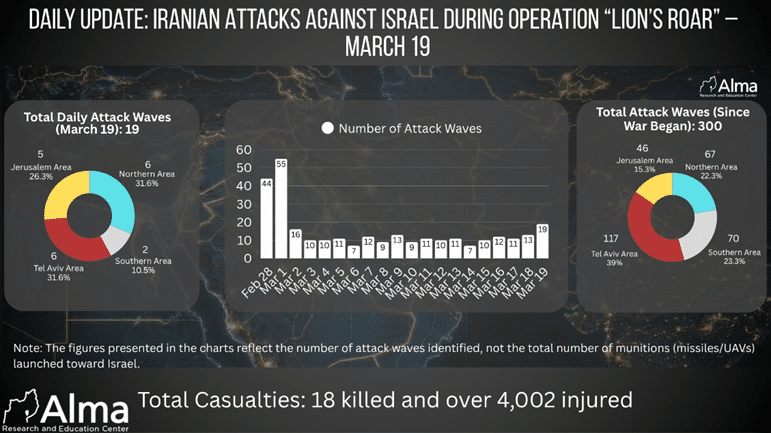
On March 19, 19 Iranian attack waves against Israel were identified, carried out using ballistic missiles. This represents an exceptional day in terms of the scale of attacks, with a particularly high number of attack waves compared to the daily average recorded in recent weeks.
Geographically, the attacks were distributed across several regions: 6 attack waves (31.6%) were directed at the Tel Aviv area, 6 (31.6%) at the north, 5 (26.3%) at the Jerusalem area, and 2 (10.5%) at southern Israel.
Since the beginning of the campaign, a total of 300 Iranian attack waves against Israel have been identified. In cumulative geographic distribution, the central region—particularly the Tel Aviv metropolitan area—remains the primary target, with 117 attack waves (39%). It is followed by the south with 70 attack waves (23.3%), the north with 67 (22.3%), and the Jerusalem area with 46 (15.3%).
In one of the attacks targeting the Tel Aviv area, a foreign worker was killed as a result of a strike on a locality in central Israel, once again demonstrating the direct impact on the civilian home front.
An examination of the daily trend indicates that after a period of relative stability in the pace of attacks, averaging around 10 attack waves per day, a sharp increase in activity has been recorded, reflecting a deviation from the established pattern and increased pressure on the Israeli home front.
Since the beginning of the war, 18 civilians in Israel have been killed, and more than 4,002 people have been injured to varying degrees as a result of direct hits, falling interception debris, and secondary damage. In addition, extensive damage has been caused to residential buildings and civilian infrastructure, and the ongoing fire continues to disrupt daily life.
The data indicates that Iran continues to combine a focus on central Israel with a broad geographic distribution of attacks, in an effort to expand the threat envelope and maintain sustained pressure across all parts of the country. At the same time, the deviation in the scale of attacks on this day may indicate an attempt to intensify pressure within the framework of a broader strategy of attrition.
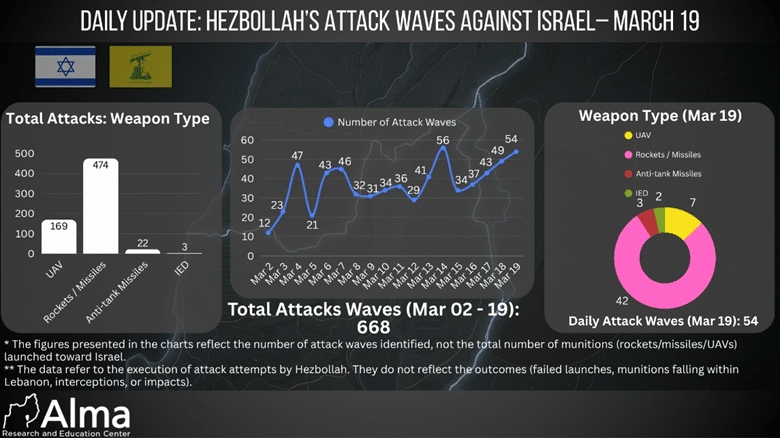
On March 19, 54 Hezbollah attack waves against Israel were identified. In terms of weapon types, 42 attack waves (approximately 77.8%) were carried out using rockets and missiles, 7 attack waves (approximately 13%) using unmanned aerial vehicles, 3 attacks (approximately 5.6%) using anti-tank missiles, and 2 additional attacks using explosive devices.
Most of the attacks were directed at border communities and the Galilee, alongside continued fire toward other areas in northern Israel. In one of Hezbollah’s attacks, a residential building in the city of Kiryat Shmona was hit, where four civilians were injured.
It also emerges that 18 of the attacks during the day were attacks for which Hezbollah claimed responsibility against IDF forces operating against it in southern Lebanon.
Since Hezbollah joined the fighting on March 2, a total of 668 attack waves against Israel have been identified. An examination of the types of weaponry indicates that rockets and missiles continue to be the primary means of attack, with 474 attack waves, alongside 169 attack waves using unmanned aerial vehicles, 22 attacks using anti-tank missiles, and 3 carried out using explosive devices.
An examination of the daily trend indicates a continued upward trend in the scope of attacks in recent days. After earlier fluctuations, a gradual increase in the number of attack waves has been recorded, reaching a high level of 54 attack waves in a single day—one of the highest levels recorded since the beginning of the fighting. The daily average stands at 37 attacks per day.
Notes: The data refers to the number of identified attack waves, not the total number of munitions actually launched. The data refers to the execution of Hezbollah’s attack attempts and does not address their outcomes (failed launch, munitions falling within Lebanon, interception, or impact).
Lebanon and Hezbollah
Prime Minister Nawaf Salam emphasized in a holiday speech that Lebanon’s priorities are ending the war, halting destruction and displacement, protecting civilians, ensuring the return of displaced persons, and launching a reconstruction process. He noted that the state did not adopt the “support” decisions for Gaza and Iran, but was forced to bear their consequences, and called for restoring decision-making authority on war and peace exclusively to the state, under the principle of one law, one army, and one authority. He also warned against internal incitement that could lead to escalation and even civil war.
According to reports, President Michel Aoun is promoting a line aimed at opening a negotiation channel and is working to persuade Parliament Speaker Nabih Berri to play a central role in providing legitimacy and support for such a move.
In contrast, it was reported that Nabih Berri clarified that negotiations with Israel are not possible at this stage, and that his minimum condition is a return to the November 27, 2024 agreement. It was also noted that Berri maintains ongoing contacts with Hezbollah and Iran. In this context, according to reports, Hezbollah expresses a lack of trust in the “mechanism committee” for implementing the agreement, claiming it is biased in favor of Israel.
General Abbas Ibrahim, former head of Lebanon’s General Security, stated that “Hezbollah’s performance on the military level is very high,” and that “resistance” forces continue to operate on the front line south of the Litani. According to him, Iran will continue to support its allies, and the war will not end without a comprehensive ceasefire across all arenas.
French Foreign Minister Jean-Noël Barrot announced during his visit to Lebanon that France is doubling its humanitarian aid to Lebanon to 17 million euros. However, according to reports, French mediation efforts to achieve a “holiday truce” (Eid al-Fitr) were unsuccessful, and the visit mainly resulted in expressions of political and moral support.
At the same time, discussions are taking place at the United Nations regarding the continuation of the international force’s operations in southern Lebanon, and the possibility of formulating a new UN Security Council resolution to regulate the international presence in the area is also being considered.
Lebanon’s electricity company announced that the main power substation in al-Sultaniyah in the Bint Jbeil district was put out of service following a strike, affecting electricity supply to a wide area in southern Lebanon.
According to IDF Spokesperson data, since the beginning of the northern campaign, more than 2,000 targets have been struck, including approximately 120 Hezbollah headquarters, more than 100 weapons storage facilities, and over 130 missile launchers. In addition, more than 570 operatives have been eliminated, including about 220 Radwan Force operatives and approximately 150 members of the rocket fire array, alongside senior commanders at various levels.
Ahmad Abdallah, a commander in Hamas’ military wing, died of his wounds after being injured in an Israeli strike in Beirut on March 11.
Syria
Syrian Foreign Minister Asaad al-Shaibani conveyed a calming message to Lebanon, clarifying that the deployment of Syrian forces along the border is intended solely for defensive purposes against smuggling and security threats, with no intention of invading Lebanon or intervening in its internal affairs.
The Syrian Ministry of Defense reported that border guard forces thwarted an attempt to smuggle weapons into Lebanon in the Jroud Flita area and arrested four suspects, including two Lebanese nationals.
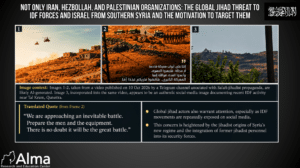
During the night, the IDF struck a headquarters and weapons belonging to the Syrian regime in southern Syria. This followed events on March 19 in which Druze civilians in the al-Suwayda area were attacked by regime forces using rockets and unmanned aerial vehicles. The attack resulted in the killing of nine people and the injury of four. The Druze also claim that regime forces abducted 19 individuals.
In an IDF spokesperson statement, it was said that the IDF will not allow harm to Druze in Syria and will continue to act to protect them, and that the IDF continues to monitor developments in southern Syria.
The International Arena
The United Kingdom, France, Germany, Italy, Japan, and the Netherlands issued a joint statement on March 19 expressing their willingness to contribute to efforts to ensure safe passage through the Strait of Hormuz. However, Italy, France, and Germany clarified that they do not intend to provide immediate military assistance, and that any involvement will be considered only after a ceasefire is achieved.
French President Emmanuel Macron stated at the conclusion of the European Union summit that France will not take part in any forced opening of the Strait of Hormuz and expressed hope that an agreed ceasefire between the involved parties can be reached soon.
Spanish Prime Minister Pedro Sánchez emphasized the need to send a clear message that Europe stands by international law and opposes the current war, which he described as illegal, and called for the advancement of a diplomatic solution.
Turkey’s Foreign Minister accused Israel of dragging the region into an unprecedented war, and Turkish President Recep Tayyip Erdoğan, in a speech marking Eid al-Fitr, described the Middle East as being in a state of boiling tension and accused Israel of responsibility for large-scale killings. Erdoğan added that, in his view, Israel will pay a price for its actions.
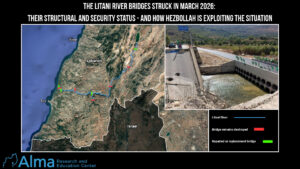
Israel’s ambassador to Russia was summoned for a reprimand meeting on March 20 at the Ministry of Foreign Affairs in Moscow following an Israeli strike in Lebanon near a position of a Russian RT news crew. The strike targeted a bridge over the Litani River and was carried out after prior notification.
Note: The next report will be published on Sunday, March 22.