The Iranian Arena
Over the past day, strikes across Iran against regime infrastructure have continued. As part of this, the IDF completed a wave of strikes in Tehran targeting weapons production sites and headquarters. At the same time, additional strikes were reported in the cities of Khorramabad, Yazd, Tabriz, Bandar Abbas, Bushehr, Bandar Lengeh, and Qeshm Island.
In addition, according to a report in The Washington Post, the United States is preparing to deploy approximately 4,500 Marines and sailors in the Middle East, supported by F-35 aircraft, helicopters, and amphibious forces.
Eliminations
Reports indicate that a scientist was eliminated in Tehran. He served as a professor in the Faculty of Electrical Engineering at the Iran University of Science and Technology (possibly linked to the missile/UAV industry).
Iran Attacks Targets in the Middle East
Saudi Arabia – A UAV was reportedly intercepted at the northern border, which may have been launched by pro-Iranian militias operating in Iraq. Additional launches were identified toward Riyadh and the eastern part of the country.
Kuwait – Reports of interceptions of missiles and UAVs.
United Arab Emirates – The Ministry of Defense stated that during the day, seven ballistic missiles and 16 UAVs launched from Iran were intercepted. It was further reported that since the beginning of the war, 352 ballistic missiles, 15 cruise missiles, and 1,789 UAVs have been launched toward the UAE.
The Iranian Ministry of Foreign Affairs announced that vessels belonging to hostile countries or to countries participating in the attack against Iran will not be allowed to pass through the Strait of Hormuz. Vessels belonging to other countries will be allowed to pass in coordination with Iran.
Iraq
It was reported that a base of the Al-Hashd al-Shaabi militia in eastern Al-Anbar was attacked.
The Israeli Arena
On March 22, eight Iranian attack waves against Israel were identified, carried out using ballistic missiles. This reflects a decrease in the scope of attacks compared to previous days, while maintaining ongoing activity within the broader pattern of sustained attacks.
Geographically, the attacks were distributed across several areas: four attack waves (50%) were directed at the Tel Aviv area, three waves (37.5%) at southern Israel, and one attack wave (12.5%) at the Jerusalem area. On this day as well, the focus remained on central Israel, alongside additional distribution toward the south.
Toward the Tel Aviv area, missiles equipped with cluster warheads were launched, dispersing in the air into multiple submunitions that strike several locations simultaneously. The use of this type of munition significantly increases the impact area and the risk to civilian populations, particularly in densely populated areas.
As a result of the attacks, impacts were recorded in civilian areas in the cities of Tel Aviv, Ramat Gan, Petah Tikva, and Holon. In addition, in recent days, a kindergarten in the city of Rishon LeZion was reported to have been hit, illustrating the direct impact on civilian spaces and daily life.
Since the beginning of the campaign, a total of 337 Iranian attack waves against Israel have been identified. In cumulative distribution, the central region—particularly the Tel Aviv metropolitan area—remains the primary target.
Since the beginning of the war, 18 civilians have been killed in Israel, and more than 4,713 people have been injured to varying degrees as a result of direct hits, falling interception debris, and secondary damage. In addition, approximately 5,000 Israelis have been displaced from their homes due to missile strikes. Most of the impacts have been recorded in the cities of Tel Aviv, Beit Shemesh, Dimona, Arad, and Be’er Sheva, alongside additional impacts in other locations across the country.
An examination of the trend indicates that despite daily fluctuations, a relatively steady pace of attacks is being maintained as part of a strategy of sustained pressure on the Israeli home front, with a focus on central Israel and the use of weaponry that increases the scale of damage.


Interception debris in Safed. Credit: Fire and Rescue Services
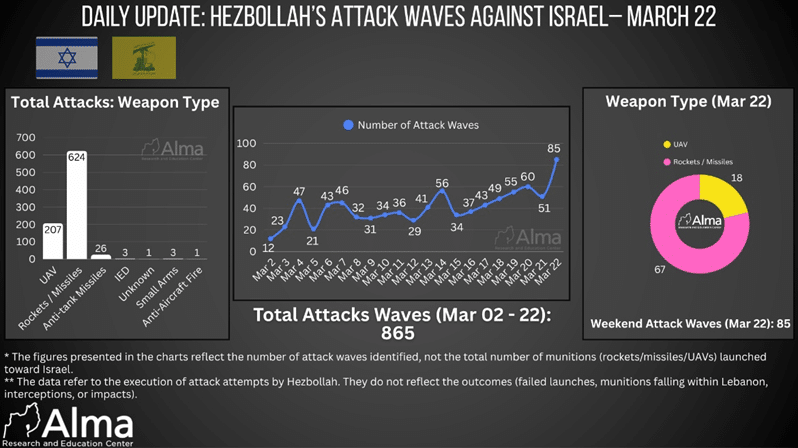
On March 22, 85 Hezbollah attack waves against Israel were identified—an exceptionally high and significant level of activity, the highest recorded since the beginning of the fighting. This represents a clear escalation compared to previous days, with a sharp increase in both the intensity and pace of attacks.
In terms of types of weaponry, most of the attacks were carried out using rockets and missiles (67 waves), alongside 18 attack waves using UAVs. These figures continue to indicate the dominance of rocket fire, alongside an increasing integration of unmanned aerial vehicles.
Geographically, the attacks were primarily directed at border communities and the Galilee. In addition, 35 of the attack that took place during March 22 were claimed by Hezbollah as attacks against IDF forces operating against it in southern Lebanon. It should be noted that these attacks are often carried out using high-trajectory fire (rockets), which is imprecise, and therefore in many cases the fire spills over and hits Israeli border communities.
Over the past week, impacts and damage were recorded in several northern communities as a result of Hezbollah rocket fire, including Ma’alot-Tarshiha, Kfar Vradim, Kiryat Shmona, Nahariya, and Metula. These impacts highlight the direct effect of the fire on civilian areas and the ongoing disruption of daily life in the northern region.
In addition, according to reports, a few days ago Hezbollah fired a surface-to-air missile at an IDF UAV.
Since Hezbollah joined the fighting on March 2, a total of 865 attack waves against Israel have been identified. An examination of the trend indicates a continued increase in the scope of attacks, with a shift to particularly high levels of activity in recent days and the breaking of new peaks.
The data reflect Hezbollah’s continued effort to apply sustained pressure on the Israeli home front, combining a high volume of fire with repeated strikes on civilian communities in northern Israel.
Lebanon and Hezbollah
In an interview with Al-Hadath, Lebanese Prime Minister Nawaf Salam stated, “Hezbollah’s threats do not intimidate us.” Salam declared that Lebanon did not choose this war and that Hezbollah’s threats do not deter the government. According to him, the government is working to regain control over the decision to go to war and to advance negotiations for peace with Israel, but no Israeli response to the initiative has yet been received. Salam accused Iranian elements, led by the Islamic Revolutionary Guard Corps, of being involved in managing military activity from Lebanon, and emphasized the government’s commitment to deploying the Lebanese Army across the entire country, in accordance with the Taif Agreement.
Lebanese President Joseph Aoun condemned Israeli strikes in southern Lebanon, particularly attacks on infrastructure and bridges, and warned that this constitutes a dangerous escalation and preparation for a ground invasion. He stated that “attacks on bridges over the Litani River, a vital transportation artery for civilians, are an attempt to sever the geographic link between south of the Litani and the rest of Lebanon, delay the delivery of humanitarian aid, and are part of suspicious plans to establish a buffer zone, entrench occupation, and promote Israeli expansion into Lebanese territory.”
In an interview with the newspaper Al-Akhbar, Wafiq Safa, a senior Hezbollah official and currently assistant to the head of the political council, expressed optimism regarding the conduct of the fighting and argued that Israel and the United States are not achieving their objectives. According to him, Hezbollah refrained from responding for an extended period in order to allow a diplomatic track and to rebuild its military capabilities, and will now act to cancel the Lebanese government’s decision to restrict its activity.
Safa added that the Lebanese authorities made a very wrong decision prohibiting Hezbollah’s military and security activity in Lebanon, and clarified that after the war ends, Hezbollah will certainly demand its reversal.
According to a report on the Saudi Al-Hadath channel, Hezbollah is renting residential apartments and offices across Beirut and in additional areas in Lebanon (i.e., not in traditional Shiite strongholds) for its military and security operatives, under false identities. The process is carried out through Hezbollah’s counterintelligence apparatus, with the aim of enabling these operatives to move into or reside in these apartments.
Israel continues extensive strikes in southern Lebanon and the western Bekaa. The al-Qaqaiya bridge over the Litani River was struck again overnight. In addition, earlier today, a secondary crossing over the Litani River near the al-Qasmiya bridge, which was struck yesterday (March 22), was also targeted.
Additionally, today (March 23), the al-Dalafi bridge in the eastern sector, which connects southern Lebanon toward the Bekaa, was struck.
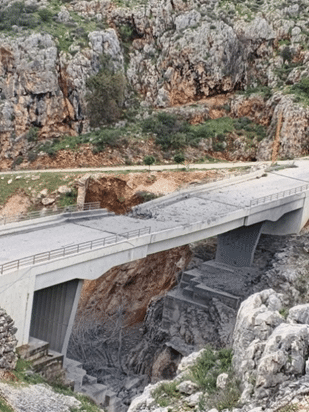
Al-Dalafa Bridge after the strike
Over the weekend (March 20–21), soldiers of the Givati Brigade located an anti-tank missile position and numerous weapons in southern Lebanon.


Kornet anti-tank missiles identified by IDF forces in southern Lebanon.
Nine Hezbollah operatives were eliminated overnight after approaching an area where IDF forces were operating.
An Iranian Quds Force operative was targeted (March 23) in an apartment in Beirut.
The International Arena
US President Trump postponed by five days the ultimatum he had issued to Iran regarding strikes on power stations, and stated that “talks are underway with Iran to end the war” (according to several reports, the talks may be taking place with Mohammad Bagher Ghalibaf—the Speaker of the Iranian Majles).
UK Prime Minister Keir Starmer spoke with President Trump and emphasized the need to reopen the Strait of Hormuz in order to restore global trade.
Saudi Crown Prince Mohammed bin Salman held a phone call with French President Emmanuel Macron, who expressed solidarity with Saudi Arabia and condemned the Iranian attacks on its territory.
The head of the International Energy Agency warned that the situation in the Middle East is extremely severe, describing it as worse than the two oil crises of the 1970s combined. According to him, the main solution to the current crisis is the reopening of the Strait of Hormuz. He also noted that consultations are taking place with governments worldwide, and that additional oil reserves may be released if necessary.
UAE Foreign Minister Abdullah bin Zayed stated on X that “we will never be subject to blackmail by terrorists.”
It was reported that Qatar is conducting negotiations with Iran in an attempt to bring about a halt to the attacks on its territory. According to the report, as part of the proposal, Qatar may transfer $6 billion—funds belonging to the Iranian regime held in Qatar and associated with the IRGC—in exchange for a cessation of the attacks. However, the report was denied by a Qatari diplomat.
NATO Secretary General Mark Rutte stated that neutralizing Iran’s nuclear program and its ballistic missiles is essential, adding that President Trump is making the world safer.