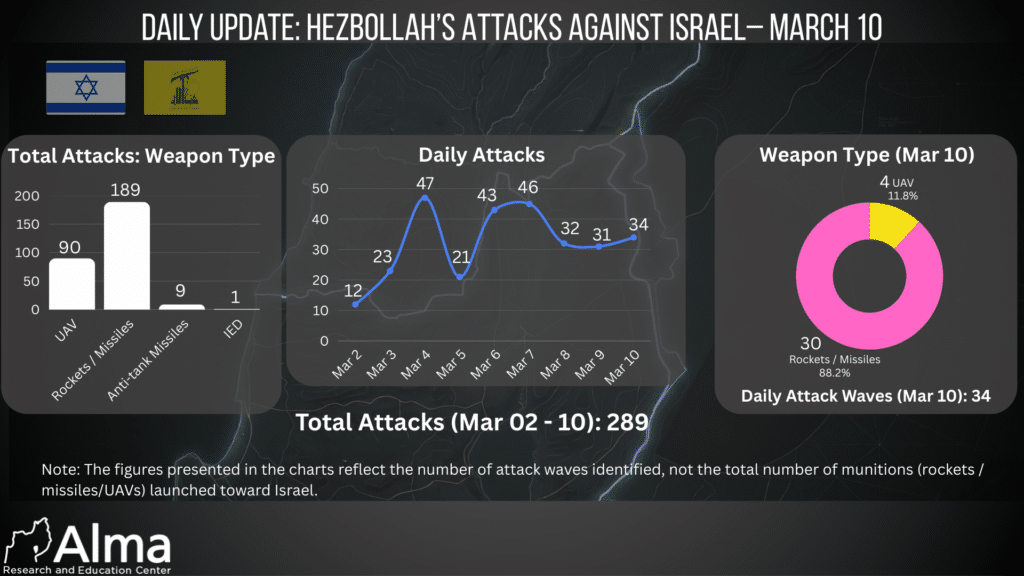
On March 10, 34 waves of attacks by Hezbollah against Israel were recorded. The attacks were carried out mainly using rockets and missiles, alongside UAVs. According to the data, 30 of the attacks (88.2%) involved rockets and missiles, while 4 attacks (11.8%) were conducted using UAVs. Since Hezbollah joined the fighting on March 2, a total of 289 waves of attacks against Israel have been identified. The data refers to the number of attack waves, not the total number of munitions launched. Trends in the Use of Weapon Systems: An examination of the weapon systems used by Hezbollah since the beginning of its involvement in the fighting shows that rockets and missiles remain the organization’s primary means of attack, accounting for 189 attacks. In addition, UAV launches account for 90 attacks, reflecting Hezbollah’s significant and continued use of unmanned aerial systems. Furthermore, 9 attacks using anti-tank missiles and one IED attack were documented during this period (an incident based on Hezbollah’s claim of responsibility). Daily Trend: An analysis of the data indicates fluctuations in the scale of attacks throughout the campaign. After 12 attack waves on the first day (March 2), the number increased and reached a peak of 47 waves on March 4. This was followed by a temporary decline and then another rise on March 6–7 (averaging 44 attack waves), after which the number stabilized at an average of about 32 attack waves per day. This trend indicates that Hezbollah is maintaining a sustained level of offensive activity, despite daily fluctuations in the scale of attacks.