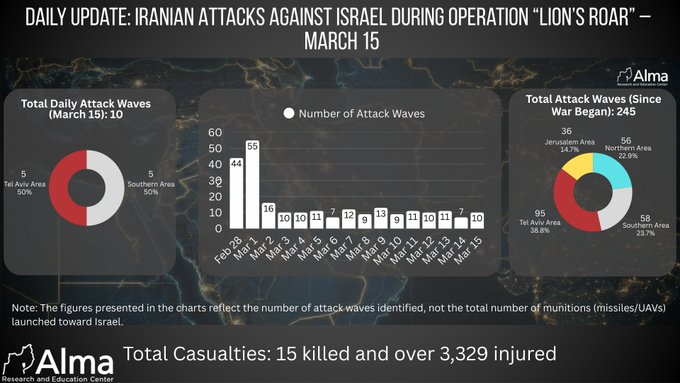
On March 15, 10 Iranian attack waves against Israel were identified using ballistic missiles. Geographically, the attacks were evenly divided between two main areas: 5 attack waves (50%) targeted the Tel Aviv area, while 5 additional waves (50%) were directed toward southern Israel. Since the beginning of the campaign, a total of 245 Iranian attack waves against Israel have been identified. In the cumulative geographic distribution of all attacks, the central region—particularly the Tel Aviv metropolitan area—continues to be the primary target, with 95 attack waves (38.8%). This is followed by the southern region with 58 attack waves (23.7%), the northern region with 56 waves (22.9%), and the Jerusalem area with 36 attack waves (14.7%). An examination of the daily trend indicates that after the peak recorded at the beginning of the campaign (44 attack waves on February 28 and 55 on March 1), there was a significant decline in the scope of attacks and a relative stabilization in the pace of activity. Over the past two weeks, the number of attack waves has averaged around 10 per day. Impact on the civilian front in Israel: Since the beginning of the war, 15 civilians have been killed in Israel, and more than 3,329 people have been injured to varying degrees as a result of direct impacts, falling interceptor debris, and secondary damage. The data indicates that despite the decrease in the scale of attacks compared to the initial phase of the campaign, Iran continues to maintain sustained pressure on the Israeli home front, combining a focus on the Tel Aviv metropolitan area with a complementary geographic dispersion of attacks toward southern Israel, thereby expanding the threat environment and complicating efforts to restore normalcy in any specific region of the country.