
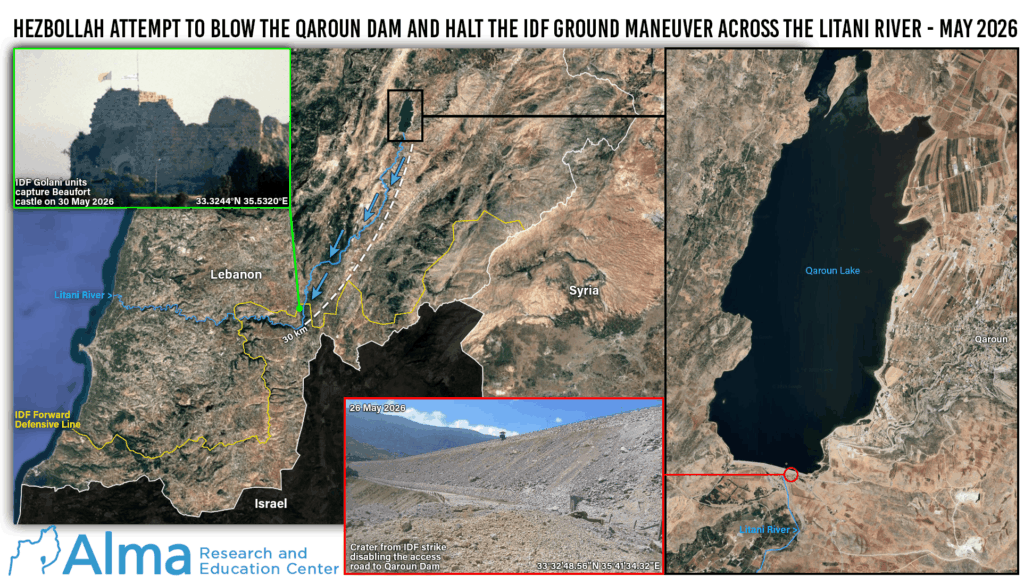
On May 26, the IDF carried out an airstrike near the Qaraoun Lake Dam, located in the southern part of the lake.
On May 27, Lebanon’s National Litani River Authority (المصلحة الوطنية لنهر الليطاني) warned of a “national disaster” in the event that the dam is damaged. According to the authority, the “repeated Israeli strikes” in the area of the Qaraoun Dam and the roads adjacent to it could jeopardize the stability of the structure itself. The authority stated that one of the roads that was struck forms part of the engineering system connected to the dam body, and therefore, the continuation of the strikes requires continuous engineering monitoring. The authority emphasized that any direct or indirect damage to the dam could result in widespread flooding, damage to critical infrastructure, and threats to populations living downstream along the Litani River.
The authority’s statement was accompanied by a document outlining possible dam failure scenarios and the expected flood zones in the event of a structural collapse, illustrating the potential scale of the risks involved.
The Qaraoun Lake Dam, whose construction was completed in 1965, is a strategic national infrastructure asset of Lebanon and serves as a critical pillar of the country’s energy sector through its hydroelectric power station, as well as its agricultural sector, particularly in the southern Beqaa Valley and southern Lebanon.
On May 28, the IDF Spokesperson announced that the purpose of the airstrike conducted near the dam, without endangering the dam itself, was to target Hezbollah operatives who intended to blow up the structure.
The collapse of the dam as a result of the explosion planned by Hezbollah would have caused an enormous volume of water to surge southward at high speed along the Litani River. According to data published by An-Nahar, a potential dam failure would generate a massive flood wave with a flow exceeding 70,000 cubic meters per second, reaching heights of more than 40 meters in several areas along the Litani River. The flood wave could travel at speeds of up to 45 kilometers per hour, sweeping away everything in its path, including people and property.
Why did Hezbollah intend to blow up the Qaraoun Lake Dam?
In recent weeks, the IDF had been operating to cross the Litani River, including in the area between Taybeh (south of the Litani) and Yohmor (north of the Litani), to reach and seize the Beaufort Castle (Qal’at al-Shaqif / قلعة الشقيف) and the Ali al-Taher Ridge (تلة علي الطاهر), both located north of the Litani.
On May 31, it was reported that IDF forces had taken control of Beaufort Castle and the Ali al-Taher Ridge area. This is a strategic area that overlooks the Nabatieh region to the northwest and the Marj Ayoun region to the northeast, into which Hezbollah reinforcement and supply routes from north of the Litani and the southern Beqaa Valley converge. Beyond its symbolic and psychological significance, control of this geographic area severely undermines Hezbollah’s deployment and operations in the Nabatieh region, which constitutes a major center of gravity for the organization in southern Lebanon.
Hezbollah’s objective was to blow up the Qaraoun Lake Dam to stop, at any cost, the advance of IDF forces and prevent them from crossing the Litani River by turning the riverbed into an impassable obstacle due to the volume and force of the water flow. In our assessment, Hezbollah also sought to drown soldiers and military equipment located within or near the river channel.
The immense environmental damage, the severe physical harm to civilians, and the extensive destruction of civilian property and state infrastructure that could have resulted from the destruction of the dam were irrelevant from Hezbollah’s perspective and did not constitute a consideration in its planning.




One Response
Dear Tal,
I agree with your analysis. Hezbollah’s terrorist tactics are to steal, kill and destroy with no regard for the Lebanese people. They consume everything available in their delusional obsession to destroy Israel at any cost. The ayatollah/IRGC with proxies must be destroyed to restore healthy governance for a path to peace to be realized.