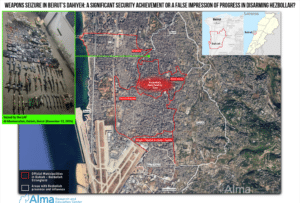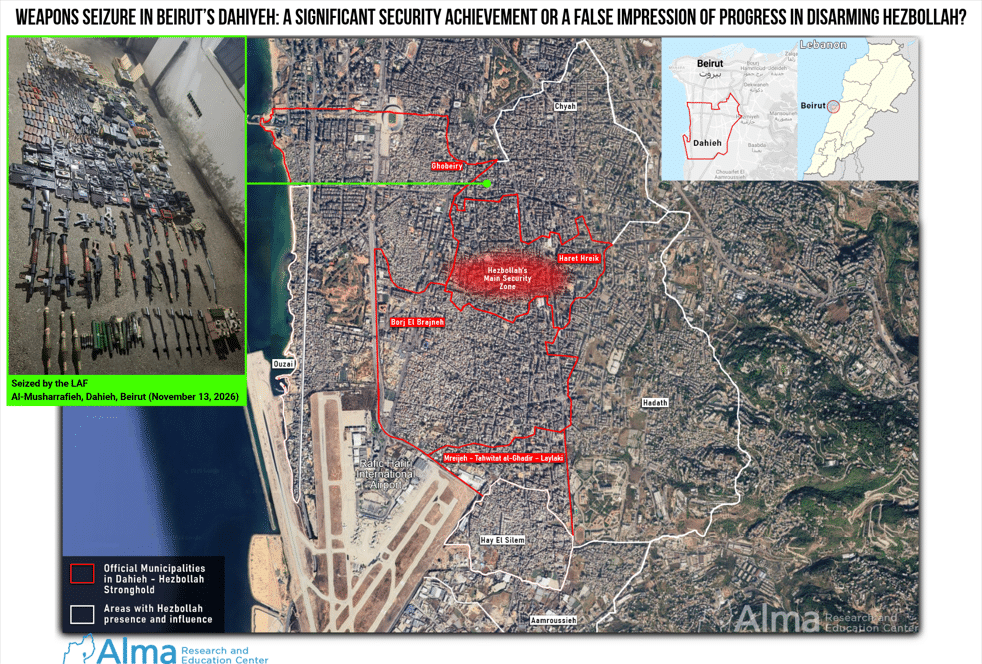
On November 13, the Lebanese Armed Forces (LAF) published photographs of weapons and ammunition seized during a raid on a warehouse in the al-Musharrafieh area of Beirut’s Dahiyeh. The LAF described the operation as a “high-quality security operation” and emphasized that a large quantity of weapons had been seized.
However, considering the quantity and characteristics of the weapons seized, it is difficult to regard this operation as a significant achievement. The weapons are of very limited quality, military value, and quantity. Even if the seized weapons do belong to Hezbollah (based on the circumstantial evidence of the warehouse’s location, north of Haret Hreik and east of Ghobeiry), their seizure has no meaningful operational impact on the organization’s military capabilities. The LAF did not attribute the seized weapons to Hezbollah, and the operation was presented as part of its efforts to combat arms trafficking.
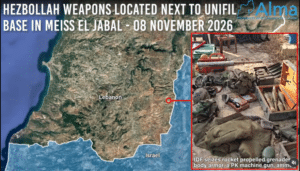
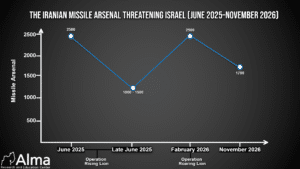
As during the ceasefire period from November 2024 to February 2026, we continue to witness an enormous gap between the Lebanese Armed Forces’ public reports of weapons seizures and the reality on the ground. The false impression of progress persists.
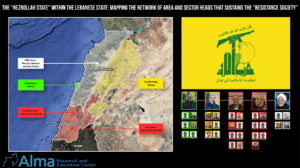
The Lebanese Armed Forces are not systematically working to dismantle Hezbollah’s military power. Highly limited, isolated weapons seizures, even in the heart of the Dahiyeh (assuming the weapons do belong to Hezbollah), are no substitute for dismantling the organization’s weapons arsenal, military infrastructure, and military control.
This is even before addressing additional questions: Was the operation coordinated with Hezbollah? Are the seized weapons eventually returned to Hezbollah through a revolving-door mechanism?