
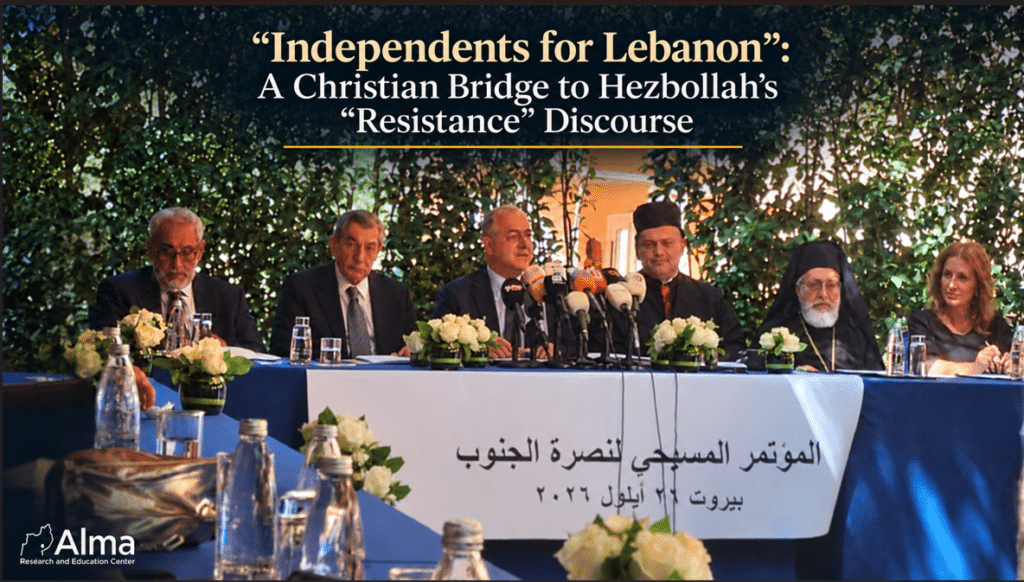
On September 26, 2026, the “Christian Conference in Support of the South” was held in Beirut at the initiative of “Independents for Lebanon” (لقاء مستقلون من أجل لبنان). The event sought to present the reconstruction of southern Lebanon, the return of its residents, and the confrontation with Israel as national issues that transcend sectarian divisions.
The conference was attended by Christian clergy and politicians, including Bishop Elias Nassar as Bkerke’s representative, Deputy Speaker of Parliament Elias Bou Saab, former Deputy Speaker Elie al-Ferzli, and Vera Yammine, representing the Marada Movement. However, it was not an official event of the Maronite Church.
“Independents for Lebanon” first emerged publicly in May 2023 as a framework of independent Christian figures seeking to offer an alternative voice to the major Christian parties. Some of its founders later distanced themselves from the group, while the remaining core surrounding its secretary, Rafi Madayan, moved closer to Hezbollah’s positions and the discourse of the “resistance.”
The messages conveyed at the conference reflect this alignment. Southern Lebanon was presented as a national cause that must be defended against Israel, which was portrayed as the principal source of threat and destruction. This framing closely resembles Hezbollah’s narrative, which seeks to portray the “resistance” not as a Shiite or partisan concern but as a Lebanese national necessity. By contrast, limited attention was given to Hezbollah’s responsibility for operating an independent military force and for deciding to open a front against Israel.
The relationship between the two sides is also public. In January 2024, a delegation from “Independents for Lebanon” met with Naim Qassem and subsequently reported “unity of position” on national and regional issues, alongside support for the “Lebanese resistance.” In August 2025, an official Hezbollah delegation headed by Mahmoud Qomati visited the organization’s headquarters to discuss the issue of the state’s monopoly on arms.
The organization’s importance to Hezbollah does not stem from significant electoral strength, but from its ability to give expression to Hezbollah-aligned messages within the Christian sphere. When Christian figures portray Israel as the principal threat and the “resistance” as a national necessity, this helps Hezbollah argue that the justification for its weapons extends beyond the Shiite community and represents a broader Lebanese outlook.
This is particularly important now, after Hezbollah suffered severe blows in the war with Israel and as Lebanon once again faces the test of establishing the state’s monopoly on arms and concentrating the authority to decide on war and peace in the hands of the state. In this context, framing the “resistance” as a national necessity helps shift the debate away from the fundamental legitimacy of Hezbollah’s weapons and toward the question of when and under what conditions they could be relinquished.



One Response
Dear Dr Zoe,
This is islamo-nazi standard practice to distort reality and invert perceptions to decieve the world to believe jihaddist “resistance lies”. THIS IS NOT “RESISTANCE”: IT IS TERRORIST LIES AND GENOCIDAL MURDEROUS PROPAGANDA WITH INSIDIOUS EVIL REBELLION AGAINST JUSTICE.
Remember October 7.