
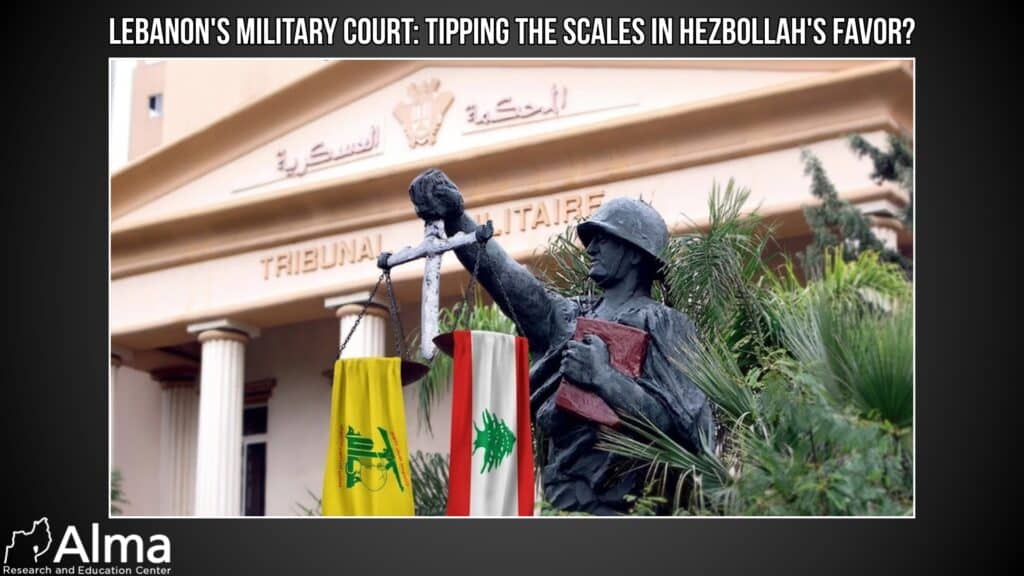
In early June 2026, Lebanon’s Military Court, presided over by Brig. Gen. Wassim Fayyad (وسيم فياض), sentenced two Lebanese political activists living abroad and known for their public opposition to Hezbollah to 15 years in prison. The proceedings before the military court had commenced in November 2024.
According to reports, the two were convicted of collaborating with Israel, inciting the continuation of Israeli military activity against Hezbollah, and harming Lebanon’s national interests through publications on social media and media appearances.
Ahmad Yassin, a lecturer and academic based in Paris, was charged, among other allegations, with disseminating information asserting that the Baalbek Citadel was being used as a Hezbollah weapons storage facility. According to Lebanese authorities, the publication of this information was intended to encourage Israeli military strikes against the site. Yassin operates a YouTube channel with more than 140,000 subscribers, where he regularly provides political analysis and commentary.
The second defendant, Joumana Jabara, a political activist and outspoken critic of Hezbollah, was accused of publicly praising the IDF Arabic-language spokesperson and Israeli military operations in Lebanon, as well as expressing support for normalization with Israel during the 2024 conflict between Israel and Hezbollah.[1] The verdict was issued in absentia.
The verdict attracted public attention not only because of the severity of the sentences, but also because of the identity of the body that issued it. Only three months before the trial of Yassin and Jabara, the same military court was at the center of another public controversy following its decision to release three Hezbollah operatives who had been arrested in southern Lebanon while in possession of light and medium weapons.
Initially, the court imposed a fine of 1.9 million Lebanese pounds on them for possessing and transferring weapons without a license. However, the military court later ordered their surprising release on financial bail of only $20 per detainee. According to the same report, the Government Commissioner (مفوض الحكومة) at the Military Court, Judge Claude Ghanem, originally intended to appeal the decision but the appeal was not expected to delay the actual release of the detainees.[2]
Public criticism surrounding the affair intensified in light of additional reports alleging that pressure had been exerted on the military court during the proceedings. Al Arabiya Lebanon reported on March 8, 2026, that Hezbollah exerted pressure on Military Court President Wassim Fayyad to secure the release of the detainees and allegedly issued threats should legal action against its members proceed.[3]
Wassim Fayyad comes from the Shiite village of Ansar in the Nabatieh District of southern Lebanon.[4] Lebanese journalist Rami Naim claimed that Fayyad was considered close to Hezbollah and that the release of the detainees created significant controversy within the military court.[5] Subsequently, Nadine Barakat, a Lebanese political activist living in exile in the United States and known as a fierce opponent of Hezbollah and Iran, alleged political ties between Wassim Fayyad and the Amal Movement and Lebanese Parliament Speaker Nabih Berri.[6]
It should be noted that these claims were not supported by public evidence within the sources examined, but they reflect the level of suspicion and lack of trust among Lebanese citizens toward Lebanon’s military justice system.
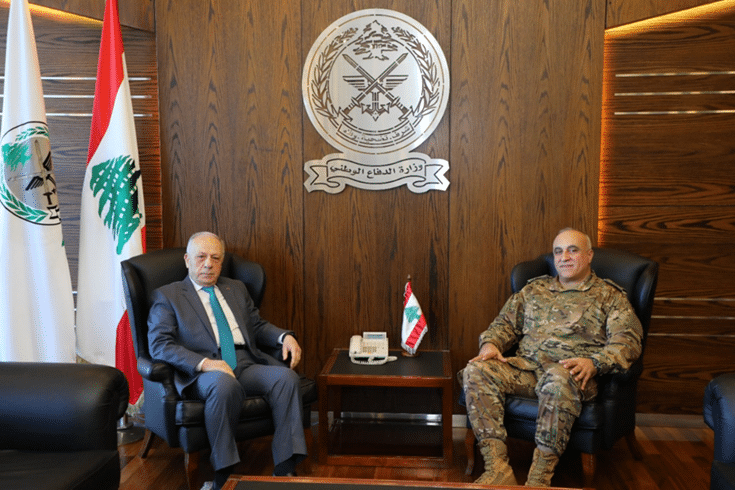
The President of the Lebanese Military Court, Wassim Fayyad (right), and the Lebanese Minister of Interior Security, Maurice Slim
Following the release decision, reports emerged that Lebanese Justice Minister Adel Nassar had ordered a review of the circumstances surrounding the ruling, including allegations that a third party may have exerted pressure on Abbas Jaha, the civilian judge serving on the court panel. At the same time, the Lebanese news outlet MTV reported that authorities were considering the removal of Military Court President Wassim Fayyad, amid claims that the decision to release the Hezbollah operatives was inconsistent with Lebanese government policy.[7]
The two affairs together – on the one hand, the release of Hezbollah operatives, and on the other hand, the imposition of heavy prison sentences on Hezbollah opponents – became the basis for sharp public criticism of the military court. Activists, journalists, and Lebanese influencers argued that there was a glaring disparity between the way Hezbollah members and operatives were treated and the way critics of the organization were treated.
The military court under Wassim Fayyad imposed heavy prison sentences on Hezbollah opponents, while Hezbollah operatives who possessed illegal weapons in Lebanon were released on low bail.
Based on the two affairs described above, it is not possible to prove unequivocally that the military court under Wassim Fayyad acts on behalf of Hezbollah or in accordance with its directives. However, they raise many questions regarding the conduct of the court and its rulings relating to Hezbollah and illustrate an additional dimension of the crisis of confidence in Lebanese state institutions.
It is difficult to ignore the possibility that the military court president’s Shiite background and the allegations made against him do indeed contribute, in the eyes of Hezbollah’s critics, to perceived injustice between Hezbollah opponents who expressed their views and Hezbollah operatives carrying illegal weapons. The vast disparity in punishments constitutes further evidence of Lebanon’s difficulty in confronting and acting independently against the Hezbollah terrorist organization – on the part of the Lebanese state in general, and the Lebanese Army in particular, where, as is known, approximately 50 percent of its soldiers and officers are Shiites, not a few of whom, at all ranks, assist and cooperate with Hezbollah.
[1] https://thisisbeirut.com.lb/news/politics/lebanon-sentences-3-exiled-journalists-in-absentia-over-anti-hezbollah-stance ; https://english.alarabiya.net/News/middle-east/2026/06/05/lebanon-sentences-activists-in-absentia-for-inciting-israeli-attacks
[2] https://www.sawtbeirut.com/lebanon-news/%D9%87%D9%84-%D9%8A%D9%82%D8%A7%D9%84-%D8%B1%D8%A6%D9%8A%D8%B3-%D8%A7%D9%84%D9%85%D8%AD%D9%83%D9%85%D8%A9-%D8%A7%D9%84%D8%B9%D8%B3%D9%83%D8%B1%D9%8A%D8%A9-%D8%A8%D8%B9%D8%AF-%D8%A7%D9%84%D8%A5%D9%81/
[3] https://x.com/Alarabiyaleb/status/2030587571890233369?s=20
[4] https://www.facebook.com/share/p/1EAuv3QDEF/
[5] https://x.com/NAIMRami/status/2030978083793043794?s=20
[6] https://x.com/nadinebarakatlb/status/2064777547418574981?s=20
[7] https://www.sawtbeirut.com/lebanon-news/%D9%87%D9%84-%D9%8A%D9%82%D8%A7%D9%84-%D8%B1%D8%A6%D9%8A%D8%B3-%D8%A7%D9%84%D9%85%D8%AD%D9%83%D9%85%D8%A9-



One Response
Dear Dvir,
It is clear that hezbollah cancerous infiltration of Lebanon has metastasized throughout the government, army and society. A systematic process of deradicalization by weeding out terror sympathizers is now needed. All terror supporters must know “We will find you, and we will kill you.” This is USA policy. Appeasement has been replaced by ENFORCEMENT OF JUSTICE!!!