Dana Polak
Analyzing Hezbollah’s patterns of weapon usage enables a deep understanding of its operational doctrine, organizational objectives, and strategic pragmatism over time.
This article analyzes the weaponry used by Hezbollah in the current conflict with Israel, from March 2 to March 21, 2026, and compares the data to that of October 2024 – the most intense month of the previous conflict within Operation “Northern Arrows,” during which Hezbollah carried out 1,158 attack waves (four times higher than the monthly average up to that point).

Breakdown of Hezbollah’s Weaponry – March 2026
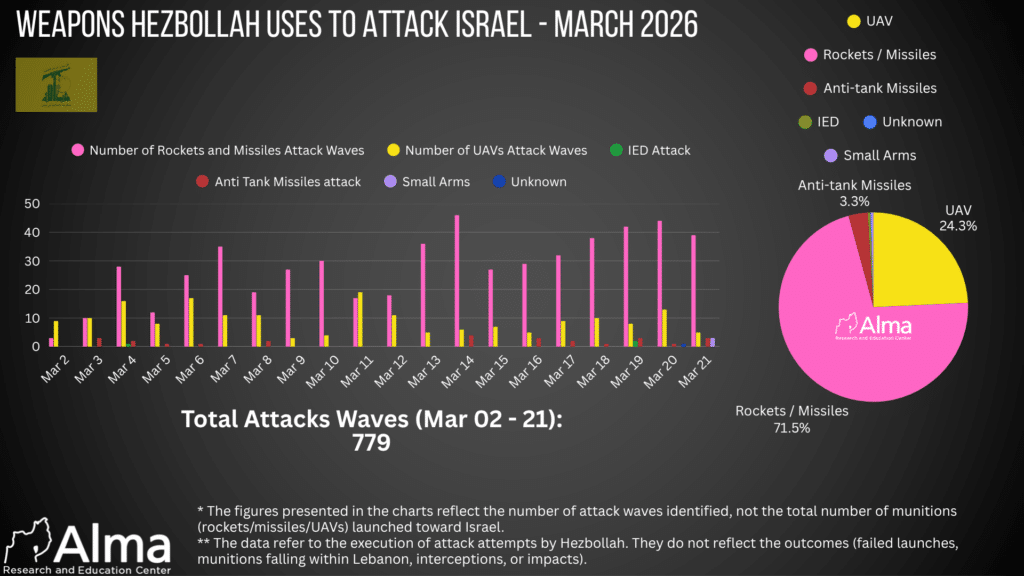
Between March 2 and March 21, 2026, a total of 779 attack waves attributed to Hezbollah were recorded. This reflects a high and sustained operational tempo, indicative of ongoing intensive combat. The average daily rate amounted to 39 attack waves.
If this intensity rate continues, the number of attack waves will be higher than those in October 2024.
The percentage of weapon types used by Hezbollah in its attacks:
Rockets and missiles: 71.5%
UAVs: 24.3%
Anti-tank missiles: 3.3%
Other categories (IEDs, small arms, etc.): negligible
An analysis of the daily breakdown of attack waves during the examined period in March 2026 indicates a distinct operational pattern combining stability in the use of rocket-based weaponry alongside volatility in UAV usage:
First and foremost, it is evident that rockets and missiles constitute the most dominant and stable component throughout the entire period: Nearly every day features dozens of rocket fire waves, with consistently high levels of activity and occasional surges exceeding 40 attack waves per day. This pattern underscores rockets as the central pillar of combat operations—enabling Hezbollah to sustain continuous and persistent pressure.
In contrast, the use of UAVs is characterized by greater volatility: there are days with relatively high activity (sometimes over 15 attack waves), alongside days with significantly lower scope. This volatility may indicate more flexible operational use –deployment according to opportunities, capability, and operational survivability.
While rockets serve as a constant attrition tool, UAVs function as a dynamic complementary means, intended to enhance both the operational and psychological effect at selected times.
Ongoing Dominance of Rocket Fire
The primary means by which Hezbollah conducts most of its attacks is indirect fire—rockets and missiles—accounting for 71.5%.
During October 2024, 995 attacks were carried out using indirect fire weapons (rockets and missiles), which constituted about 86% of all attacks, indicating the dominance of this weapon even then.
The dominance of rocket fire in March 2026 is not incidental, but is based on Hezbollah’s continuous force-building infrastructure. Even after the damage Hezbollah sustained in 2024, it continues to maintain a broad arsenal of short- and medium-range rockets, deployed and dispersed in a manner that enables survivability.
The preservation of the rocket array is made possible through a combination of existing stockpiles, local production and rehabilitation (reuse) capabilities – mainly of short-range rockets – and continued smuggling from Syria. Over the past year, several attempts to transfer hundreds of rockets into Lebanon were thwarted, but the Syria–Lebanon border, characterized by numerous illegal crossings, continues to serve as a central supply route. The working assumption is that for every successful interception of smuggling, there are several successful smuggling attempts.
However, in the current conflict, an operational limitation is also evident: rocket barrages are relatively small, and Hezbollah strains to execute large-scale barrages as observed in the previous conflict. In addition, recurring launch failures have been identified, including rockets falling within Lebanese territory, not reaching their destination (estimates in this context are around a 60 percent failure rate out of Hezbollah’s total launches).
Despite these limitations, the extensive use of rockets (71.5% of attack waves) reflects a clear strategic operational logic – this is the only means that allows Hezbollah to generate volume of fire, continuity, and attrition over time, while UAVs complement and enhance the effect but do not replace it.
Hezbollah employs rocket fire against both military and civilian targets. It is important to note that this is an inherently imprecise, statistical weapon; accordingly, even when Hezbollah claims in its responsibility statements that it aimed at a military objective, this does not necessarily reflect the actual impact point of the rockets.
Increase in UAV Usage
In October 2024, UAVs constituted only about 7.5% of all attacks (and overall, from October 2023 to November 2024, they accounted for about 14% of total attacks). In the current conflict, they constitute 24.3% of all attacks, indicating a significant increase compared to the previous conflict.
The significant increase in UAV usage in the current conflict reflects a clear operational trend whereby the UAV array has become a “trump card” for Hezbollah – both operationally and psychologically – due to its potential ability to penetrate deep, remain over Israeli territory for extended periods, and exert pressure on defense systems and the civilian population. In addition, UAVs are a relatively inexpensive weapon, simple to assemble and operate, and possess high accuracy, which allows Hezbollah to deploy them in growing numbers and integrate them systematically into the ongoing combat, constituting an advantage due to their precision capability.
The increasing use of UAVs, which constitutes about a quarter of Hezbollah’s weapon deployment, indicates a shift from point-based UAV usage to systematic and integrated use, as part of a combat doctrine that seeks to combine physical attrition through rockets with psychological impact and the burdening of air defense systems through the use of UAVs.
However, despite the above, and in contrast to October 2024, as of the time of writing, there are almost no incidents of UAV penetration deep into Israeli territory. In our assessment, most UAVs are intercepted before entering Israeli territory, or in the contact line / near the border area. A small number of UAVs manage to penetrate at most over the Galilee region and are intercepted there.
Significant Decrease in the Use of Anti-Tank Missiles
Regarding anti-tank missiles, the limited scope of anti-tank fire toward Israeli territory also reflects a change in Hezbollah’s force deployment: unlike during the “Iron Swords” war period, when the organization was widely deployed along the border and prepared for a scenario of infiltration into the Galilee, in the current conflict its deployment is more limited, reducing the operational relevance of anti-tank weaponry as a central tool.
During the fighting period from October 2023 to November 2024 (including October 2024, during the ground maneuver in Lebanon), Hezbollah’s use of anti-tank missiles was intensive and succeeded in significantly damaging civilian settlements and military sites near the border.
As of the time of writing, Hezbollah’s use of anti-tank missiles is very limited and is mainly focused on IDF forces located within Lebanese territory.
October 2024 Data