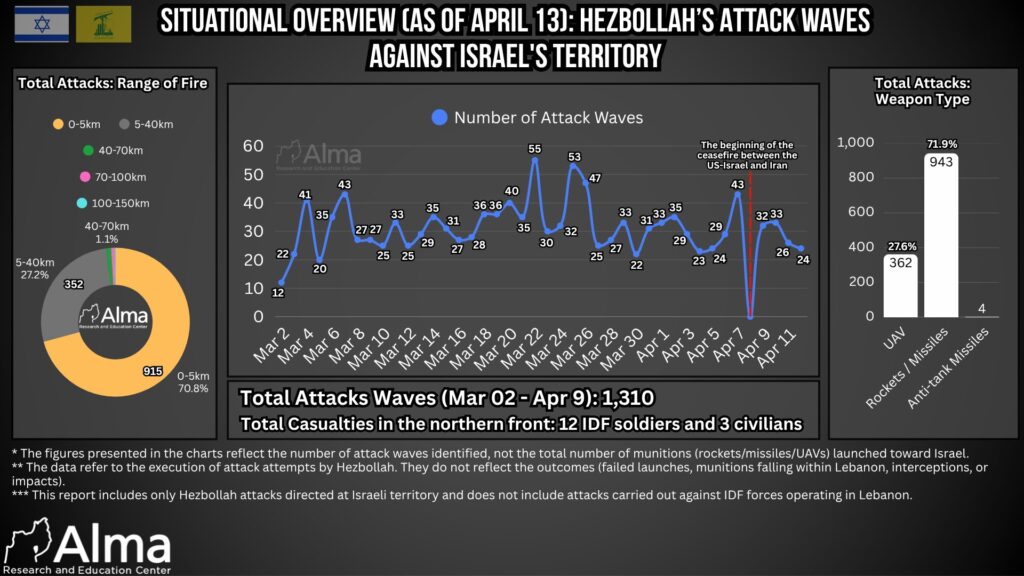
Since the ceasefire with Iran came into effect (April 8), Hezbollah has gradually resumed attacks against Israeli territory, following a sharp but temporary one-day decline in the volume of fire at the onset of the ceasefire. Since the beginning of the fighting (March 2), a total of 1,310 Hezbollah attack waves targeting Israeli territory have been identified, with a daily average of approximately 30 attacks. To date, 12 IDF soldiers and 3 civilians have been killed in the northern arena. In terms of weapon types, there remains a clear dominance of rockets and missiles (approximately 71.9%), alongside significant use of UAVs (approximately 27.6%), and relatively limited use of anti-tank missiles. This mix indicates a preference for wide-area, statistical weapons, enabling broad-area impact and sustained pressure on the civilian rear, alongside complementary use of more precise capabilities. Geographically, the majority of attacks continue to focus on northern Israel, particularly border communities: 915 attacks (70.8%) within 0–5 km of the border 352 attacks (27.2%) at ranges of 5–40 km, up to the Haifa area A very small proportion of attacks reached longer ranges This distribution reflects a consistent focus on border communities, alongside an effort to sustain ongoing attrition of both the civilian population and military infrastructure across the broader northern region. At the same time, there have been limited attempts to extend firing ranges: on Friday (April 10), Hezbollah launched a surface-to-surface missile toward central Israel, which was intercepted. In recent days, direct rocket impacts in civilian areas have been recorded, including in the cities of Kiryat Shmona and Nahariya, as well as in the Muslim village of Deir al-Asad in the Carmiel area. These incidents underscore Hezbollah’s continued ability to pose a tangible threat to the civilian sphere. In addition, Hezbollah continues to conduct direct attacks against IDF forces operating in southern Lebanon, employing high-trajectory fire, anti-tank missiles, and loitering UAVs. These data are not included in the current report, which focuses solely on attacks directed at Israeli territory.