
Key Points
The Council for the South (مجلس الجنوب) is a Lebanese public body established in 1970 to address the neglect of southern Lebanon and the damage caused by the ongoing conflict with Israel. It deals with compensation, assistance to displaced persons, the rehabilitation of infrastructure, and the development of communities in southern Lebanon, the Western Beqaa, and Rashaya (for more on the Council for the South, see the appendix).
The Council for the South is not a Hezbollah institution and is not formally part of it. Nevertheless, for decades it has been identified with the Amal Movement and with Parliament Speaker Nabih Berri. The alliance between Amal and Hezbollah, their control over many of the local authorities in the south, and Hezbollah’s network of civilian bodies create a permanent interface between the council and the power structure of the Shiite duo.
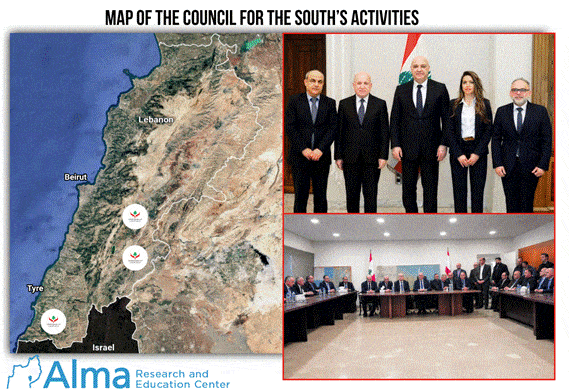
From Amal’s perspective, the Council for the South serves as a central mechanism for mediation between the region’s residents and the state. Although the assistance funds are public funds, access to them sometimes passes through members of parliament, mayors, mukhtars, and activists affiliated with the movement. Amal can thus present itself as the provider of the assistance and translate state resources into political loyalty and a deepening of the residents’ dependence on its mechanisms. At the same time, Hezbollah operates an independent reconstruction and assistance system, primarily through Jihad al-Bina and its network of civilian, economic, and social institutions, which provides its support base with a rapid response that is sometimes more efficient than that of the state.
A combined system is thus created: state resources and international assistance are transferred through the Council for the South and other government bodies, while Amal and Hezbollah influence priorities through the local authorities affiliated with them and use their institutions to fill the gaps left by the state. In this way, they receive public credit even for resources that did not originate with them. The assistance addresses genuine needs, but it also deepens the residents’ dependence on the Shiite duo for compensation, services, and access to state resources. This dependence strengthens its political and social power and makes it difficult for the state to establish a direct relationship with its citizens.
Reconstruction is therefore a struggle over sovereignty and legitimacy, and not only over homes and infrastructure. Whoever arrives first in a village, documents the damage, pays the family, and restores water, electricity, and housing is perceived as the party providing security in its broadest sense. Amal seeks to preserve its status as the principal intermediary between the Shiite public and the state, while Hezbollah seeks to demonstrate that the “resistance” is also a social system that cares for the public. The government and external donors, on the other hand, seek to ensure that reconstruction strengthens the state rather than Hezbollah’s parallel system.
Hezbollah’s system of civilian services is an integral part of its political and military power. It preserves a supportive population, assists in recruiting resources and manpower, disseminates the narrative of the “resistance,” and consolidates the organization’s status as the de facto sovereign in the Shiite core areas. Consequently, civilian reconstruction may also contribute to Hezbollah’s organizational recovery. This does not mean that every civilian project conceals military activity; however, contractors, engineering equipment, local information, and access to assets may serve civilian purposes and, in certain cases, also support military recovery.
Without oversight, reconstruction funds are liable to reinforce Amal’s patronage system, deepen the population’s dependence on Hezbollah, and facilitate its organizational—and even military—recovery. By contrast, transparent and equitable reconstruction, carried out under governmental and international supervision while providing citizens with direct access to assistance, can strengthen the state and reduce the Shiite duo’s ability to transform the population’s needs into a political, social, and military resource.
Reconstruction Under Supervision: Preventing Hezbollah’s Renewed Strengthening
The central question is not whether southern Lebanon should be reconstructed, but rather who manages the process and how the resources flowing into the region are used. Genuine civilian reconstruction that enables residents to return, strengthens state institutions, and improves infrastructure and services can contribute to stability and reduce the population’s dependence on Hezbollah.
Conversely, if funding, engineering equipment, and access to infrastructure and assets pass through mechanisms affiliated with Amal and Hezbollah without effective oversight, reconstruction may assist Hezbollah in restoring its civilian influence, its public legitimacy, and even its military infrastructure.
Experience demonstrates that Hezbollah uses civilian activity not only to provide services, but also to collect intelligence, reinforce dependence, deepen its presence in local communities, and conceal its organizational and military recovery processes within the civilian environment.
Therefore, civilian reconstruction must not be viewed as a process separate from the reconstruction of Hezbollah’s power.
To ensure that the Council for the South serves the citizens of Lebanon and ceases to function as an indirect channel for strengthening Hezbollah, several key changes are required:
• International oversight of reconstruction funds: External assistance should be conditioned on the publication of budgets, tenders, contractors, projects, and beneficiary lists, while establishing the ability to monitor the flow of funds from the initial contribution through project completion.
• Reducing partisan mediation: Residents should be able to submit applications for compensation and reconstruction directly to state institutions, without dependence on mayors, mukhtars, or activists affiliated with Amal and Hezbollah.
• Screening contractors and implementing bodies: The transfer of budgets, equipment, and contracts to companies or associations linked to Hezbollah, Jihad al-Bina, or mechanisms that simultaneously serve both its civilian and military activities should be prevented.
• Separating civilian reconstruction from military entrenchment: Every project in the south, particularly in the border villages, should include oversight to ensure that construction work, excavation, road paving, and building rehabilitation are not exploited to establish tunnels, warehouses, observation posts, or other military infrastructure.
• Leadership by state institutions: The powers of the Lebanese government, the army, ministries, and oversight authorities should be strengthened, and the Council for the South should be defined as a professional implementing body subordinate to these institutions rather than as an independent mechanism reliant on Amal’s patronage network.
• Equitable distribution of assistance: Reconstruction should be based on the extent of the damage and civilian need, rather than sectarian or political affiliation. Equal distribution, including to communities outside the control of the Shiite duo, may reduce Hezbollah’s ability to present itself as the exclusive protector of the residents of the south.
• Ongoing oversight rather than only preliminary review: Monitoring of the use of buildings and infrastructure is required even after their completion, since infrastructure established for civilian purposes may later be used to support Hezbollah’s activities.
Israel’s interest is not to prevent the reconstruction of southern Lebanon, but to ensure that it strengthens the Lebanese state rather than recreating the conditions that enabled Hezbollah to reestablish itself. Transparent and supervised reconstruction may weaken the organization’s claim that only it is capable of protecting the public and providing for its needs.
By contrast, reconstruction controlled by bodies affiliated with the Shiite duo may enable Hezbollah to transform state funds and international assistance into resources that reinforce its civilian, political, and military influence—and lay the groundwork for the next confrontation.
Summary
The Council for the South is a governmental institution with extensive experience and a proven record of activity, but it also represents a clear expression of Lebanon’s political structure. It emerged from the neglect of the south and the need to assist a population that bore the cost of the conflict with Israel. Over the years, it has built infrastructure, addressed war damage, and assisted residents; at the same time, it became a center of power for Amal and part of Nabih Berri’s patronage system.
Its connection to Hezbollah is significant, though more indirect. The council does not belong to the organization, but it operates within a political environment largely dominated by the Amal–Hezbollah alliance and in coordination with local authorities affiliated with it. Alongside the council, Hezbollah operates an independent civilian mechanism through which it provides services, reinforces dependence, and translates reconstruction into legitimacy and the preservation of its power.
Following the wars of 2023–2024 and 2026, the scale of the damage became too great for the Council for the South, Hezbollah, or the Lebanese state to address alone. A multi-actor model has therefore emerged: the Council for the South operates at the local level; the Council for Development and Reconstruction (CDR) and the relevant government ministries manage parts of the reconstruction and infrastructure programs; external donors provide part of the funding; and Hezbollah continues to operate in parallel through its own independent assistance and reconstruction mechanisms.
The central question is not merely how much money will reach the south, but how it will be distributed and who will derive political power from it. If funding passes through opaque mechanisms based on partisan mediation, it may once again strengthen Amal’s patronage system and Hezbollah’s civilian grip. If, however, it is administered through transparent, equitable, and supervised institutions, reconstruction may become an opportunity to strengthen the state and reduce the population’s dependence on partisan systems.
The reconstruction of southern Lebanon may contribute to stability, provided that it strengthens state institutions rather than Hezbollah’s infrastructure. Without effective oversight, aid funds, engineering equipment, and civilian projects may serve the organization in restoring its influence over the population and even support the recovery of its military infrastructure. Therefore, the main interest is not to prevent reconstruction, but to ensure that it is conducted transparently, under governmental and international supervision, and without the involvement of bodies affiliated with Hezbollah. Such reconstruction, by strengthening the sovereignty of the Lebanese state, may reduce the population’s dependence on the organization and its ability to rebuild its power in preparation for a future conflict.
The challenge, therefore, is not only to reconstruct southern Lebanon, but to determine who will exercise civilian sovereignty there after the war: the Lebanese state, or a hybrid system in which public funds pass through partisan power centers and Hezbollah continues to function as the de facto sovereign in its core areas.
Appendix: The Council for the South in Lebanon – Institutional and Political Profile
The Council for the South – A Government Institution Within a Partisan Political System
The Council for the South is an institution of the Lebanese state: it is funded from the state budget, is subject to government decisions, and operates under public law.
Like many public institutions in Lebanon, the Council for the South is integrated into the country’s sectarian and partisan power-sharing system. In its case, the dominant influence is that of the Amal Movement, while Hezbollah’s influence is expressed through its alliance with Amal, its power within the local authorities, and the network of social, economic, and religious organizations that it operates.
This distinction is essential: it is not a matter of Hezbollah exercising direct control over the council, but rather of an interface between a state institution that relies on Amal’s patronage network and a local environment in which Hezbollah possesses broad political, social, and organizational influence. This interface enables both movements to shape local priorities and influence the manner in which residents gain access to state resources.
Background to the Establishment of the Council
The council was established in 1970, before the outbreak of the Lebanese Civil War, as a result of a combination of prolonged governmental neglect and deteriorating security conditions along the border with Israel. At the time, southern Lebanon was a relatively poor agricultural region suffering from a shortage of roads, schools, hospitals, water and electricity networks, and employment opportunities. At the same time, Israeli attacks intensified in response to the activities of Palestinian organizations operating from Lebanese territory.
Imam Musa al-Sadr, the Shiite leader who later founded the Amal Movement, played a central role in the campaign to establish a dedicated governmental body for the south. He argued that the state required the residents of the region to bear the security burden of the conflict while failing to provide them with protection, compensation, or basic services. Following public demonstrations and pressure, the law establishing the council was approved in May 1970.
The council was granted broad powers: compensation for families suffering loss of life and property; assistance to displaced persons; reconstruction of villages; construction of infrastructure; and provision of services intended to encourage residents to remain on their land. This objective is described in Lebanon by the term “strengthening steadfastness” (تعزيز الصمود). From its inception, therefore, the council linked civilian development, population presence, and a security-political conception of the region.
The Council’s Leadership and Institutional Continuity
The Council for the South is headed by engineer Hashem Haidar (هاشم حيدر), a long-serving official who served for many years as the council’s Director General and was involved in its activities during the period of the Israeli presence in southern Lebanon’s security zone until 2000. After the end of the tenure of the previous chairman, Kabalan Kabalan, the position remained vacant for a period. Since 2023, Haidar has appeared in official publications as Chairman of the Council and has participated in government meetings dealing with assistance, displaced persons, and reconstruction.
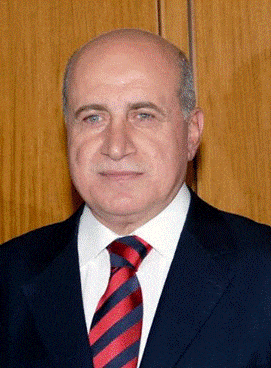
Haidar is regarded as a figure acceptable to both Amal and Nabih Berri. The media occasionally describe the council under his leadership as a body connected to Amal, although publicly available information does not allow a definitive determination of his current formal party status. Alongside his role in the council, he has served since 2001 as President of the Lebanese Football Association.
Areas of Activity: From Infrastructure Rehabilitation to Emergency Assistance
The council’s activities are not limited to rebuilding homes. They include documentation and assessment of damage to homes, businesses, and public buildings; preparation of compensation files for the families of those killed and wounded, and for owners of damaged property; construction and repair of roads; development of water and sewage infrastructure; rehabilitation of schools, hospitals, clinics, and municipal buildings; removal of rubble and reopening of roads; assistance to displaced persons; and ongoing cooperation with municipalities, mukhtars, and municipal unions.
During wartime, the council also functions as a relief organization. It distributes food, mattresses, blankets, hygiene supplies, and basic necessities to families displaced from their homes. During the 2026 war, Haidar stated that, with the approval of the Prime Minister, part of the council’s budget had been used to assist displaced persons from southern Lebanon and other areas.
Following a ceasefire, engineering teams are dispatched to inspect buildings and classify the damage. Residents are required to present proof of ownership and additional documentation in order to receive compensation. The process is particularly complex in villages where property has passed through inheritance for generations without updated land registration. This situation increases the influence of local intermediaries, mayors, mukhtars, rabats (Hezbollah operatives who serve as liaisons between the local population and the organization), and political activists, who are affiliated with Amal or Hezbollah and assist residents in navigating the process.
Amal and the Council for the South: From a Struggle Against Neglect to a Patronage Mechanism
The relationship between the Council for the South and the Amal Movement is a historical one that began during the era of Musa al-Sadr and evolved into tangible political control during the 1980s. Against the backdrop of the Lebanese Civil War, the 1982 First Lebanon War, and the struggle for leadership within the Shiite community, Amal, under the leadership of Nabih Berri, became the dominant force within the public institutions identified with southern Lebanon.
Several of the council’s chairmen were prominent Amal figures. Mohammad Baydoun, who headed the council during the 1980s, was a senior Amal official who later served as a member of parliament and a minister. Kabalan Kabalan, who served for many years as chairman, was likewise an Amal politician. At the same time, the movement established a network of members of parliament, mayors, municipal unions, and local intermediaries through which residents’ demands were conveyed to the state.
Following Nabih Berri’s election as Speaker of Parliament in 1992, the status of the Council for the South was strengthened. It received budgets for compensation related to Israeli attacks and for financing roads, water systems, schools, hospitals, and public buildings. From Amal’s perspective, the council enables the movement to present itself as the bridge between the residents of the south and the state. From the perspective of its critics, however, it constitutes a patronage mechanism: the money is public, but the party serves as the gateway to accessing it and receives much of the resulting political credit.
This creates a dual dependency. Residents depend on the state as the source of funding, but often require partisan intermediaries to gain access to it. The party does not completely replace the state; rather, it controls part of the access to it and translates public resources into loyalty, influence, and political visibility.
The Interface with Hezbollah and the Municipal Network
The relationship between the Council for the South and Hezbollah differs from its relationship with Amal. Hezbollah does not exercise the same historical, traditional, or direct control over the council, but it influences the council’s operating environment through its political alliance with Amal and through its local, social, and organizational power.
In many municipalities in southern Lebanon, joint Amal–Hezbollah electoral lists operate. In the 2025 municipal elections, the two movements won control of numerous local authorities, and in some localities they faced no competing list. Accordingly, when the council collects damage assessments, identifies families in need, or establishes priorities, much of its local interface is conducted with officeholders connected to the Shiite duo.
In January 2025, a meeting was held at the council’s offices in coordination with the local government offices affiliated with Amal and Hezbollah. Participants included Council Chairman Hashem Haidar, representatives of both movements, mayors, heads of municipal unions, and mukhtars. The purpose of the meeting was to coordinate the return of residents to the border villages. Similar meetings were also held following the 2026 war.
The municipal level constitutes a central component of Hezbollah’s civilian infrastructure. Municipalities provide the organization with access to information, planning processes, infrastructure, and the local population, enabling it to integrate into activities presented as municipal or governmental in nature. This does not mean that every action taken by a municipality controlled by the Shiite duo is necessarily a Hezbollah activity. However, local political control enables the organization to influence priorities, public visibility, and the distribution of political credit.
The Council for the South as a Complementary Component of Hezbollah’s Civilian System
Hezbollah functions as a hybrid military, political, and civilian entity. Under its Executive Council operates a network of institutions dealing with reconstruction, healthcare, welfare, education, finance, culture, and religion. These bodies are not merely providers of community services; they constitute a strategic infrastructure for building influence, creating dependency, recruiting organizational and ideological loyalty, and shaping public consciousness.
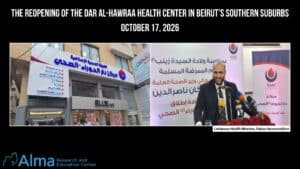
Jihad al-Bina is a central component of this system. It operates in the fields of construction, infrastructure rehabilitation, and agriculture. During post-war periods, it enables Hezbollah to reach affected populations rapidly, assess damage, provide temporary housing, and manage reconstruction work. Alongside it operate institutions in the fields of healthcare, welfare, education, and finance, including the Islamic Health Organization and Al-Qard al-Hassan, which provide partial alternatives to weak state institutions.
These civilian activities serve several objectives simultaneously: they provide solutions to genuine civilian needs; reinforce Hezbollah’s image as the defender of the “Resistance Society”; deepen economic and social dependence; preserve collective identity; and enable the organization to transform Iranian and organizational resources into long-term political legitimacy.
Within this context, the Council for the South constitutes a complementary, rather than subordinate, component. It is capable of transferring state resources and implementing public projects, while Hezbollah’s own mechanisms operate in much closer proximity to the local population and seek to receive public credit for their speed, accessibility, and efficiency. At times the two systems compete; at other times they operate in parallel; and in some cases state resources pass through a local environment in which Hezbollah and Amal control the mechanisms of mediation.
The strategic implication is that Hezbollah does not necessarily have to finance reconstruction on its own in order to derive political benefit from it. It is sufficient that it influence access to resources, integrate itself into the reconstruction process, present itself as the representative of the local population, and rapidly fill the gaps left by the state. In this manner, the distinction between public service, partisan patronage, and alternative governance becomes blurred.
Lessons from 2006 and the Different Conditions in 2026
The Second Lebanon War is the principal point of reference for understanding the current struggle over reconstruction. Following the war, Hezbollah moved quickly to distribute financial assistance to families whose homes had been damaged, primarily through Jihad al-Bina and with Iranian funding. At the same time, the Lebanese government, the Council for the South, the Higher Relief Commission, Arab states, and international organizations were also active.
Iran financed part of the reconstruction associated with Hezbollah, while Arab states including Qatar, Saudi Arabia, and Kuwait funded villages and various reconstruction projects. The Council for the South handled compensation payments and public works. The multiplicity of actors often blurred the distinction between the source of funding, the implementing body, and the party that ultimately received public credit.
Hezbollah succeeded in presenting its response as faster and more effective than that of the state, thereby strengthening its standing within the Shiite community. Civilian reconstruction enabled the organization not only to repair physical damage but also to restore the legitimacy of the “resistance” and portray the destruction as a collective sacrifice for which the organization was capable of providing compensation.
The conditions in 2026 are considerably more complex. Iran faces much more severe economic and political constraints; Hezbollah’s alternative financial system operates under sanctions and increased oversight; Gulf states are reluctant to finance areas controlled by the organization; and the scale of destruction is far greater. As a result, Hezbollah’s ability to replicate the 2006 model depends more than ever on state funds, external donations, and the use of decentralized local networks.
The gap between residents’ expectations and Hezbollah’s financial capacity may undermine its standing. Nevertheless, the weakness of the state may reduce the political cost for the organization: even a resident angered by Hezbollah because of the war may continue to depend on its institutions if the state fails to provide an effective alternative.
Public attitudes in southern Lebanon are not uniform. Some residents continue to support Hezbollah because of ideological conviction or a perceived need for protection against Israel; others are angry with the organization over the decisions that led to the war; and many are simultaneously disappointed with the Lebanese state. These positions are not necessarily contradictory: a person may oppose Israel, criticize Hezbollah, and be angry with the Lebanese government at the same time. As long as the state does not provide a credible, direct, and effective alternative, public criticism of Hezbollah does not necessarily eliminate dependence on its institutions.
The Government, the Budget, and Dependence on Donors
The Council for the South does not operate entirely independently. Its budget is approved as part of the state budget, and additional allocations require government decisions. The government of Nawaf Salam, established in February 2025, adopted a policy emphasizing state sovereignty and the exclusive right of the army and the security institutions to defend Lebanon. This policy creates tension with Hezbollah but does not eliminate the need to work with the Council for the South.
The emerging governmental compromise is to utilize the council’s expertise, personnel, and local connections while leaving the management of donor funds and major infrastructure projects in the hands of the Council for Development and Reconstruction (CDR) and the relevant ministries. In this way, the government seeks to balance the need for implementation capacity in the south with the transparency requirements of the World Bank, Western countries, and Arab states.
The 2026 budget became another arena of struggle between the government and the Shiite duo. Nabih Berri and senior Hezbollah officials made clear that they would not support the budget without a substantial allocation for the reconstruction of the south. Ultimately, an allocation of approximately USD 60–90 million was reported. Later reports referred to higher amounts, which apparently included transfers from government reserves and additional budgetary items. In the absence of a detailed published budget, comparisons between the reported figures should be treated with caution.
Even the highest estimate remains small compared with the damage, which is estimated in the billions of dollars. Lebanon, which has faced a severe financial crisis since 2019, cannot finance reconstruction on its own. As a result, it depends on the World Bank, donor countries, UN organizations, the Gulf states, and Lebanese diaspora communities.
Donors should evaluate not only engineering efficiency but also whether their funding strengthens state institutions rather than mechanisms that reinforce Hezbollah. Consequently, the question of who records, who approves, who implements, and who supervises is no less important than the amount of money involved.
Corruption, Patronage, and Lack of Transparency
The Council for the South is among the most controversial bodies within Lebanon’s public sector. Established in 1970 as a special response to a national crisis, it continues to operate more than half a century later despite overlapping responsibilities with government ministries, the Council for Development and Reconstruction, the Higher Relief Commission, and local authorities.
The public does not have straightforward access to a comprehensive and up-to-date database of projects, contractors, costs, beneficiaries, or compensation payments. The difficulty of tracking transfers from the state budget and government reserves fuels suspicions that public funds are being used for political purposes. The council’s close relationship with Amal and with authorities affiliated with the Shiite duo raises concerns that preference is given to political allies. Even where assistance is distributed equitably, the existence of partisan mediation itself reinforces the patronage system.
At the same time, there is no solid basis for claiming that the council’s entire budget is stolen or that all assistance is provided exclusively to supporters of Amal and Hezbollah. There are strong indications of political control, patronage, and a lack of transparency, but many of the more specific allegations have not been adjudicated through legal proceedings. A professional analysis therefore requires distinguishing between well-founded institutional criticism and claims that are unsupported by documentary evidence.
Despite these criticisms, the council possesses decades of accumulated experience, engineering teams, extensive archives, and deep familiarity with the local communities. In a region that has suffered decades of neglect and repeated wars, it has often been the only governmental body to reach remote villages. The problem, therefore, is not necessarily the existence of a regional council, but rather the absence of clear institutional boundaries, transparency, political competition, and effective public oversight.


One Response
Dear Dr Zoe,
Good work and reporting. The Amal network and virtually all humanitarian aid organizations should be considered to be infiltrated and corrupted including all UN sources and related NGO’S. This is IRGC, Hezbollah and Hamas standard operating procedures: Infiltration, corruption, terror, destabilization misrepresented as “resistance”, and domination for exploitation. That is how we ended up with terrorist tunnels on both borders. NEVER AGAIN.