
Executive Summary
The past thirty days (late May through late June 2026) have marked significant developments in the Iranian arena, ranging from the signing of fragile interim agreements to continued kinetic exchanges of blows and internal economic and governance crises in Iran.
According to International Monetary Fund data, Iran’s GDP is projected to contract by 6.1% this year – the sharpest contraction since the 1980s – alongside runaway inflation approaching 70%. On the political level, US Vice President JD Vance claimed that the United States had completed its ‘central mission’ of ensuring the denial of nuclear capability to Iran.
This report analyzes the recent developments across the four key strategic axes of the Islamic Republic:
- The Nuclear Program: Iran’s physical uranium enrichment infrastructure reportedly remains paralyzed, with no active enrichment capability, following previous strikes. Nevertheless, the regime is waging a stubborn narrative and diplomatic battle to preserve its future right to enrich uranium, deliberately creating dual versions (Persian and English) of the negotiation documents.
- Missile Array and Kinetic Warfare: Despite significant erosion of launch capabilities and very severe damage to the missile production industry, Iran is attempting to demonstrate deterrent capacity. In response to a concentrated ballistic barrage in early June, the Israeli Air Force carried out a strike inside Iran on June 8, 2026, which destroyed advanced air defense systems and severely damaged the petrochemical complex in Mahshahr, used for producing solid fuel for missiles
- Proxy Support Capability and the Regional Front: The Islamabad Memorandum of Understanding (June 2026) includes a mutual commitment to a permanent end to military operations on all fronts, with explicit mention of Lebanon. However, on June 26, 2026, a separate trilateral framework agreement was signed in Washington between Israel, Lebanon, and the United States, recognizing an Israeli presence in a security strip in southern Lebanon and a mechanism for an IDF withdrawal from southern Lebanon, to be replaced by the Lebanese Armed Forces (LAF). This is in effect conditioned on the proven, gradual capability of the LAF to disarm Hezbollah, beginning in pilot zones far from the Israeli-Lebanese border. Iran and Hezbollah firmly rejected the agreement and view it as sabotage of the Islamabad understandings. At the same time, Tehran’s attempts to include Gaza in the memorandum of understanding failed.
- Economy and Internal Stability: The Iranian home front is facing severe crises. The internet shutdown lasting 88 consecutive days (which partially ended on May 26, 2026) caused damage of tens of millions of dollars per day and deepened the economic crisis stemming from years of sanctions, 2 wars, damage of hundreds of billions of dollars to military infrastructure, government corruption, a naval blockade, currency collapse, and severe inflation. Alongside this, serious failures were exposed in the financial management of the Islamic Revolutionary Guard Corps’ (IRGC) oil smuggling operations, and the regime is contending with armed uprisings and lethal attacks by peripheral minorities, among them the Baloch MPF organization.
Diplomacy in the Shadow of the Blockade: The Islamabad Talks Channel and the Interim Agreement
The defining event of June in the Iranian arena is the signing of the American-Iranian memorandum of understanding (MoU), known as the “Islamabad Agreement,” comprising 14 points. After months of fighting and a naval blockade, a temporary 60-day interim agreement was signed on June 17, 2026, by US President Donald Trump and Iranian President Masoud Pezeshkian. The memorandum explicitly establishes the end of military operations on all fronts, including in Lebanon, and obligates both sides to refrain from using force against one another.
The 14-point memorandum of understanding links the cessation of direct hostilities to significant economic relief:
- Lifting the Blockade and Regulating Shipping: The United States committed to fully lifting the naval blockade on Iran’s ports within 30 days. In return, Iran committed to restoring commercial vessel traffic through the Strait of Hormuz to its previous state and to refraining from collecting transit fees in the strait during the first 60 days of the agreement.
- Financial Relief and Sanctions: The US Office of Foreign Assets Control (OFAC) issued a general license on June 22 permitting the export and sale of Iranian oil in dollars, alongside opening channels for the release of approximately 12 to 24 billion dollars of Iran’s frozen assets in Qatar, Iraq, and China.
| Strategic Issue | American Commitment (per the Islamabad Agreement) | Iranian Commitment (per the Islamabad Agreement) |
| Strait of Hormuz and Maritime Trade | Fully lifting the naval blockade from Iran’s ports within 30 days. | Opening the Strait of Hormuz to free international shipping; freezing the collection of transit fees for 60 days. |
| Economy and Sanctions | Granting waivers for selling oil in dollars; releasing frozen funds; freezing new sanctions. | Willingness to negotiate the dismantling/limiting of the nuclear program in exchange for the release of funds. |
| Kinetic Warfare | Suspending initiated attacks against Iranian infrastructure inside Iran. | Freezing direct attacks against American assets and merchant ships. |
| Warfare and Fronts | A permanent and immediate cessation of hostile actions on all fronts, including Lebanon. | A permanent and immediate cessation of hostile actions on all fronts, including Lebanon. |
Despite the official signing, implementation of the agreement has run into immediate difficulties. Iran conditioned the start of the count of the agreement’s 60 days on the actual unfreezing of its assets, while Washington demanded that Tehran first take real and verifiable nuclear steps.
In addition, the Iranian regime attempted to include the Gaza Strip in the political understandings. As reported on June 19, 2026, by Al Jazeera, quoting Iranian Deputy Foreign Minister Saeed Khatibzadeh, Iran demanded “peace on all fronts, including Gaza,” and argued that Lebanon’s inclusion in the agreement stemmed from its direct connection to the various confrontations in the region. However, the interim agreement leaves Gaza outside the arrangement, which neutralizes the Iranian regime’s ability to use Hamas as a direct political leverage tool within the current framework.
The position of the Arab Gulf states stands out for its complexity. Despite their historical hostility toward Iran, these states, including the United Arab Emirates, officially welcomed the agreement in light of the enormous economic damage they sustained during the war and their fear of the fighting continuing to spill over into their territory.
Nuclear Program: Physical Paralysis versus a Battle of Narratives
Iran’s nuclear program is currently at its deepest functional and structural low point in two decades. The series of precise and intense strikes carried out by the United States and Israel between June 2025 and April 2026 led to the almost total destruction of the enrichment infrastructure.
As of June 2026, Iran does not possess active enrichment capability or active operational facilities for producing enriched uranium.
Iran’s nuclear infrastructure, centered on the facilities at Fordow, Natanz, Isfahan, and the plutonium reactor at Arak, was completely shut down as a result of the cumulative damage sustained during the 2025 campaign, and there has been no sign since of activity being restored at them. The facilities at Natanz and Isfahan suffered heavy damage to their enrichment and conversion infrastructure, the plutonium reactor at Arak was destroyed, and the Fordow facility remains paralyzed with no operational enrichment capability.
Alongside the halt of active enrichment, the clauses of the Islamabad memorandum of understanding stipulate that the stockpile of highly enriched uranium (HEU) currently existing in Iran will undergo a down-blending process inside the country, under close supervision of the International Atomic Energy Agency.
The destruction of facilities, such as the Sanjarian facility, which was demolished by bunker-buster bombs, created a new and improved baseline. Nevertheless, the United States, which at the start of the second campaign against Iran had set an ultimatum of “zero enrichment” and the removal of all enriched uranium from Iranian territory, showed flexibility in the Islamabad talks. Instead of removing the material, the clauses of the memorandum of understanding propose a framework in which the nuclear material will be down-blended inside Iran under the watchful eye of the International Atomic Energy Agency.
Despite the loss of physical capability, the Iranian regime continues to wage a sophisticated narrative campaign to preserve the legitimacy of its right to enrich uranium in the future. A clear example of this was exposed by nuclear physicist and former IAEA inspector David Albright, president of the Institute for Science and International Security. Albright pointed to a substantive discrepancy between the versions of the draft agreement published by Iran in April 2026: while the English version presented to the West stated that the first clause dealt solely with an international guarantee that the US and its allies would not attack Iran again, the Persian version published for the local public added a key sentence demanding “acceptance of Iran’s uranium enrichment program” by the West. This move was designed to preserve an image of “negotiating from strength” for the domestic audience and to prevent political unrest.
Missile Array and Kinetic Warfare
It is important to note that the current state of the missile array in June 2026 is the result of the cumulative attrition since the start of Operation “Roaring Lion” in February-March-April 2026. During the months preceding June, the Israeli-American coalition forces carried out thousands of targeted strikes that led to the destruction of approximately 60% of Iran’s launcher array. In addition, most of the ballistic missiles in storage facilities and approximately 1,500 missiles that were in the process of production were destroyed. The production industry itself sustained severe and extensive damage that is delaying Iran’s capacity for self-rehabilitation and self-production.
During the month of June 2026, the exchange of kinetic blows continued, with Iran attempting to prove that its ballistic missile array still constitutes a tangible threat despite its significant erosion.
At the start of June, Iran fired a concentrated barrage of approximately 30 ballistic missiles toward Israel, joined by 2 missiles launched by the Houthis in Yemen. In direct response, on June 8, 2026, the Israeli Air Force opened a wave of strikes against targets in Iran:
Destruction of Air Defense Systems: Air Force jets attacked and destroyed dozens of new batteries and air defense systems that Tehran had attempted to deploy in the area in order to regain detection and interception capability.
Damage to Missile Production Infrastructure: A second wave of strikes was directed straight at an industrial petrochemical complex in the city of Mahshahr in southwestern Iran, which is used for producing chemical materials and solid fuel components required for manufacturing ballistic missiles. This strike constitutes a significant engineering setback that is delaying the Iranian missile industry’s capacity for self-rehabilitation and self-production.
Command Changes and Instability in the IRGC Navy
Dramatic changes were recorded in the IRGC Navy fleet. Mohammad Akbarzadeh, who may have been appointed commander of the IRGC Navy after the death of his direct commander Alireza Tangsiri, was killed in a car accident in Kerman, according to official reports. However, eyewitness accounts of explosions in the area raise questions about the circumstances of his death. Akbarzadeh, who was one of the architects of Iran’s strategy in the Strait of Hormuz, was officially described as a deputy commander (with the title ‘Mo’aven Siasi’ – political deputy), and upon the death of the previous commander, likely assumed command.
Rehabilitation Efforts, Activation of Proxy Forces, and the New Lebanese Framework
Iran’s proxy strategy, which relies on a network of regional proxies and the construction of a ring of fire around Israel capable of raining down fire and conducting ground incursions, faced an extraordinary upheaval this month. The especially significant development was recorded on June 26, 2026, when Israel, Lebanon, and the United States signed a trilateral framework agreement in Washington. The agreement was signed by Israel’s Ambassador to the US Yechiel Leiter, Lebanon’s Ambassador Nada Hamadeh, and US Secretary of State Marco Rubio.
This agreement authorizes, at least on paper, according to the terms of the agreement, the IDF to hold the expanded security strip established during the war, and it will only begin a modular and gradual withdrawal from two pilot zones within the security strip it established in southern Lebanon (one north of the Litani River and one south of it), which will be transferred to the exclusive responsibility of the Lebanese army. The agreement sets a rigid and unambiguous condition: completion of the withdrawal and the handover of territory are conditioned on the complete disarmament of Hezbollah and the restoration of Lebanese state sovereignty.
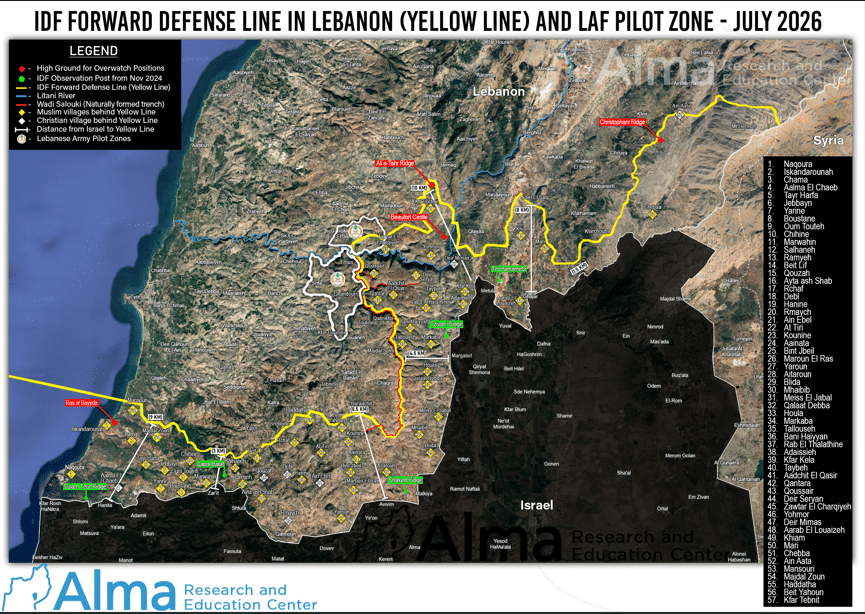
Hezbollah and Iran reacted furiously to this agreement, which they viewed as an attempt to circumvent the Islamabad understandings (the interim agreement with Iran) and to strip away the legitimacy of Hezbollah’s power in Lebanon.
For more on the framework agreement between Israel and Lebanon, see: Analysis of the Israel-Lebanon Framework Agreement: Does It Provide an Answer to the Israeli “Endgame”? As published by the Alma Center on June 29.
The Gulf Arena
In an attempt to project force and disrupt shipping lanes, IRGC forces carried out a naval attack using a drone against the civilian cargo ship M/V Ever Lovely in the Strait of Hormuz. In an response on June 26, US Central Command (CENTCOM) carried out airstrikes against a series of Iranian missile and drone storage facilities and coastal radar stations.
Iranian state media said the IRGC carried out retaliatory attacks against U.S. targets or installations in the region after the CENTCOM strikes. A subsequent report said Bahrain reported being targeted by several Iranian drones, with the U.S. Fifth Fleet base the intended target. In a follow-on exchange the next night, Iran also targeted U.S. facilities in Kuwait.
The Iranian Economy and Internal-State Stability
Iran’s civilian home front and the national economy are in an extremely severe and ongoing crisis. According to International Monetary Fund data, Iran’s GDP is projected to contract by 6.1% this year – the sharpest contraction since the 1980s – alongside runaway inflation approaching 70%. This crisis is also reflected in the plunge of the Iranian rial, which collapsed to a rate of 1.7 million to the US dollar, reflecting a catastrophic devaluation of the currency, and hyperinflation exceeding 100% annually due to the war, which has severely eroded the purchasing power of the Iranian public and destroyed the middle class.
While in previous months damage exceeding 40% of national GDP was caused due to the destruction of infrastructure and war damage, in the past month the price of internal repression measures became clear. In an effort to prevent public organizing against the regime, authorities in Iran imposed an unprecedented nationwide internet shutdown. As reported on May 26, 2026, by NetBlocks and monitoring organizations, Iran was almost completely disconnected from the global internet for 88 consecutive days (a total of 2,093 hours of complete disconnection) – the longest national internet shutdown in modern history.
According to assessments by experts and human rights organizations, this shutdown caused enormous macroeconomic damage estimated at approximately 35 to 80 million dollars per day, due to the paralysis of financial transactions and commerce, the collapse of local businesses (with a decline of approximately 80% in online sales), and mass job losses. Although President Pezeshkian ordered the restoration of connectivity at the end of May 2026, the restoration of service is being carried out partially, slowly, and under very tight control (with social platforms such as WhatsApp and Instagram remaining blocked and requiring VPN workarounds that may be expensive for Iranian residents).
| Economic/Internal Damage Mechanism | Macroeconomic and Operational Consequences |
| Naval Blockade (until the signing of the agreement) | Halt of petrochemical oil exports, a plunge in foreign currency revenues, and difficulty importing goods. |
| Hyperinflation and Currency Collapse | A rial rate of 1.7 million to the dollar, hyperinflation of nearly 70%, erosion of the middle class’s purchasing power, and International Monetary Fund data indicating a GDP contraction of 6.1% and inflation of approximately 70%. |
| Ongoing Internet Shutdown | Daily damage of 35–80 million dollars, paralysis of local business and banking activity. |
The inefficiency of government mechanisms was recently exposed when it emerged that figures within the IRGC (under the oversight of General Mohammad Bagher Zolghadr, secretary of the Expediency Council) responsible for oil smuggling and managing transactions via the shadow fleet, failed to collect payments due to “mismanagement”. This sparked unprecedented anger in the Supreme Leader’s office and an internal rift, following which calls arose to transfer financial oversight authority to President Pezeshkian.
Summary
In summary, an analysis of the Iranian reality in June 2026 reveals a picture of a state in an unprecedented internal low and major erosion of military and proxy capabilities, attempting to take advantage of an American administration that is rushing to try to end the confrontation with it due to domestic political and economic considerations.
The combination of currency collapse, runaway hyperinflation, damage to critical nuclear and missile infrastructure, and deep governmental instability alongside a frustrated public, points to a deep systemic weakness.
In light of this fragility, any sweeping forecast regarding the regime’s future or its stability necessarily becomes nothing more than a gamble.
Sources
1. https://www.theguardian.com/world/2026/jun/17/us-iran-deal-trump
6. https://www.theguardian.com/world/2026/may/26/iran-internet-blackout
7. https://www.washingtoninstitute.org/policy-analysis/irans-next-internet-blackout-inevitable
8. https://understandingwar.org/research/middle-east/iran-update-special-report-april-10-2026/
9. https://understandingwar.org/research/middle-east/iran-update-special-report-april-16-2026/
10. https://www.eurasiareview.com/19012026-us-intervention-could-spark-chaos-in-iran-analysis/
12. https://www.jpost.com/international/article-900621
13. https://efe.com/english/other-news/2026-06-27/israel-lebanon-peace-framework-agreement/
14. https://understandingwar.org/research/middle-east/iran-update-special-report-june-26-2026/
15. https://www.iranintl.com/en/202606196385
16. https://mei.edu/experts-react-the-us-and-iran-reach-an-agreement



One Response
Dear Yaakov,
The cardboard ayatollah/IRGC regime has no credibility, no authority and no legitimacy. They are a cancerous tumor remnant of a destabilizing, antigovernment, parasitic, terroristic evil. They carry the stench of death, and should be buried as soon as possible to prevent further spread of disease. The MOU is a simple management tool without any substance. They are pathological liars, so agreements mean nothing to them. Their cries of death to Israel and death to America will be executed against themselves instead. Their oppression, tyrrany, piracy, genocide and terror must now be ended permanently.